
Home / Antique Paintings
Antique Oil Paintings
Modernist landscapes, School of Paris paintings and naïve folk pieces. Our selection of antique oil paintings brings together French and Continental paintings from the late 19th to the mid 20th century, selected for their expressive brushwork, colour and atmosphere.
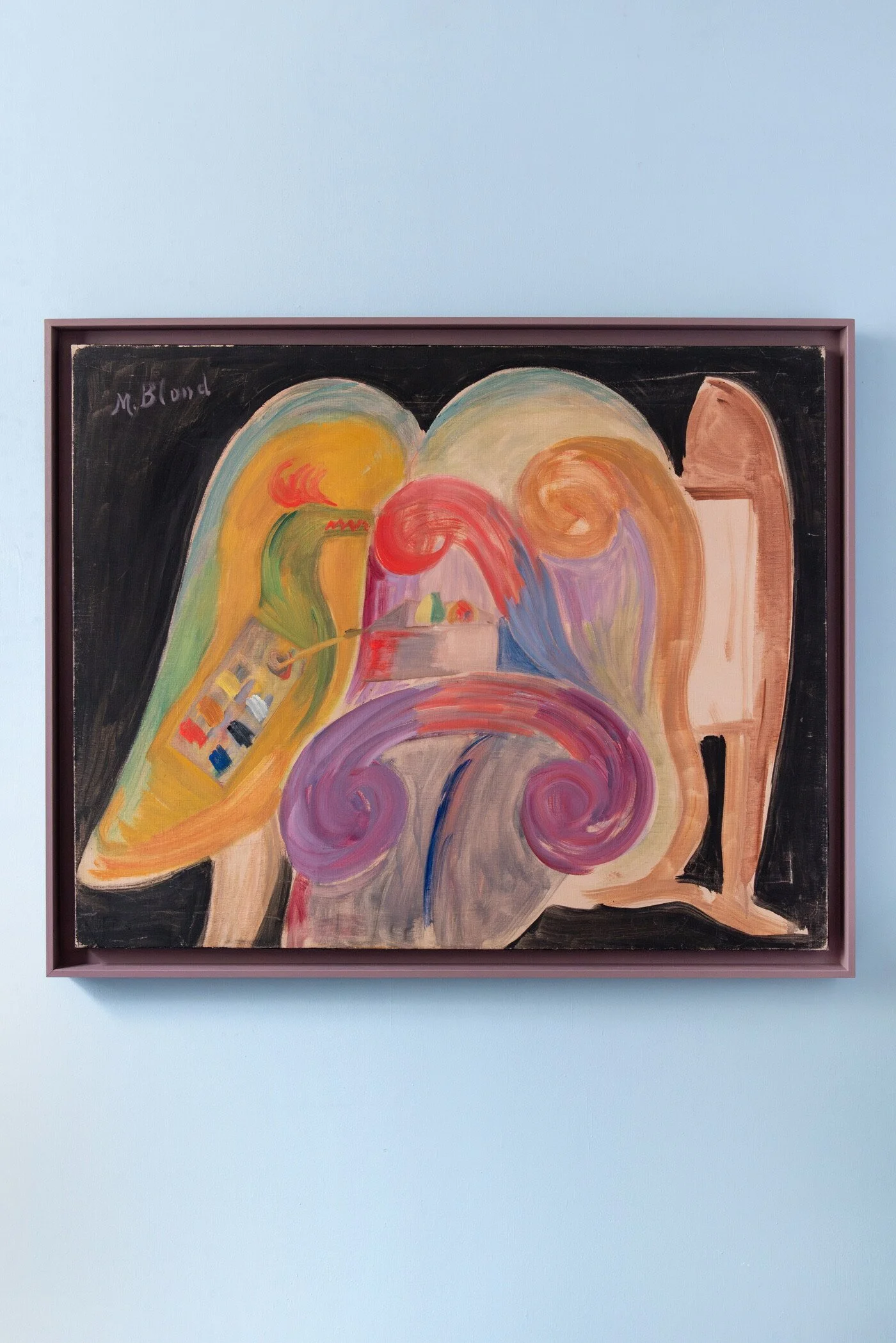
A late work by French-Polish artist Maurice Blond (Lodz, 1899 – Clamart, 1974), executed in 1974. The painting presents a dreamlike vision of the artist's studio, depicting a fantastical creature wielding brush and palette before a still life of fruits upon a table. The enigmatic subject is enveloped by sweeping abstract waves and scrolls set against a black ground, creating a composition that bridges figuration and abstraction.
The work employs a distinctive palette of dusty purple and light brown, punctuated by richer accents of red, yellow and green. Blond's expressive brushwork animates the flowing scrolls and background, while finer strokes articulate the palette and the creature's teeth, adding figurative detail to the broader gestural forms. The composition is further animated by pattern—from the undulating scrolls to the zigzag of teeth and the geometric divisions of the palette.
While Blond’s early works encompassed streetscapes, still lifes and portraits, his later output increasingly focused on the quiet elements of studio life: fruits on tables, chairs, and the painter's palette itself. This rare and compelling work synthesises these familiar motifs whilst introducing a fantastical element—a creature both playful and enigmatic—revealing everyday artistic practice as both mysterious and imaginative.
Signed upper left and dated on a stretcher bar on the reverse. Newly fitted in a painted tray frame, in the manner of those used by the artist for his later works.
Born in Lodz, Poland, in 1899, Maurice Blond’s early engagement with art drew notice when in 1911 when one of his watercolours was exhibited at the Kiev museum. Studying natural sciences first, he took classes at the Warsaw School of Fine Arts and left for Berlin in 1923 where he met Isaac Mintchine and Kostia Terechkovitch. He arrived in Paris in 1924, settling at the artist’s colony La Cité Falguiere near Montparnasse and becoming friends with Russian artists such as Pinchus Krémegne and Natalia Goncharova. After WWII, he settled in Grenoble and dedicated his time exclusively to painting. Blond exhibited at the Salon des Independents (1926) and Salon des Tuileries (1930), followed by numerous gallery exhibitions in Paris, most notably at Weil (1960), Durand-Ruel (1961) and Kriegel (1971).
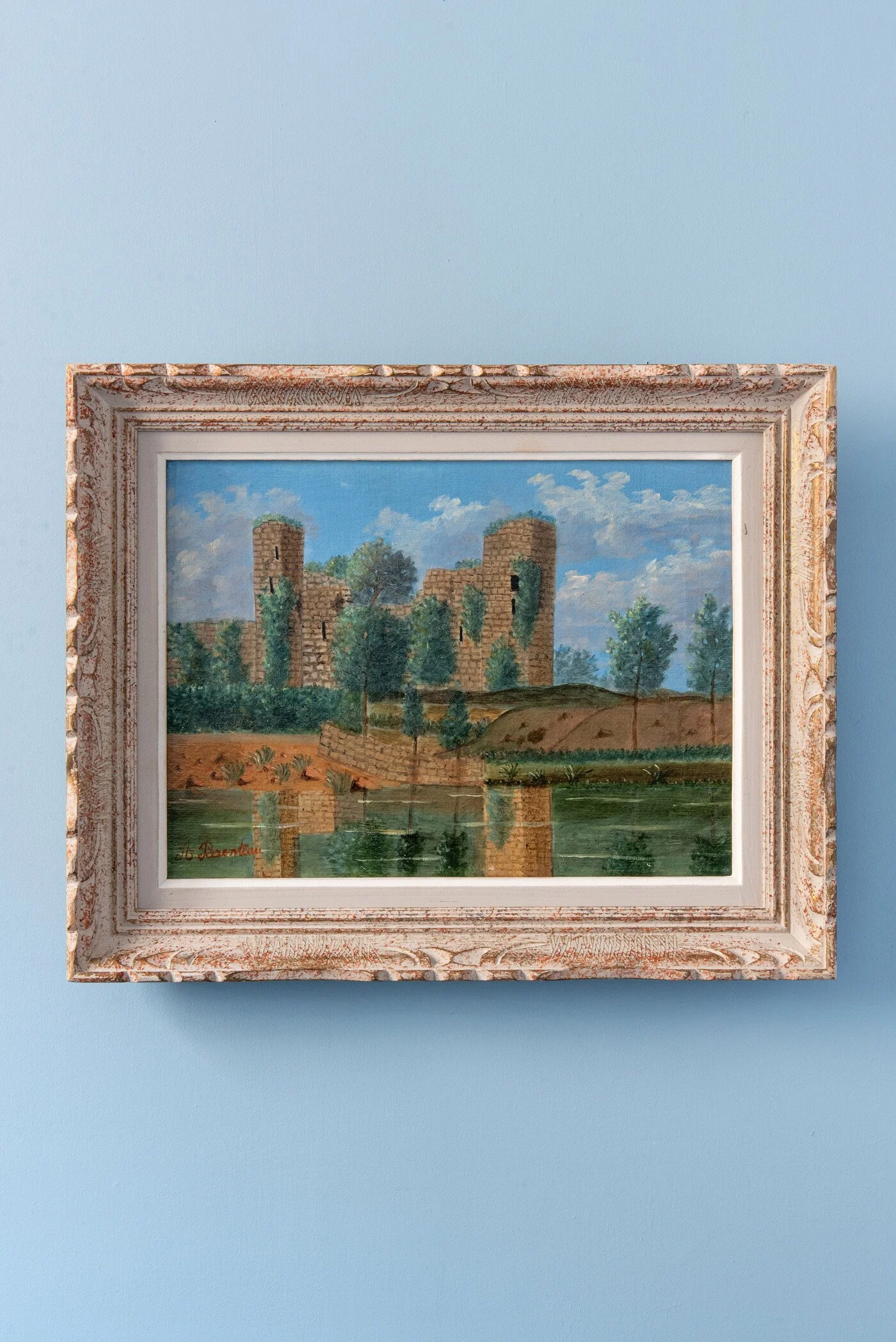
A late 19th-century oil painting on canvas by the French artist Amélie Parenteau (1835-1923). The composition depicts a ruined medieval castle flanked by towers and ramparts, set among trees and dense foliage along the bank of a river, with the architecture reflected in the water below.
The palette is vibrant and earthy, combining warm yellows and browns with greens, blues, and touches of white. Short, lively brushstrokes articulate the stonework of the castle, the movement of clouds and the texture of leaves through an emphasis on pattern, giving this calm rural scene a gently naive and evocative quality.
Signed ‘A. Parenteau’ in red in the lower left corner and presented in an antique Montparnasse frame. The location is inscribed on the reverse as La Salbart, Deux-Sèvres, most likely referring to the 13th-century fortress of Château de Coudray-Salbart in Poitou.
Amélie Parenteau worked from the late 19th to the early 20th century in a naturalistic landscape tradition, depicting rural paths, village views and rivers with a quiet, observational approach. Her work recalls the realism of the Barbizon school, tempered by looser, impressionist brushwork and vivid colours, viewed from a distinctly local perspective.
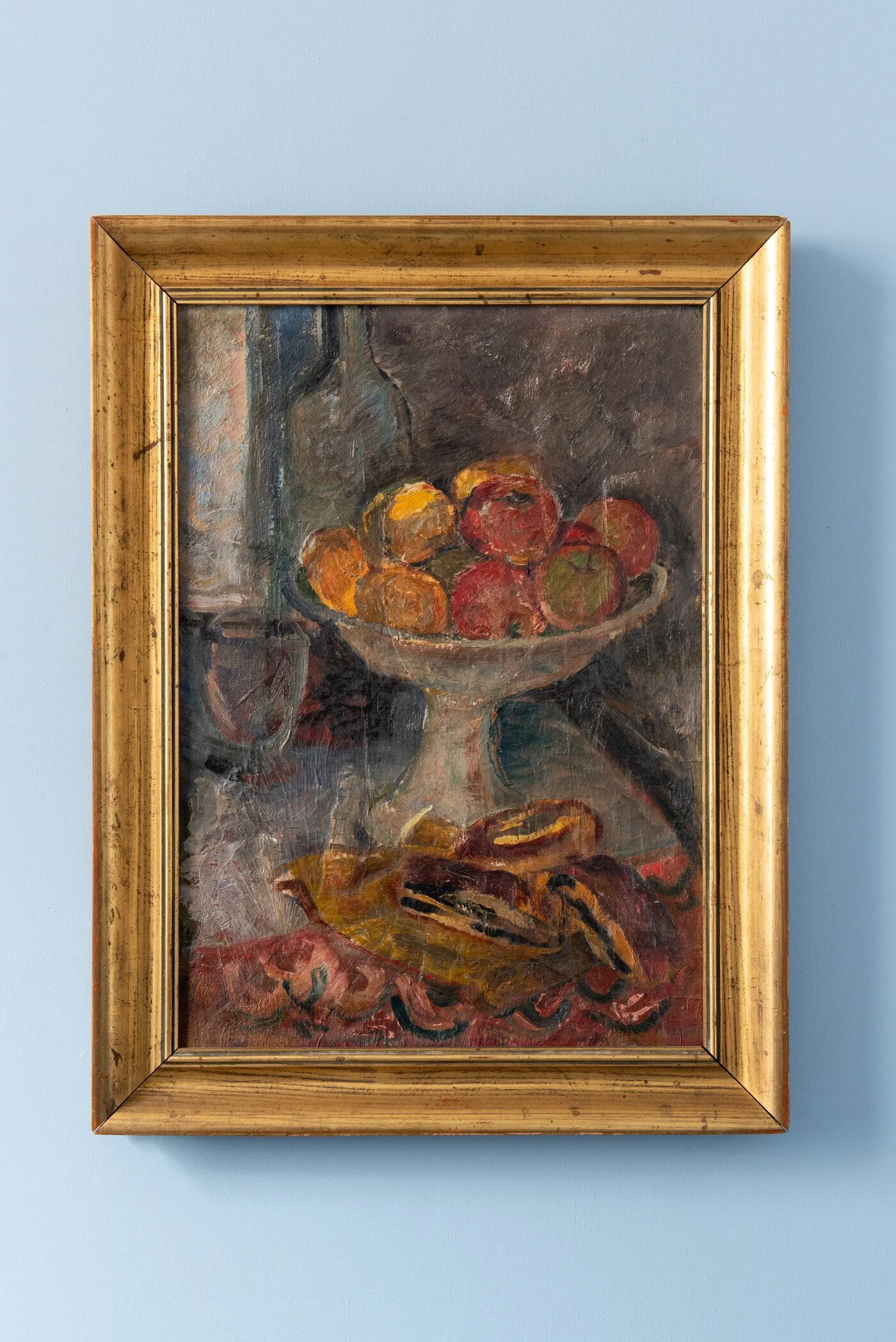
An early 20th-century French oil painting on canvas, depicting a still life of fruits in a compotier, with a wine glass and bottle beyond and game on a cloth in the foreground. The composition is set in a warm palette of red, orange and brown against a cool grey background. Dynamic, considered brushwork animates the scene, amplifying the materiality of the fruits and lending texture to their surroundings. The pattern of the draped cloths introduces a fluid movement, while the bottle and glass anchor the composition vertically. With its elegant wide bowl and stemmed base, the compotier is a recurring motif in modern still life, its refined shape set in charming contrast with the everyday character of the bread, fruit and glassware.
Presented in a period giltwood frame, a characterful modern still life with considered colour.
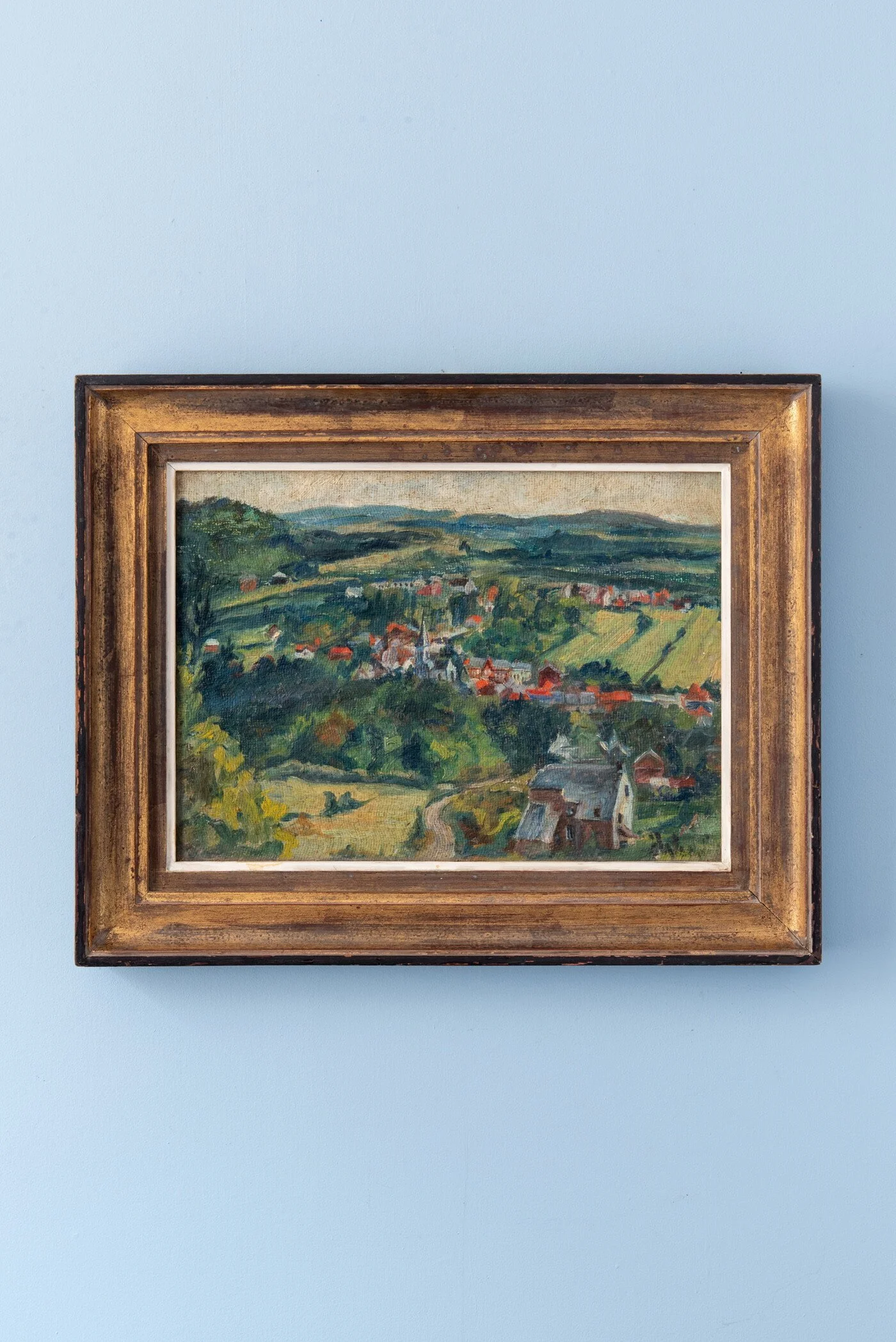
A 1949 Belgian oil painting on board, depicting the village of Barvaux-sur-Ourthe in the Ardennes from a high vantage point. The composition is centred on the village church and its surrounding streets, nestled among rolling hills, trees and fields, with a path and farm building in the foreground. Characterful details lend life to the landscape, from the architecture of the church spire to the functional forms of the farm buildings in the foreground.
A fresh palette of green, grey and orange combines the lush nature of the region with the characteristic architecture of brick, tile and slate roofs, rendered in broad brushwork that echoes the softness of the landscape.
Signed lower right, retaining its original giltwood frame, dated 1949 and located on the reverse. An evocative mid-century country landscape.
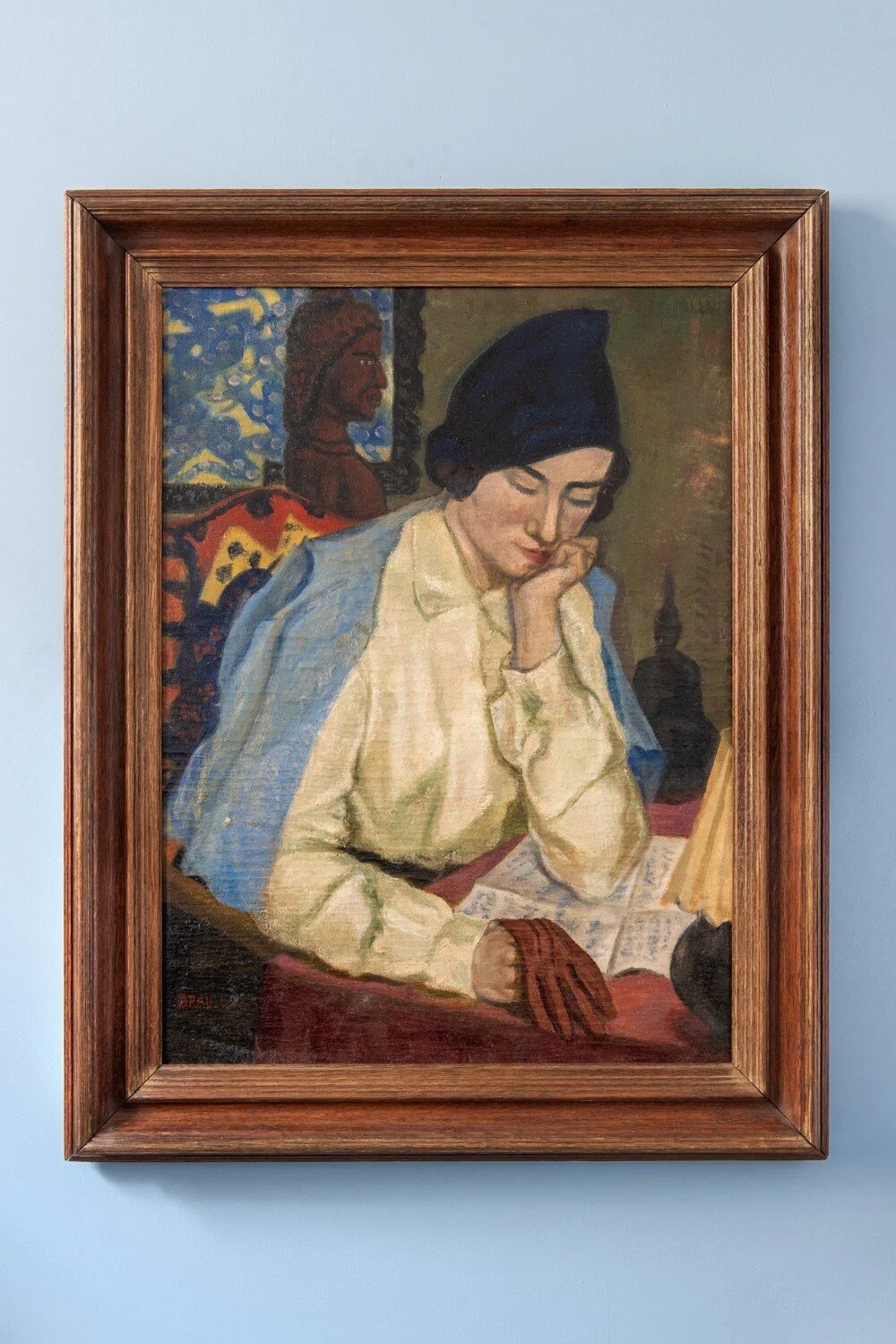
An early 20th-century oil painting on canvas depicting a woman seated at a table, reading a letter with a glove in hand. The sitter’s thoughtful pose creates an intimate, contemplative mood within a quiet interior, layered with bold patterned textiles, vibrant artwork, and an African sculpture in the background. Decorative rhythm guides the eye across the composition, from the folds of the shirt to the sculptural forms of the hat, sculpture, and objects on the table. A restrained palette is heightened by accents of blue and red, and the luminous white of the shirt. The African sculpture and abstract artwork suggest an early modern sensibility, offering insight into the artistic world of the sitter.
Presented in a 19th-century oak frame, signed lower left, and of impressive scale, this rare and distinctive work combines a captivating portrait with a refined early modernist interior, offering strong decorative appeal and a glimpse into an introspective, cultured world.
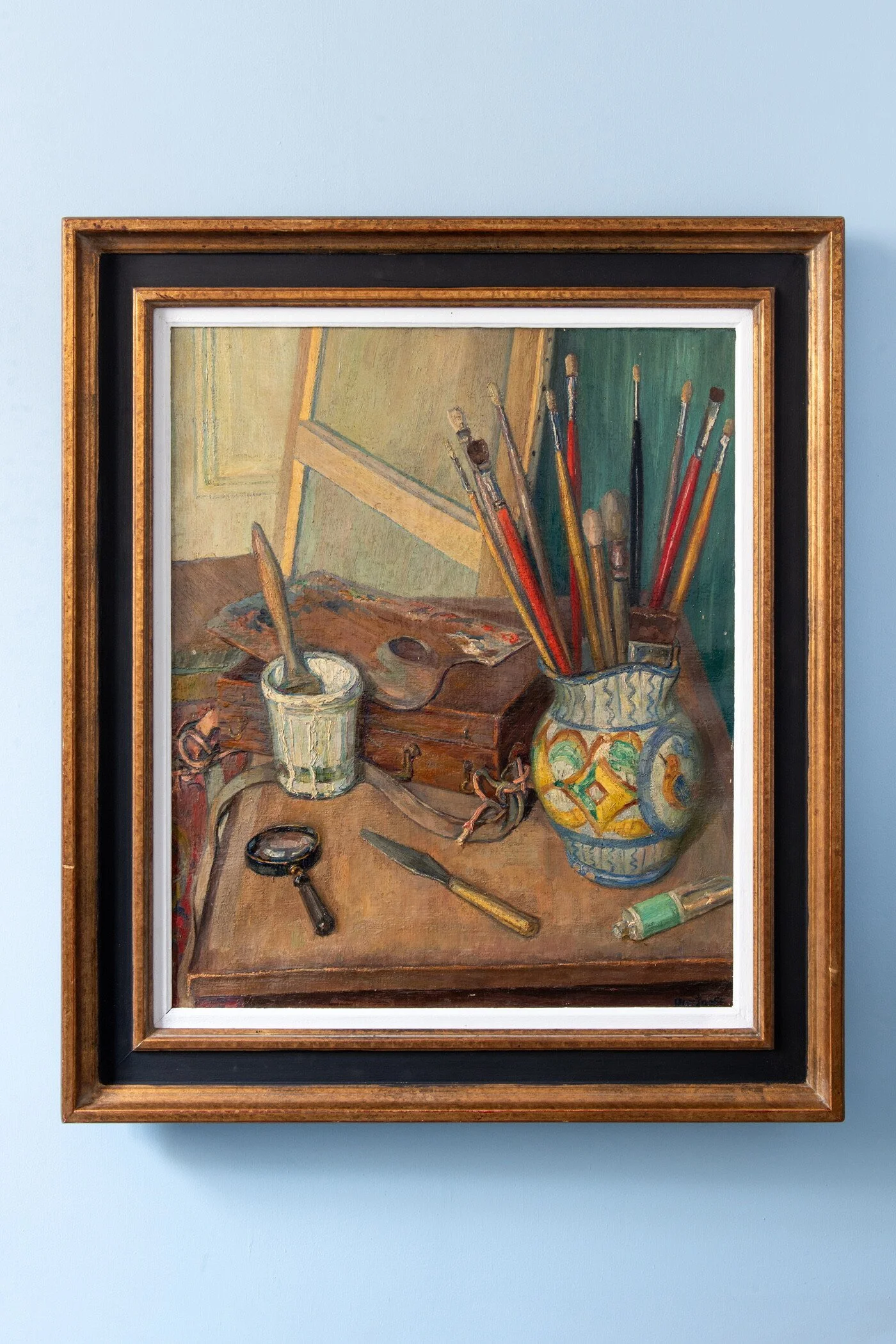
An oil painting on canvas by French-Ukrainian artist Michel Portnoff (1885-1978), c. 1950-60, depicting a still life with artist's brushes contained in a jug, along with a palette knife, magnifier, a brush in pot, a painter's palette and a wooden studio case, all laid on a rustic table. The scene is set in an interior with an antique carpet to the left, stretchers and a door in the background.
Earthy tones dominate the composition, making the colours of the brushes, the white of the pot, and the blue and yellow of the jug stand out. Strong architectural lines give rhythm to the work, from the vertical of the brushes to the horizontal of the table, set against the oblique of the stretchers and case.
The handpainted faience jug, with its bird, geometric motifs and wavy lines, adds character and a sense of place through its folk decoration. Impasto brushwork renders the varied materials with tactile realism, from the reflection of light on the magnifier to the wood of the table and case, and the oil paint itself.
Signed lower right and presented in a period black and gilded frame. An impressive work with substantial presence, offering a refined study of the painter’s environment and introspective glimpse into his creative space.
Born in 1885 in Elizavetgrad (then Russian Empire, now Kropyvnytskyi, Ukraine), Portnoff studied at the Odessa School of Art and lived in Florence for approximately twenty years before settling in Paris in 1929. He regularly exhibited at the Salon d'Automne and the Salon des Indépendants, with a solo exhibition at the Simonson gallery in 1935. Commemorative exhibitions were held in Paris in 1979 and 1984.
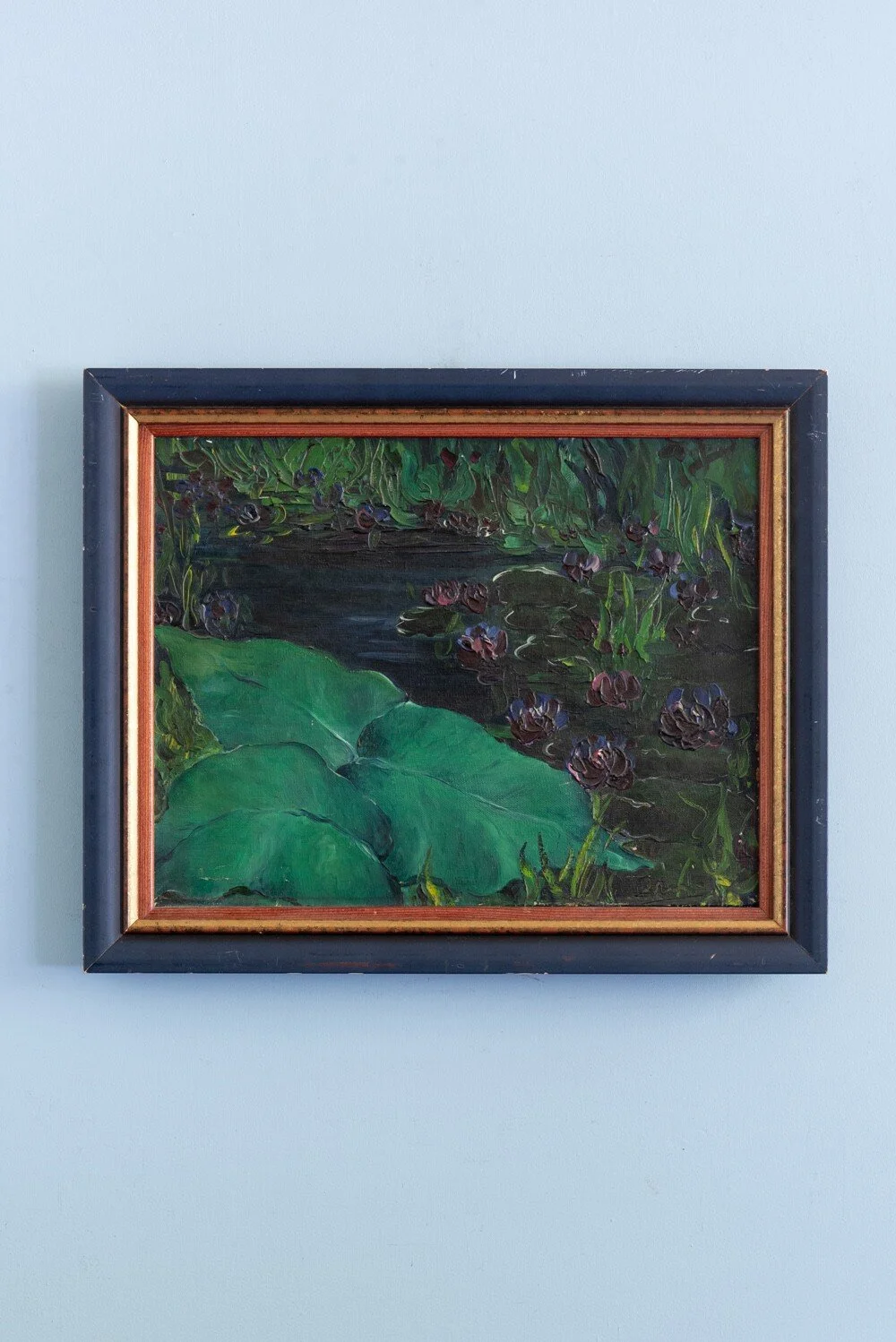
An early 20th-century oil on canvas by French artist Marcel Pottier (1908-1949), offering a striking close-up view of a pond. Broad waterlily leaves dominate the foreground, with delicate blooms floating across the surface and aquatic plants rising softly in the background. The scene is rendered in a rich, atmospheric palette of deep blues, verdant greens and contrasting violet tones, capturing the quiet depth of water and light. Signed and presented in a painted wooden frame of soft blue and gold. A captivating and immersive composition.
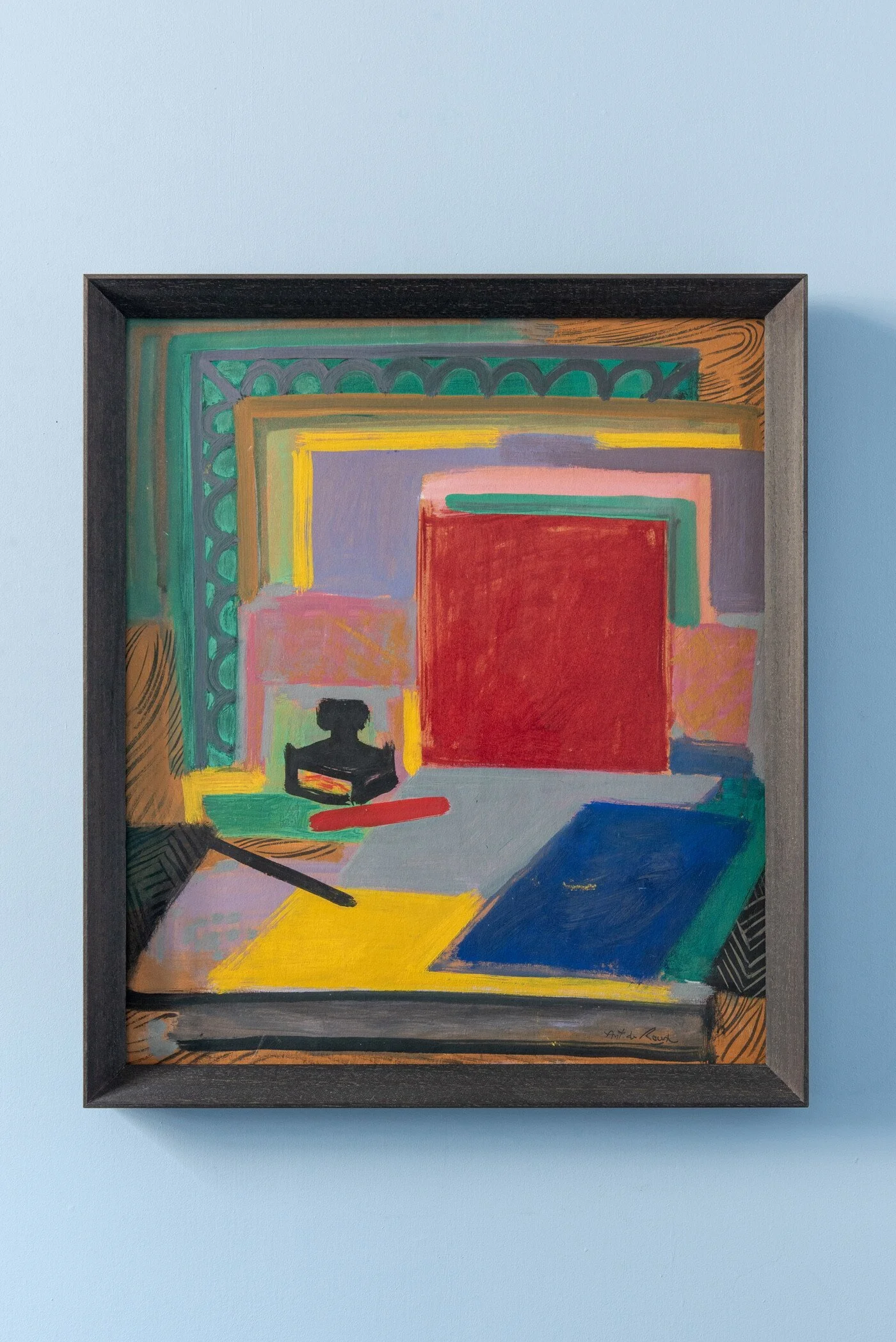
A mid-century gouache on board, c. 1950–1960, by French painter Antoine de Roux (1901-1986), depicting an interior still life centred on an inkwell and pencils, arranged alongside paper cards on a tabletop. The background is animated by an abstract composition of rectangular forms, bordered by a frieze of scalloped motifs, while the overall scene is framed by wood-grain patterns.
A bright and assured palette of red, blue, yellow and green, structured by black accents, gives the composition rhythm through geometric planes of colour and decorative pattern, balancing a sense of perspective with abstraction and colour experimentation.
Signed lower right and presented glazed under museum glass in a dark brown modernist frame. Antoine de Roux worked from the 1930s to the 1960s, focusing primarily on interior scenes and still lifes. While his earlier works retain a naturalistic, almost naïve approach to objects, his later works, such as this one, favour abstraction, while maintaining a consistent interest in interior space, colour structure and decorative presence.
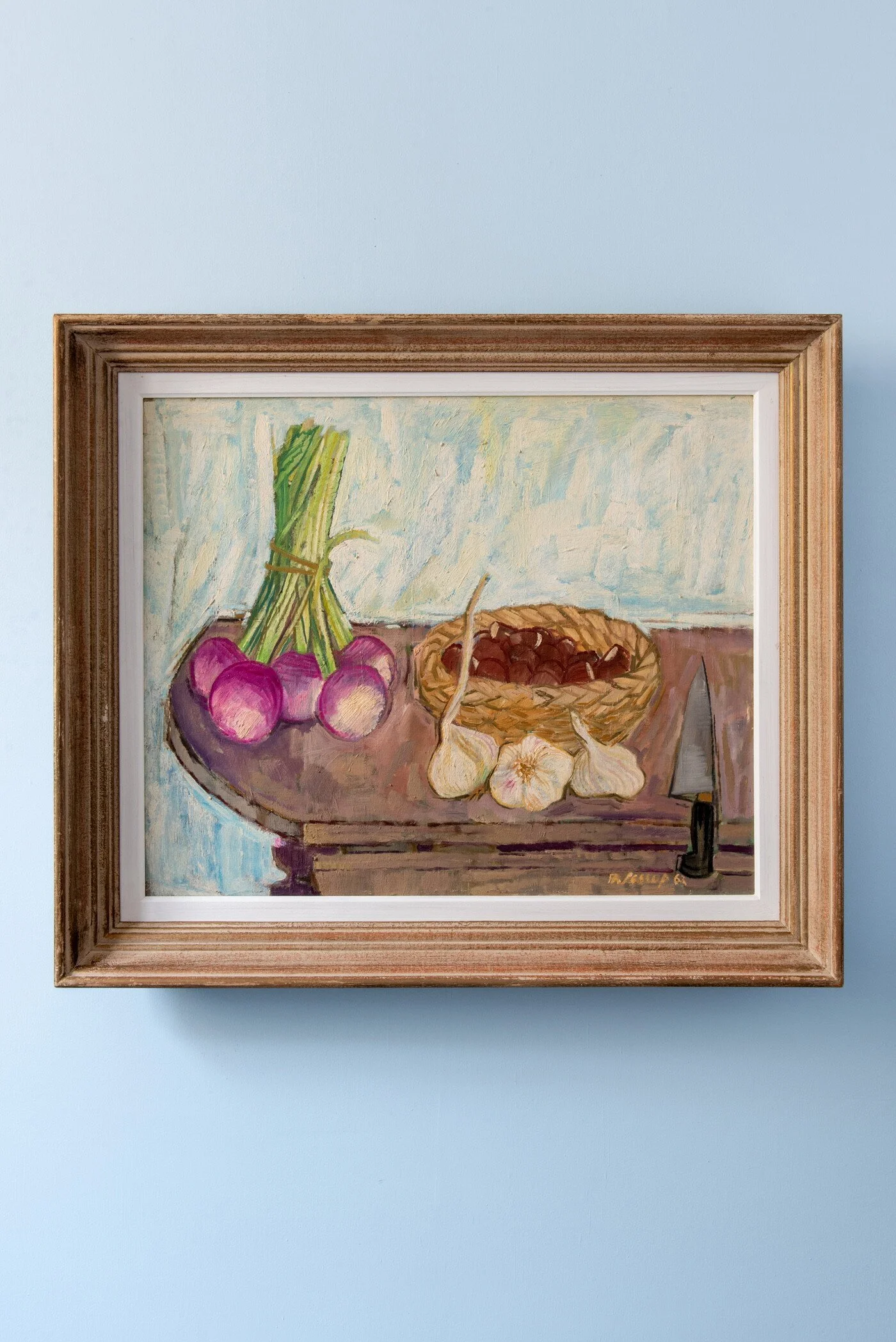
A 1963 oil painting on canvas by Australian painter Frederick Arthur Jessup (1920-2007), depicting a still life with chestnuts in a woven basket, alongside a bunch of red onions, garlic heads and a sharp knife on a wooden table.
The composition features accented geometry, with the round shapes of the onions, woven pattern of the basket, and dynamic vertical lines of the knife and sprouts contrasting with the horizontal of the table. A natural palette of purple, green, white and brown contrasts with a striking abstract backdrop of blue and white strokes, while the wooden table is rendered with lively brushwork.
Signed and dated lower left, and presented in a period Montparnasse frame. A captivating kitchen still life with strong colours and composition.
Jessup studied at the East Sydney Technical College and received the NSW Travelling Scholarship in 1945. He settled in France in 1948, where he remained for the rest of his life while continuing to exhibit in Australia and holding solo exhibitions in France and the USA.
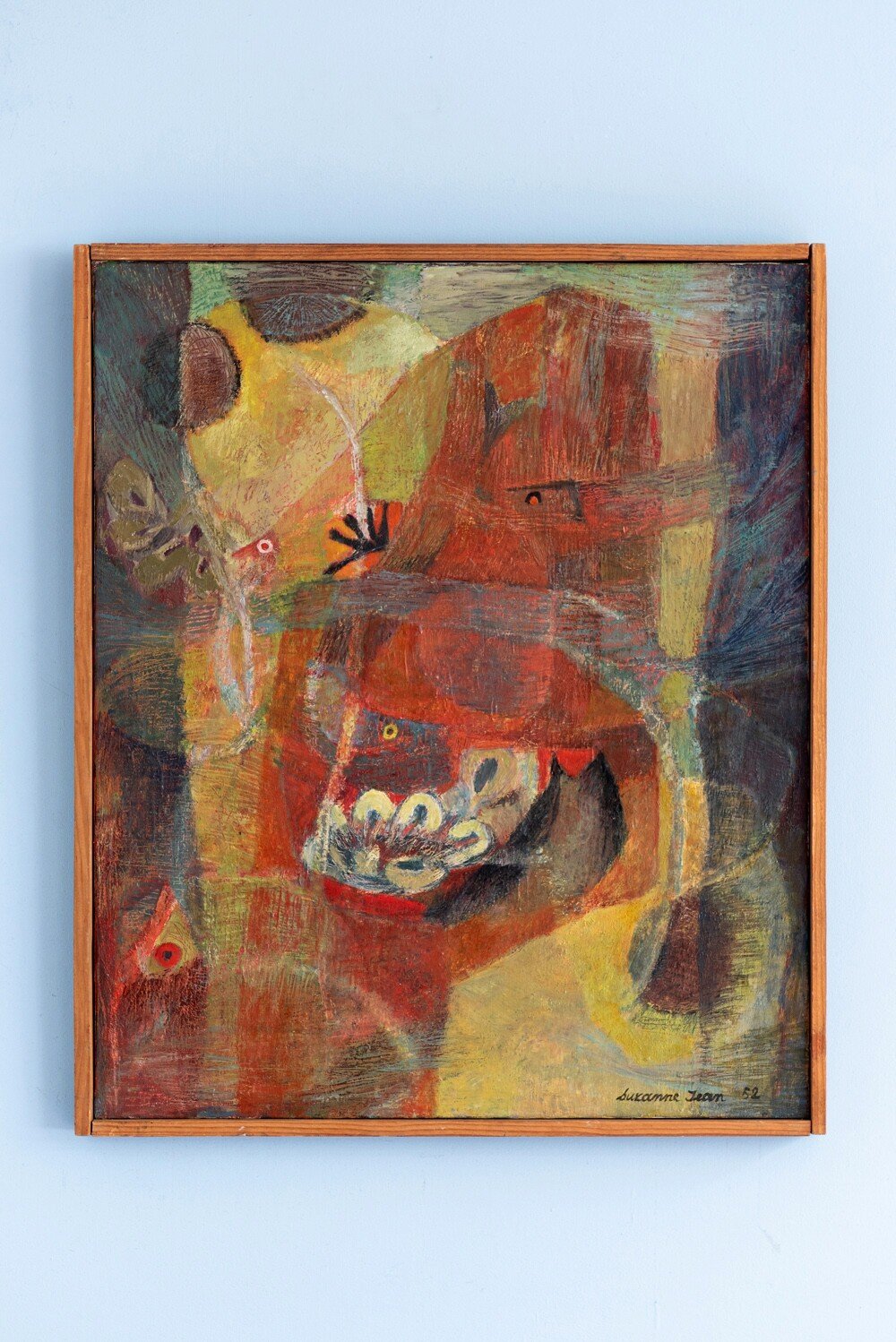
This oil painting on canvas by French artist Suzanne Jean, titled Fonds Marins (Underwater) and dated 1952, presents a dynamic abstract composition of curves and circles layered over vertical stripes, anchored by a red form reminiscent of a face. A rich palette of reds, oranges and yellows contrasts with cooler purples and blues, creating an immersive surface suggestive of the movement of ocean waves.
Hints of maritime imagery appear throughout the composition, with small rounded forms recalling fish eyes and seashells gathered at the centre, lending the painting a subtle surreal quality. Jean builds the surface through textured brushwork and overlapping patches of colour to evoke a rich and expressive landscape.
Although little is documented about Suzanne Jean’s artistic career, this work engages with the spirit of post-war French abstraction, combining geometric structure with imaginative, dreamlike references. The maritime undertones draw parallels with the poetic visual language found in the work of Leonora Carrington or Leonor Fini.
The painting is signed and dated on the front, with the artist’s signature and title on the reverse, and is presented in its original artist’s frame.
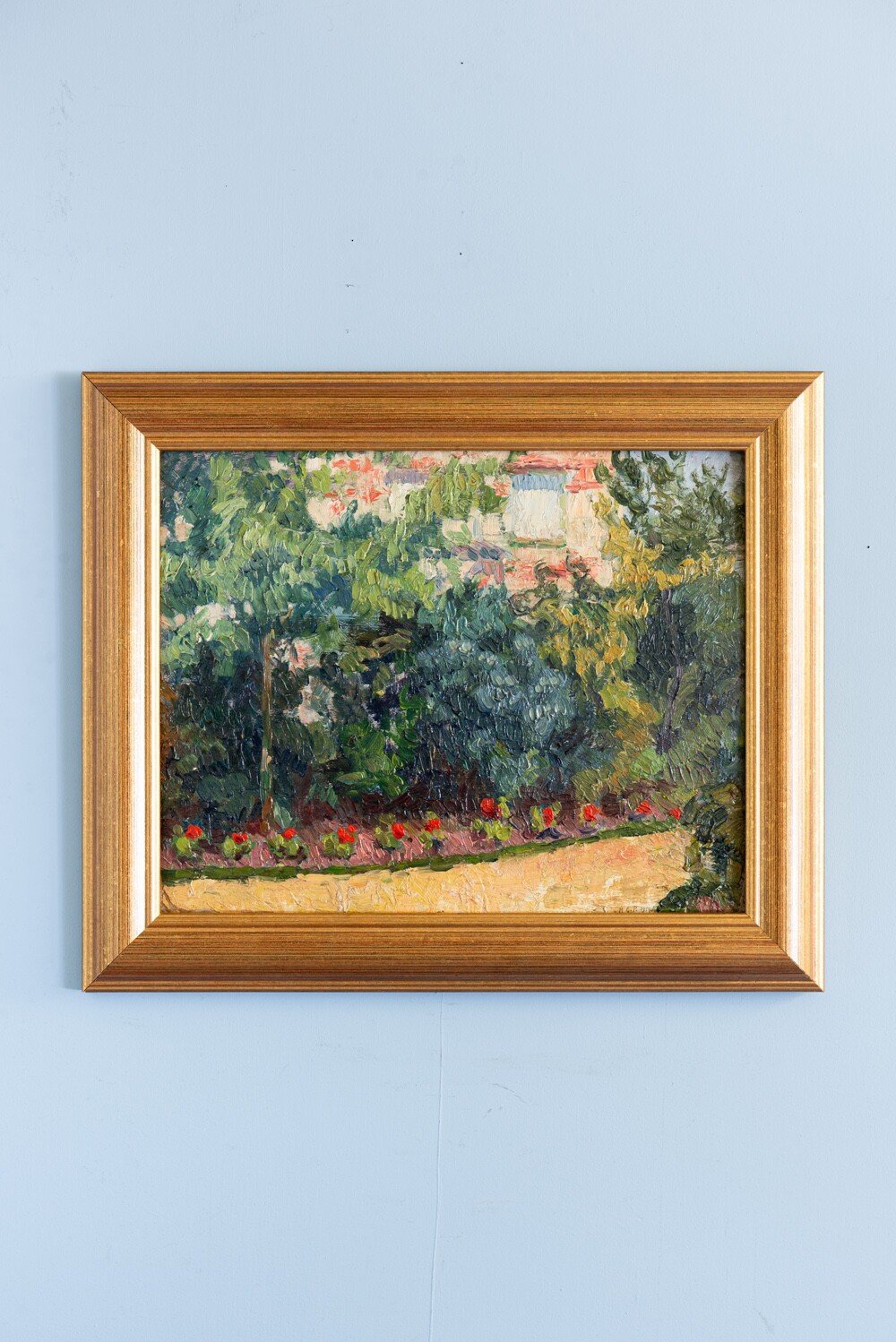
This early 20th-century oil painting on board by French artist Maurice-Georges Poncelet (1897-1978) depicts the patio in the artist’s garden located in the Parisian suburb of Chelles. A charming path, bordered by small red flowers, leads the viewer through abundant trees and lush bushes rendered in a harmonious camaïeu of greens. The architecture of a house, featuring typical French decorative brickwork in soft pink, is visible in the background, adding depth to the composition. Dynamic brushstrokes blend nature and architecture, adding movement to this serene scene. This vibrant artwork is signed and dated 1914 at the front, while the location noted at the back.

This midcentury oil painting on canvas by French painter Marcel Saint-Jean (1914-1994) portrays a still life in an interior. A coffee pot filled with fresh flowers is placed on a table while dried flowers are hung in the background. An evocative palette and textured brushwork vividly render the different materials of the scene, setting the colourful fresh flowers against the cool white of the ceramic pot and the earthy brown of the table. The bold perspective of the table and window is softened beautifully by the organic lines of the flowers.
The painting evokes the beauty of a country kitchen and showcases authentic details, such as the shape of the coffee pot and the dried flowers hung on a rope. This large work is mounted in a black and gilt frame and signed by the artist.
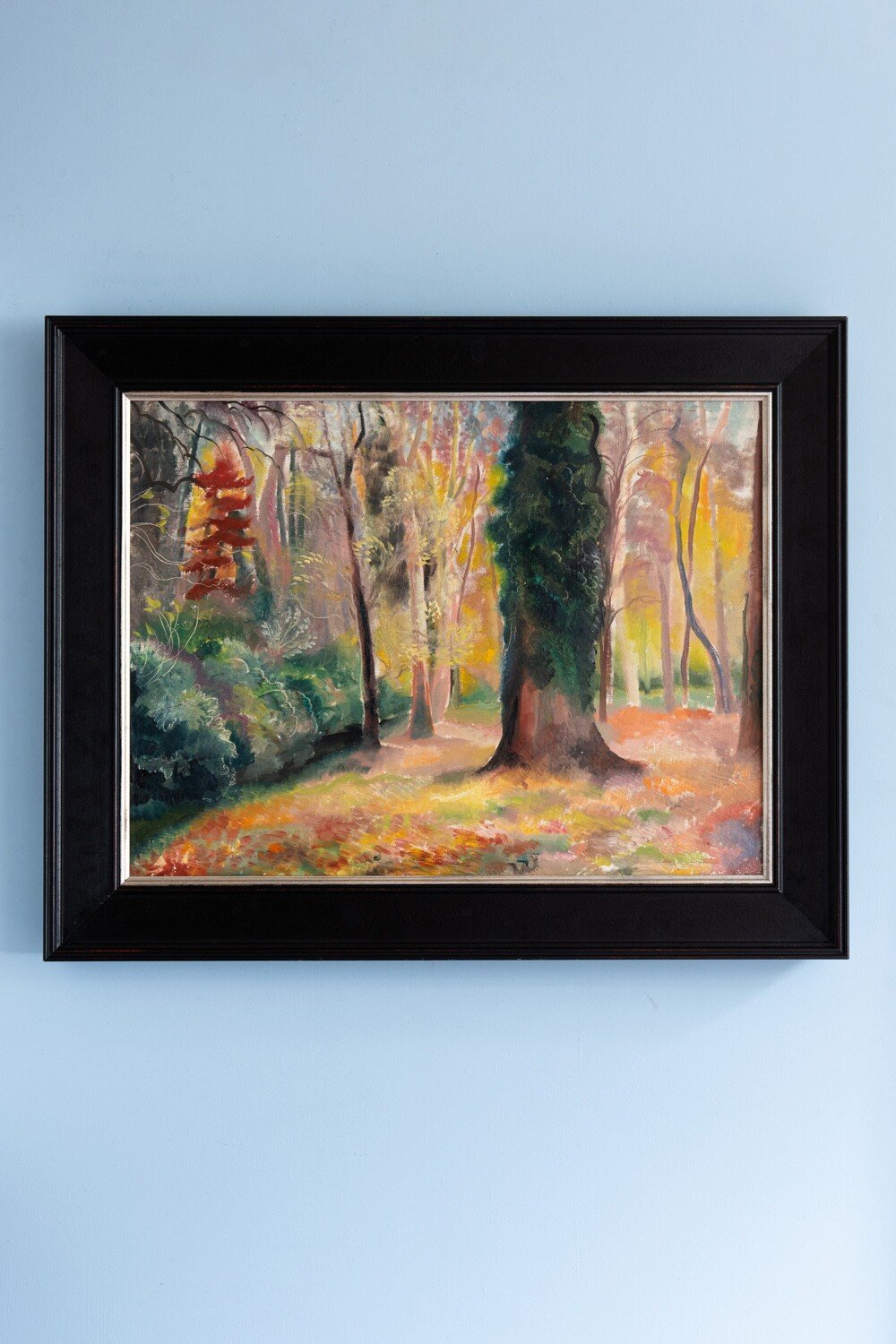
This 1930s oil painting on canvas by French artist and decorator Camille Roche (1894-1948) depicts a forest undergrowth, featuring a large tree covered in foliage, surrounded by slender trees and dense bushes. Its sumptuous palette of deep greens and reds contrasts with the softer yellows and pinks, capturing the rich variations of autumn colours. Painterly brushwork adds texture to the grass, foliage, and bushes, while the elongated shapes of the trees bring movement to the scene. Delicate lines are incised into the surface of the painting, introducing an additional layer of structure over hazy patches of colour. Roche employs a striking array of techniques to convey depth and texture, creating a poetic and immersive depiction of nature. Coming from the artist’s studio, this rare work is presented in a black and gold frame.
Camille Roche (1894-1948) was a French Art Deco artist and decorator renowned for his keen observations of nature and animals. A regular exhibitor at the Salon d’Automne, he created striking frescoes and painted decors for notable figures such as the writer Colette and Coco Chanel. In the 1930s, Roche frequently collaborated with his brother, renowned designer Serge Roche, contributing frescoes to various projects. His artistic range encompassed oil paintings, frescoes, screens, and glasswork, demonstrating his remarkable adaptability across different mediums

This early 20th-century French oil painting on canvas portrays an abundant still life of a large melon open with slices displayed on foliage and surrounded by grapes and peaches. The gorgeous textures of the skin and flesh of the fruits are rendered in soft brushstrokes, creating a striking yet delicate sense of realism. With a beautiful light and a dark background, its warm palette of colour emphasises the bountiful feeling of this still life. This distinctive work is a sumptuous statement piece that would take a place of pride in a kitchen or in any other room.
-
Our collection of antique paintings includes exquisite French impressionist paintings. Originating in the late 19th century, French impressionist paintings combine a commitment to figuration with the introduction of plein-air painting. Dynamic brushstrokes render the movement of nature and are combined with fresh colours to capture the variation of light in evocative impressionist landscapes. Interiors are portrayed in vibrant hues, focusing on the textures and tactile details of the furnishings. In impressionist portraits, the subtle brushstrokes of these antique oil paintings focus on the seater’s inner thoughts. These paintings of France render country landscapes particularly well and give a delightful impression of the past.
Regardless of the period, we source French paintings that are inspired by the impressionist tradition. We gather both rare works by recognised artists, such as Charles Picart Le Doux, Anne de Saeger, or Lilian E. Whitteker, as well as exquisite antique oil paintings by lesser-known French painters. With soft hues, these evocative impressionist artworks are particularly suited for country interiors while adding contrast and lightness to modern homes.
-
We source vintage wall art and midcentury paintings that focus on subjective depictions of everyday life, close to nature. Influenced by abstraction, large brushstrokes add flatness to render objects and interiors with delightful impasto work in vintage oil paintings. Vivid planes of colours create geometry and playfulness in evocative landscapes, giving a personal vision of country and urban environments in midcentury modern wall art.
Our collection of vintage and modern oil paintings gathers rare French paintings by renowned artists such as Gilbert Pastor, Joseph Terdjan, or Nicole Marette, as well as exquisite midcentury paintings by lesser-known artists. Their vibrant colours and geometry are particularly suited to modern interiors and they also add playfulness and flair to historic homes.
-
Our collection of antique paintings for sale includes peaceful landscapes in serene palettes. Classic oil paintings from the 18th and 19th-century alternate between the idealised landscapes of the picturesque and the soft elements of realism of the pastoral tradition. Oil paintings on canvas from the early 20th century share the same focus on landscapes, where subjective brushstrokes render a more personal vision. Our collection of framed oil paintings is carefully selected for their authentic quality. We endeavour to keep or restore the original frames, with exquisite examples of Montparnasse or giltwood frames, or to choose modern frames that add character to antique artworks
Choose a large oil painting to make a statement in living rooms or halls. Our collection of antique pictures also includes small oil paintings that are ideal for intimate spaces such as bedrooms, but can also add interest to a corridor.


An early 20th-century oil painting on canvas by French artist Fernand Combes (1856–1943), depicting a mill with a large wooden wheel, surrounded by trees and buildings, the scene viewed from below with a slope of grass and rocks in the foreground. A warm palette of ochres, browns and green contrasts with the blue of the sky, the striking perspective highlighting the hilly position of the cluster of buildings, with a stream running through the wheel towards the back of the slope. The warm palette, together with the repetitive brushwork of the rocks and stone wall, evokes the regional character of the architecture from the South of France, its dark tones lending the scene an evocative atmosphere. Signed to the lower part of the artwork.
The painting is mounted in a striking, impressively scaled Montparnasse frame of cassetta form, with egg-and-dart and rope patterns highlighted in red and gold. Signed to the lower part of the artwork.
An evocative country scene, paired with a striking sculptural frame.