
Home / Antique Paintings
Drawings & Prints
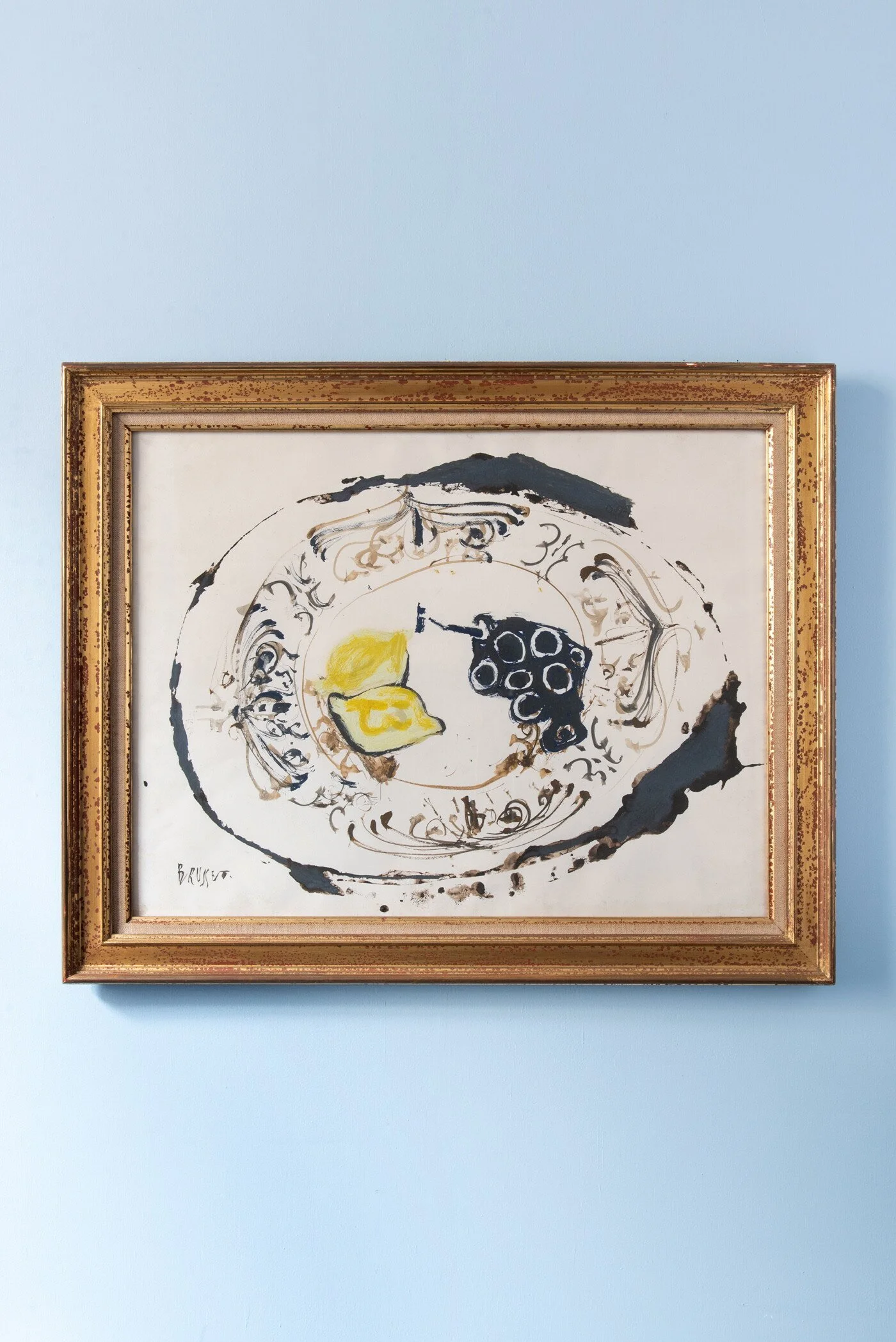
A French midcentury gouache and ink on paper, depicting a still life of two lemons and a bunch of grapes on an ornate dish. Lively brushmarks highlight the elegant scrollwork on the lip of the plate, contrasting with the organic shapes of the lemons and grapes, while a bold painterly line surrounds the plate, adding depth. The deep black of the ink is set against the colourful yellow of the lemons and the white of the paper, lending a dynamic, graphic quality to the artwork. Signed lower left, glazed in a giltwood frame with a fabric slip.
A dynamic still life with captivating movement.
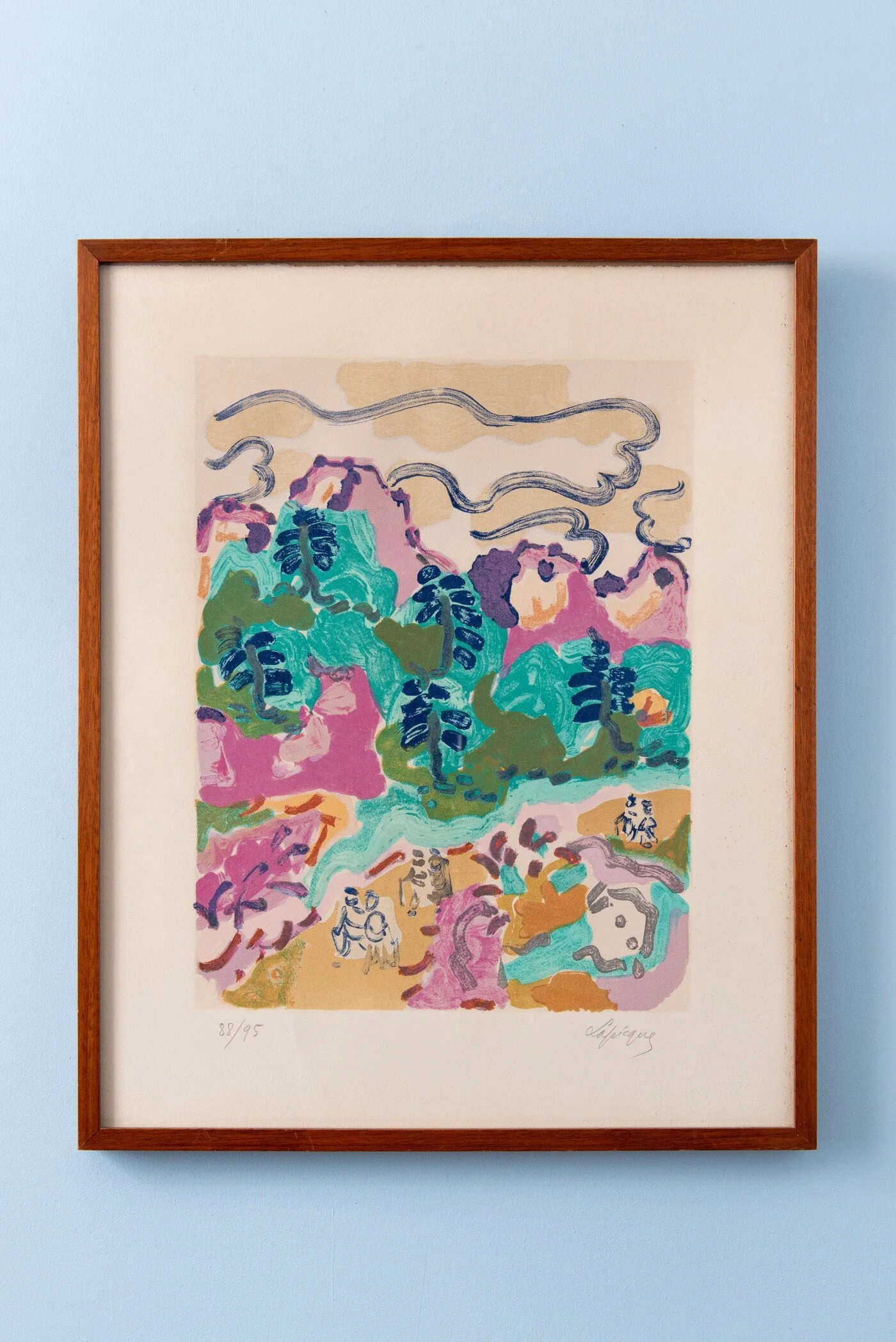
A midcentury lithograph on paper by French painter and printmaker Charles Lapicque (1898-1988), depicting figures walking down a path through a lush forest beneath a cloudy sky. A contrasting palette of pink, blue, green and sand creates a bright atmosphere, patches of colour alternating with expressive brushwork to a joyous, pattern-like effect that lends the scene a sense of abstraction. Characterful details add lightness throughout, from the figures walking in pairs to the lush rendering of the forest and the squiggly shape of the clouds. Numbered 88/95 lower left and signed 'Lapicque' lower right. Glazed in a stained wood frame.
A characterful lithograph with bright colour and painterly shapes.
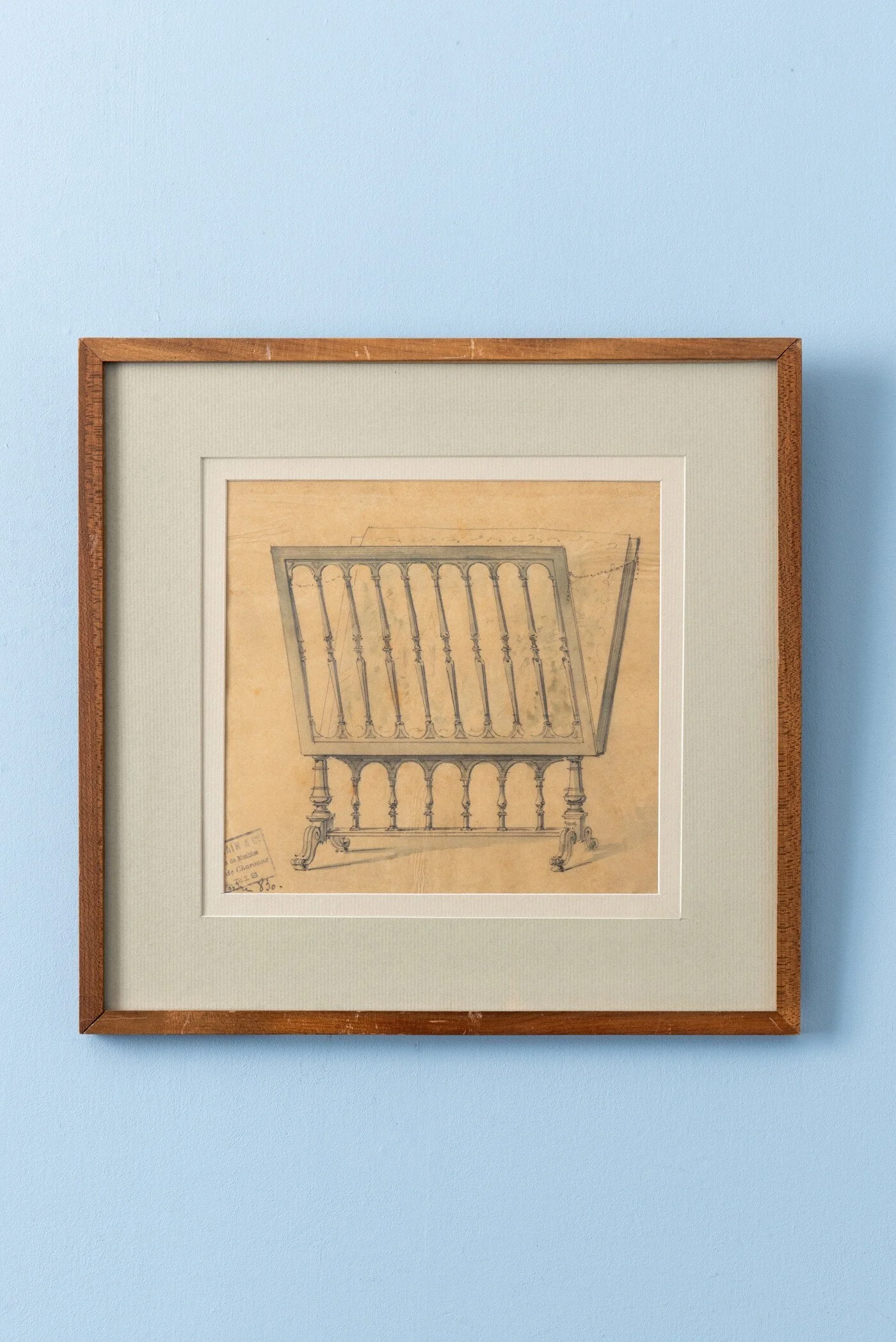
A 19th-century French watercolour and graphite drawing on yellow tracing paper, depicting a print rack containing several paper sheets, standing on a four-footed base, its two panels linked by a small chain. It is adorned with finely turned wood balusters, architectural arcading to the base and scrolling feet, the precision of the graphite line highlighting the intricate decoration of the rack, while watercolour lends a painterly wood texture and subtle shadow. A stamp to the lower left corner bears part of a firm name, the word "furniture" and an address on rue de Charonne in Paris, a neighbourhood famous for its furniture workshops, suggesting the drawing was an artistic impression for clients. Glazed in a stained wood frame under a double ivory mount.
Likely coming from a Parisian furniture workshop, a finely rendered drawing of an ornate print rack.

This late 19th-century albumen print is attributed to Greek photographer Konstantinos Athanasiou and portrays a block of the north frieze of the Parthenon amongst ruins. The frieze represents the procession of the people of Athens during the Panathenaic festival. In this particular block, three men wearing a himation carry ovoid vessels, while a fourth one on the right side rests on the ground, behind a musician playing the flute. Its close-up composition highlights the elegance of Ancient Greek sculpture, combined with the character of antique photographs.
Specialised in archaeological photography, Konstantinos Athanasiou operated a studio in Athens from 1875 to 1905, using albumen prints as the first commercial photographic process to produce a positive image on paper. This refined work is glazed in an acid-free mount and a giltwood frame.
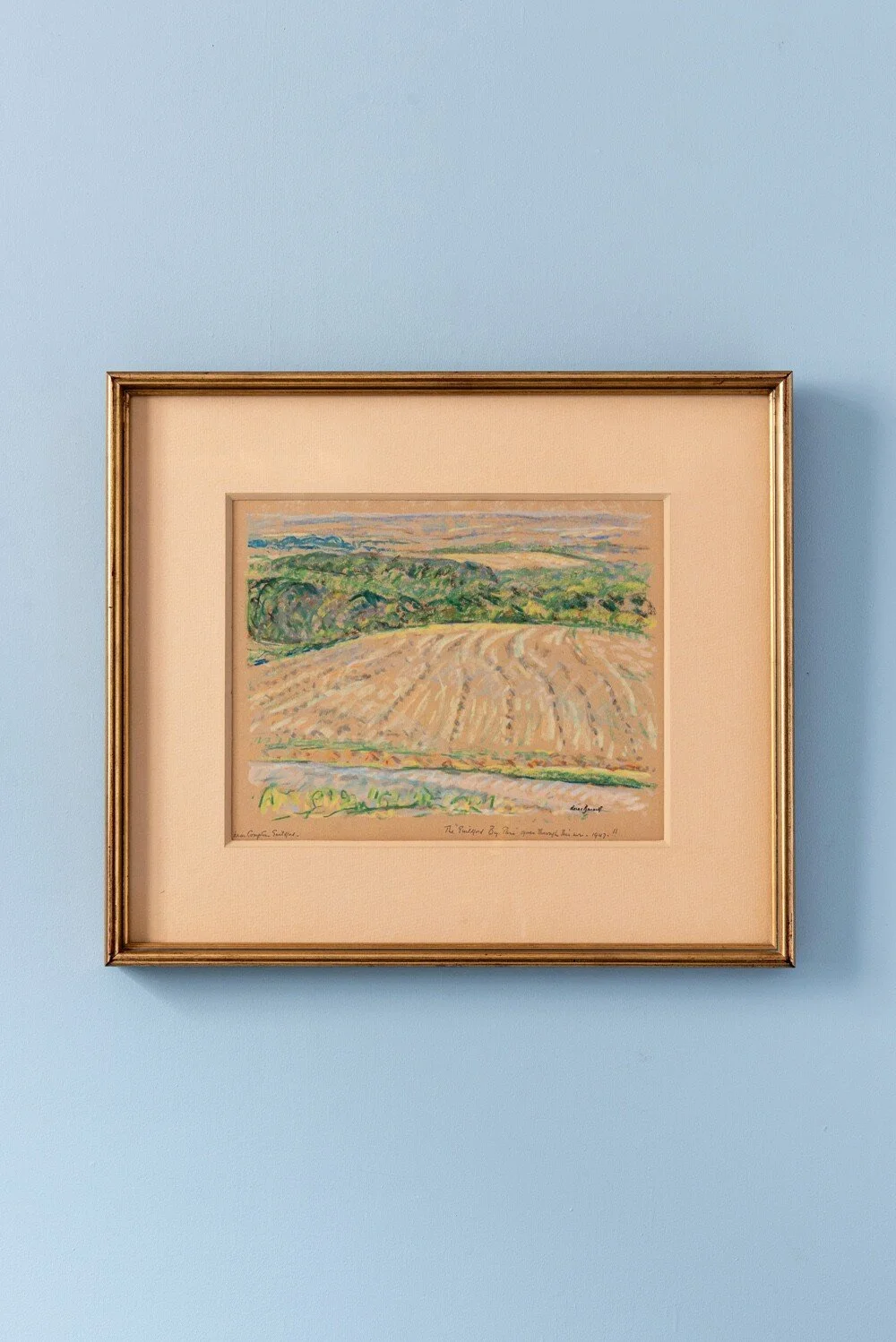
This early 20th-century pastel on paper by Walter Durac Barnett (1876–1961) depicts a rolling country landscape with a field in the foreground and woodland beyond. Executed on hay-coloured paper, it features a warm palette of greens, blues, and yellows that captures the atmosphere of a summer day. The varied shades of green convey the vibrancy of the foliage, while sinuous pastel strokes emphasise the outline of the hills and the gentle movement of the trees.
With a distinctive composition, the open field draws the eye toward the woods and distant hills, creating a sense of depth and calm. Located lower left, signed lower right, and presented glazed under a cream mount within a gilded wood frame. A serene and uplifting pastoral study with bright colour.
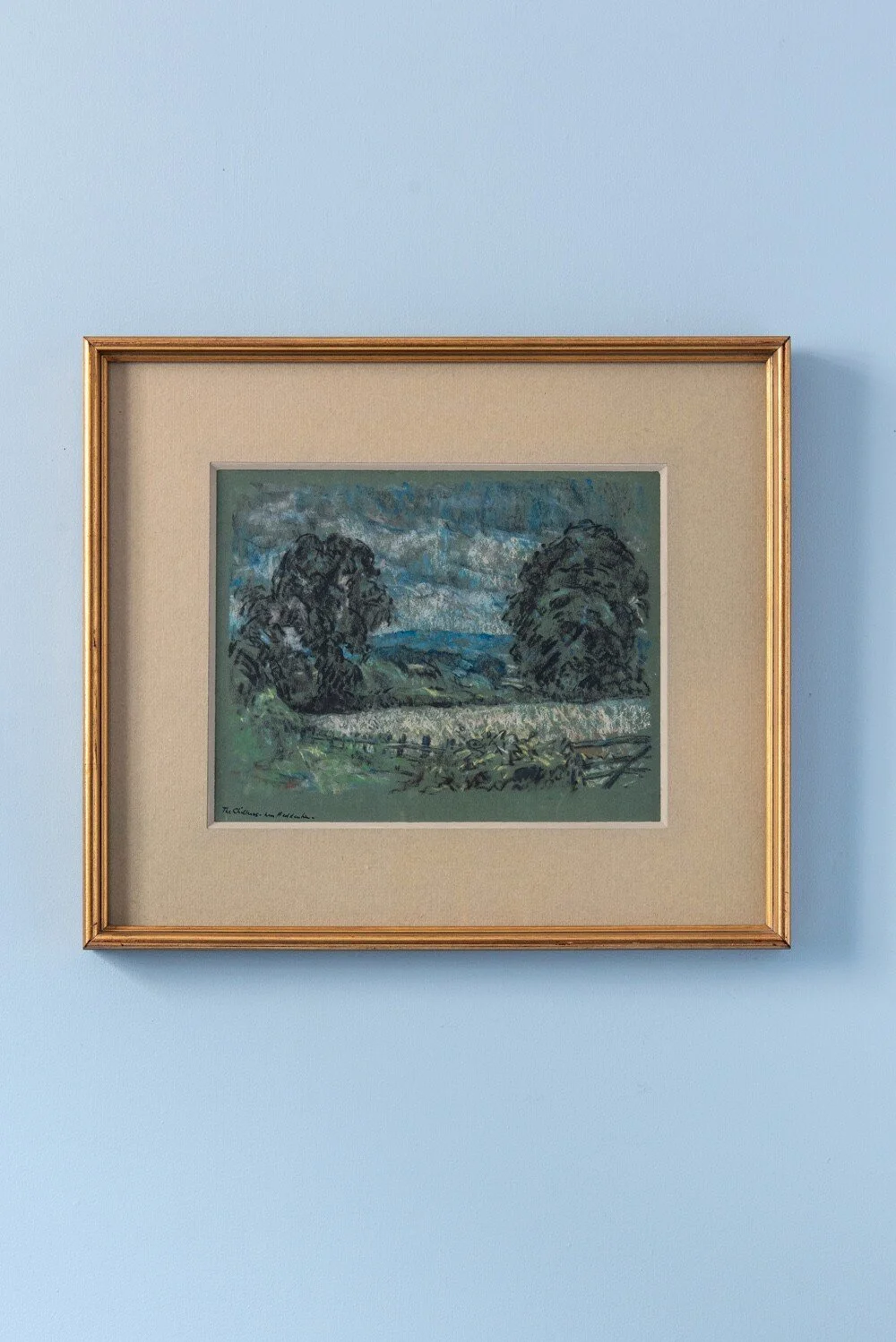
This early 20th-century pastel on paper by Walter Durac Barnett (1876–1961) depicts a tranquil country landscape, with a field bordered by wooden fences in the foreground, framed by tall trees and rolling hills in the distance. Executed on green paper, it features a distinctive palette of greens, whites, and blues — the pale tones of the field echoing the clouds above, while the blue hills dissolve into the sky.
Expressive pastel strokes lend movement to the trees and structure to the composition, creating a serene atmosphere evocative of a cool evening. Located lower left, and presented glazed under a green mount within a gilded wood frame. An evocative country scene in fresh, harmonious colours.

This early 18th-century hand-coloured etching on paper depicts the ‘Fontaine de l’Etoile’ in the gardens of Versailles. Known as the "mountain of water," it shows a grove with a rocaille pond and a dramatic tall fountain, surrounded by smaller jets forming a cascading mount of water. The grove is framed by dense trees and architectural trellises with alcoves, characteristic of Versailles’ gardens. Elegant figures stroll through the scene, their attire highlighted in bright red and blue, contrasting with the pastel blues and greens of the landscape. Drawn and printed by printmaker Nicolas Langlois in Paris, this rare etching offers a striking perspective view, capturing the refined beauty of the Versailles gardens.

This pair of late 19th-century cyanotype prints on paper portrays two ornate door knockers. One handle is richly decorated with intricate foliage and finished by two horses’ heads, while the other has a classical design. Both plates showcase an exquisite decor of scrolls that contrasts with their flat shape. The deep contrast and sumptuous blue monochrome of the cyanotype process highlight their lavish details and artistic ambition. With their attractive colour and distinctive subject, this rare pair of late 19th-century cyanotype prints makes a refined addition to a shelf or on a wall.
Commercially available in 1872, the cyanotype process was favoured by amateurs because of its simple application. They looked for artistic subjects in everyday life, mirroring the dual nature of photography at this time, between document and art.
Cyanotype prints are stable but best kept in the dark. The original prints are mounted on a single album page and preserved in an acid-free archival box. We’ve printed two facsimiles giclée prints for display, mounted in walnut frames.


A 19th-century French gouache on paper, depicting a rooster with the words 'Credit will be given when the rooster crows' ('Quand le coq chantera, crédit on fera'), a motto in French popular culture that was written alongside depictions of roosters and hung in cafés and shops as a humorous way to deter customers from asking for credit. The rooster is rendered in bright colours on a textured off-white background, the green and blue of its sickle and wing feathers set against its red comb and brown body. It stands on a ridge in brown, red and yellow, surrounded by shrubs, just above the motto rendered in elegant lettering.
A captivating level of detail sets this work apart from other folk depictions of roosters, with fine white strokes, dots and dark green patterns on the wing adding depth and texture, while long painterly brushwork accentuates the curves of the feathers. It is painted on two sheets, glazed in its original pitch pine frame.
A rare French folk work, with attention to colour and detail.