
Home / Antique Vases & Vessels
Antique Vases & Tulipieres
French faience bough pots from Nevers, vibrant Moroccan ceramics and Dutch Delft vases in blue and white. Our collection of antique vases spans Europe and North Africa from the 18th to the early 20th century. Bottles, tulipieres, bough pots and albarelli chosen for their rarity, form and pattern.
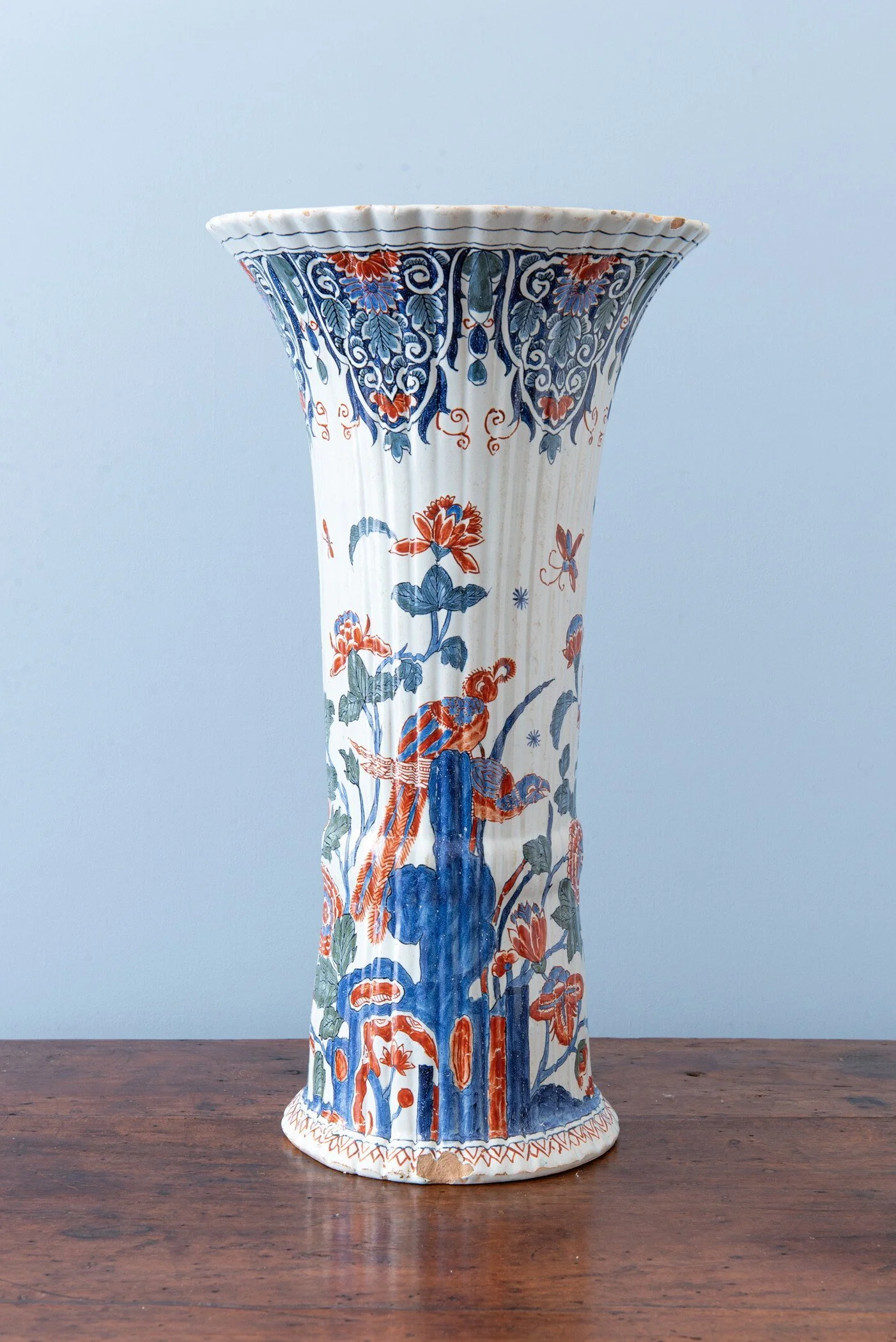
An 18th-century Dutch Delft vase of generous proportions and flared trumpet form with a fluted body. It is decorated in vivid cobalt blue, red and green on a white ground with birds perched on rocks, surrounded by oversized flowers, lush foliage and insects in the Chinoiserie taste. A frieze of scrolls and lambrequins adorns the upper edge. The graceful scrolling movement of the flowers and elongated stems accentuates the impressive verticality of the vase, while the bright polychromy, set against the white ground, renders the abundance of the decoration in a particularly compelling way. Marked to the underside.
A rare piece, with distinctive shape and refined decorative presence.
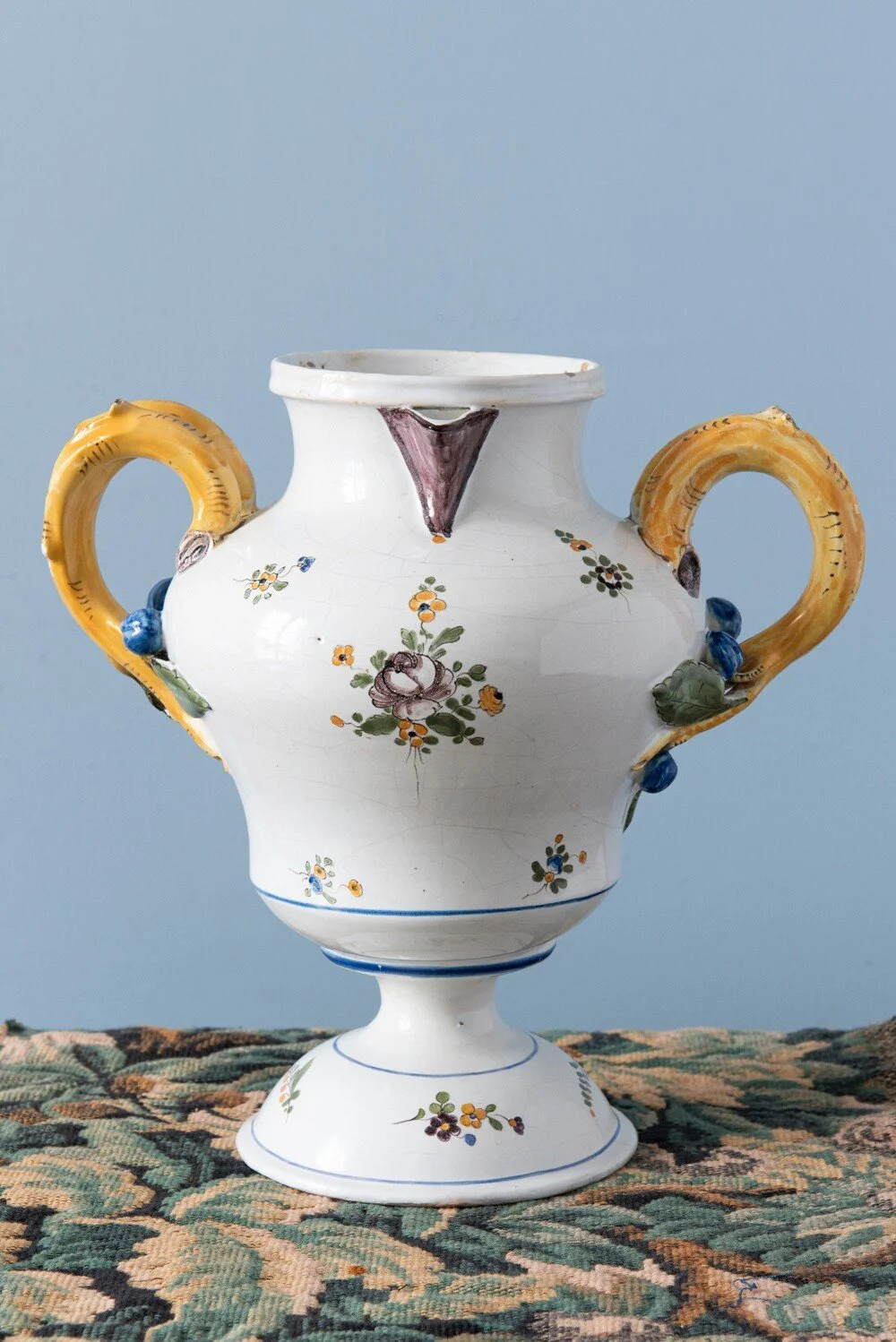
An 18th-century French faience polychrome vase. Its elegant baluster form with a piedouche is adorned with delicate sprays of flowers and foliage, enclosed within fine blue line borders. Two striking handles, modelled as yellow branches with green leaves and blue fruits, frame the vase, their naturalistic detailing particularly captivating. With a generous size, this statement piece combines sculptural presence with elegant floral motifs.
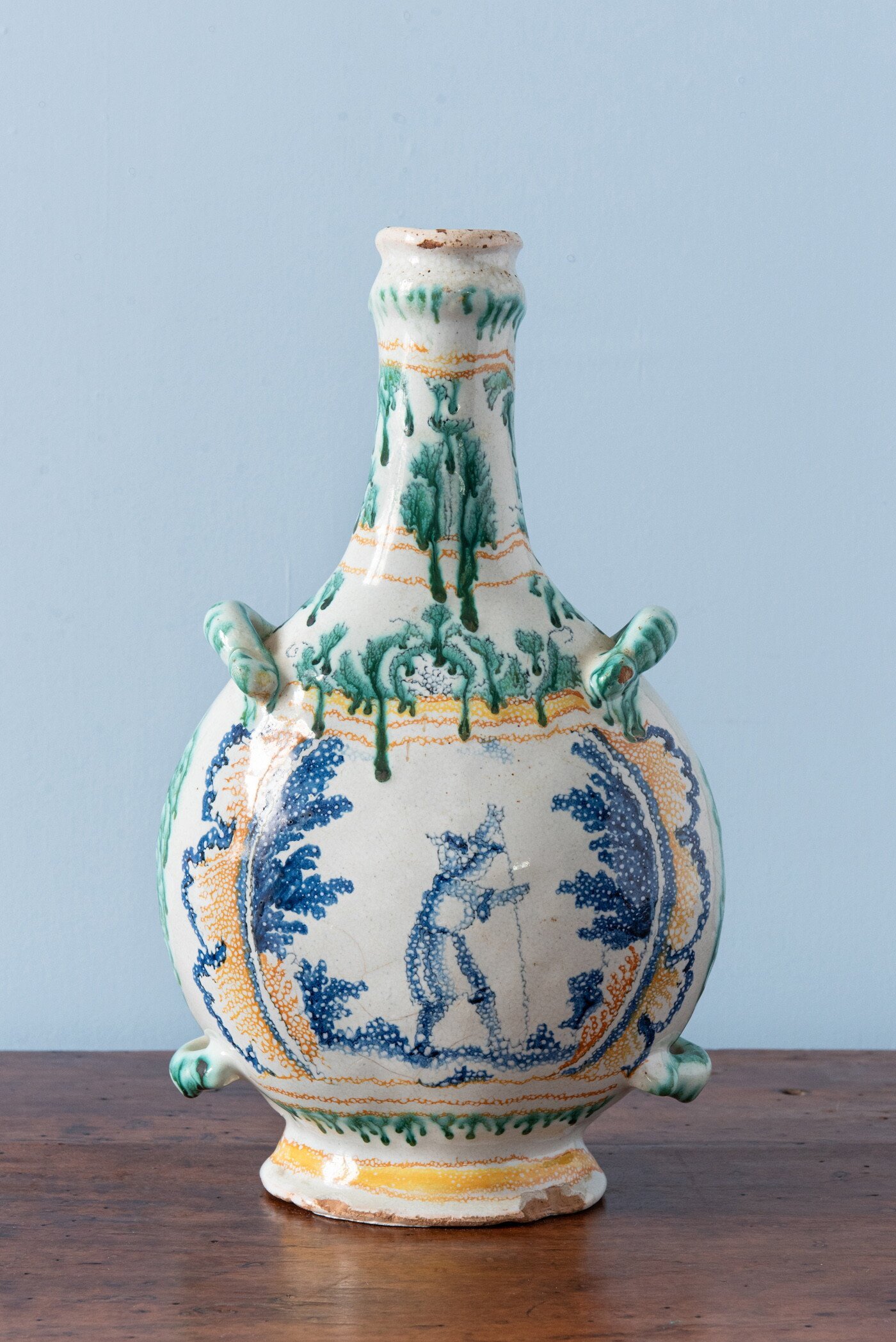
A mid-18th-century French faience bottle from Nevers, of elegant flattened form with rounded body, narrow neck and four handles. The decoration features blue figures surrounded by trees within a landscape, contained in reserves framed by foliate patterns in orange and blue. Abundant green foliate ornament adorns the sides and neck.
Striking green drips and blue and orange bubbles across the surface add distinctive texture and visual interest, characteristic of 18th-century kiln firing of large vertical forms. These spontaneous effects lend authenticity material vitality.
A rare bottle with vibrant colours, characterful decoration and sculptural presence.
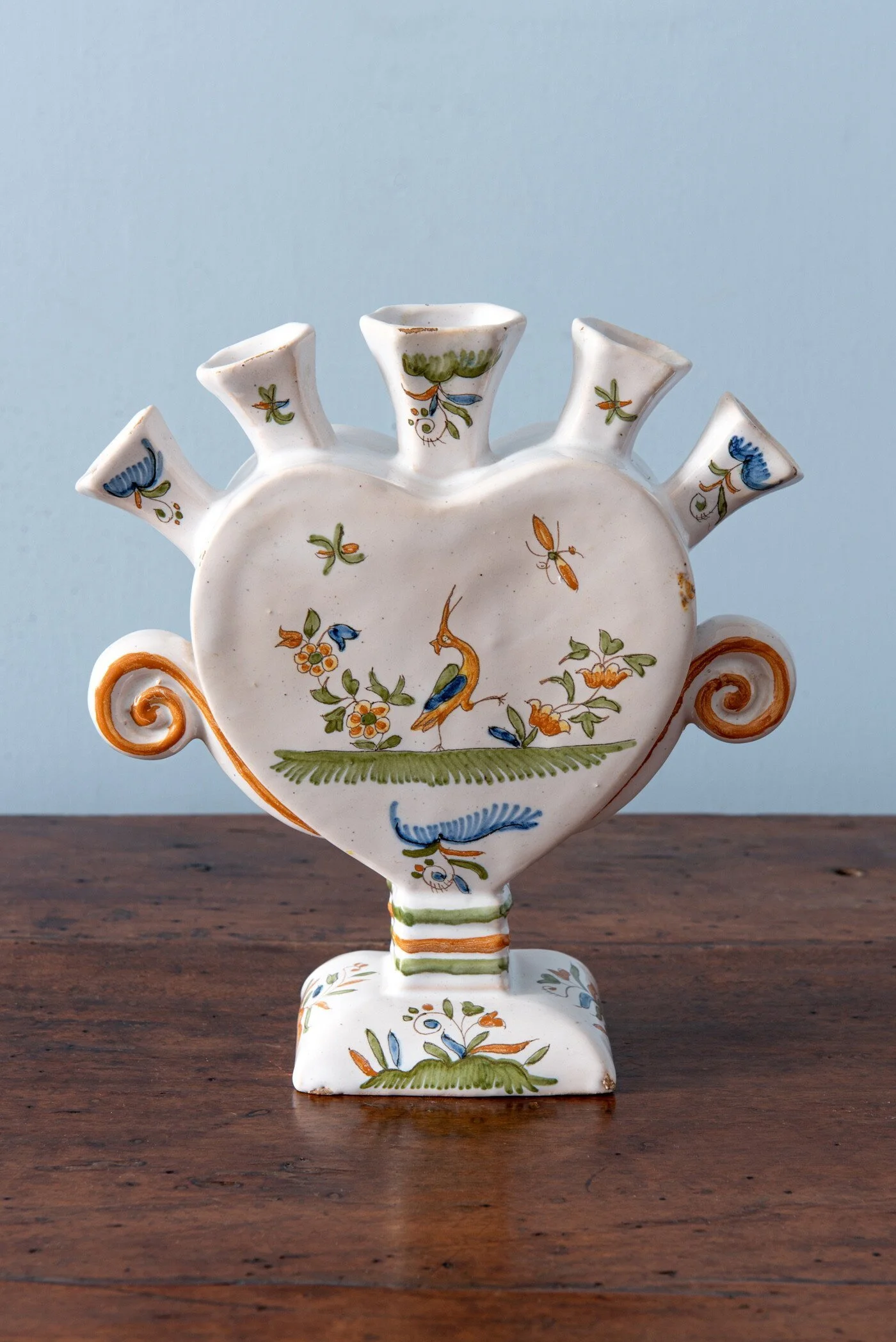
A late 19th to early 20th-century French faïence tulipière from Moustiers, of striking heart-shaped form topped with five hexagonal openings and framed by scrolling handles, raised on a square piédouche.
Decorated in orange, blue and green, one face depicts a heron while the other features a figure in historical costume, both among flowering bushes and butterflies. The piédouche and openings are further adorned with flowers and foliage, while the handles are highlighted by an orange stroke. The light, charming decoration places the emphasis on the tulipiere’s imaginative sculptural shape.
In very good condition and unrestored, an imaginative piece, perfect to display fresh cuttings or as a decorative piece on its own.
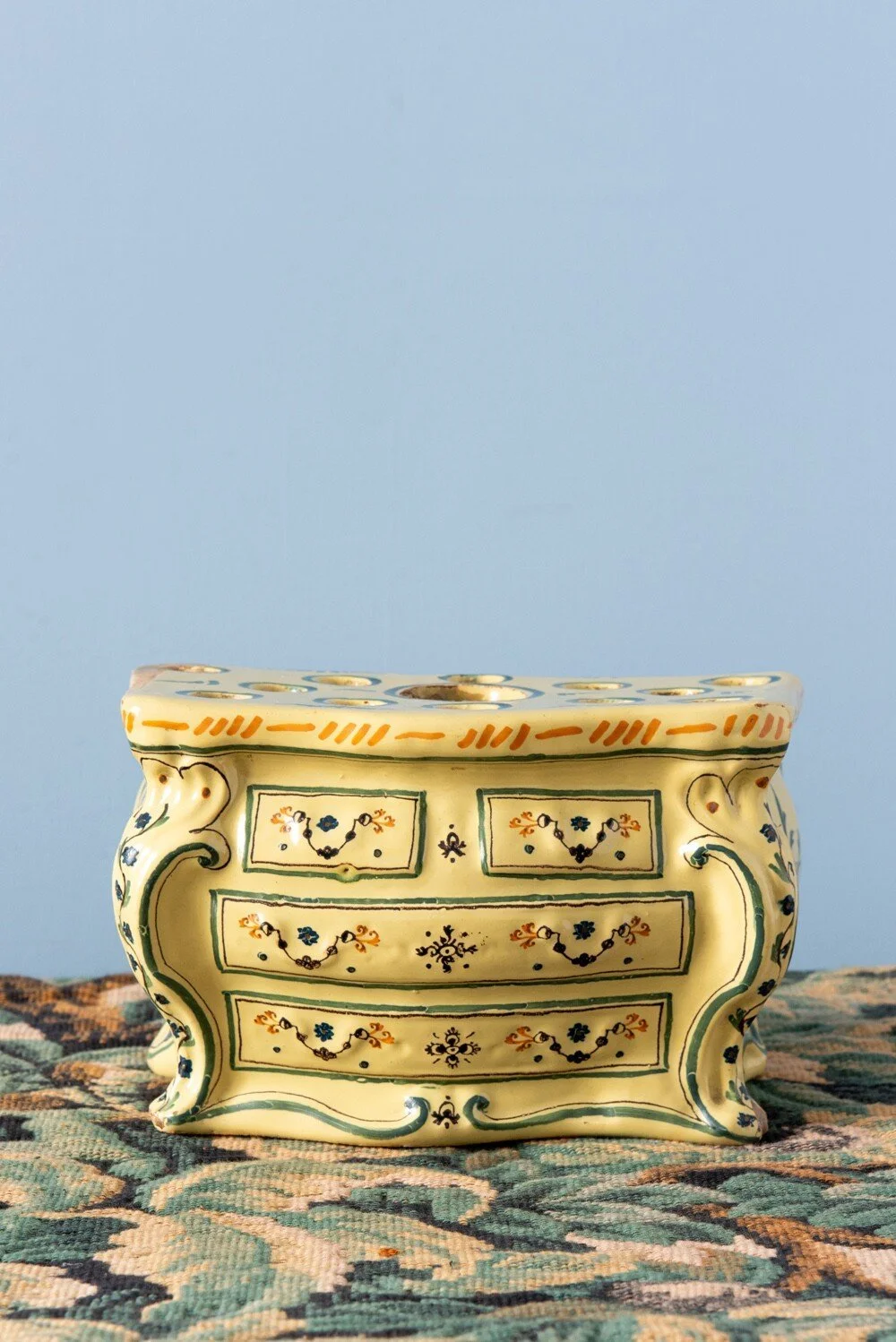
A rare late 18th-century French faience bough pot from Nevers, modelled in the playful form of a commode. Complete with finely detailed drawers, handles and gilt-bronze accents, its rounded body is elegantly painted in bright yellow, blue and orange. The front features elaborate floral patterns framed by scrolls and stripes, while each side is adorned with delicate sprays of flowers. Designed with one large opening and twelve smaller ones, this exquisite piece is perfect for elaborate floral displays and equally striking as a decorative object year-round.
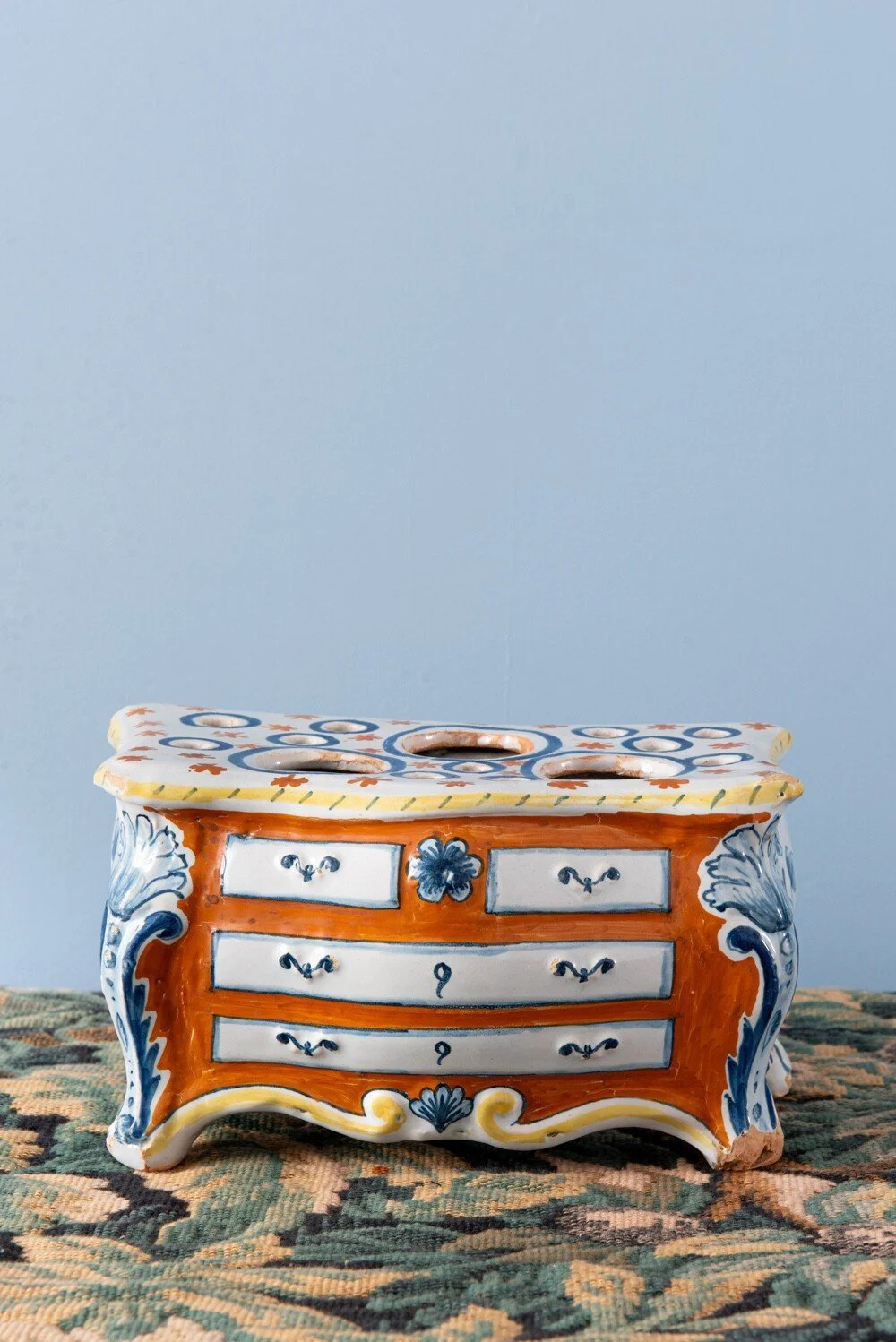
This rare 18th-century French faience bough pot from Nevers takes the playful form of a commode, complete with drawers, handles, and gilt-bronze accents. The rounded body is painted in vibrant orange, animated with blue scrolls and yellow framing lines. An imaginative array of patterns — from florals to stripes and stars — enlivens the surface, with sprays of flowers on each side and a top scattered with orange stars and blue circles. With three large openings and eleven smaller ones, this remarkable piece is ideal for elaborate floral displays and serves as a striking decorative object year-round.
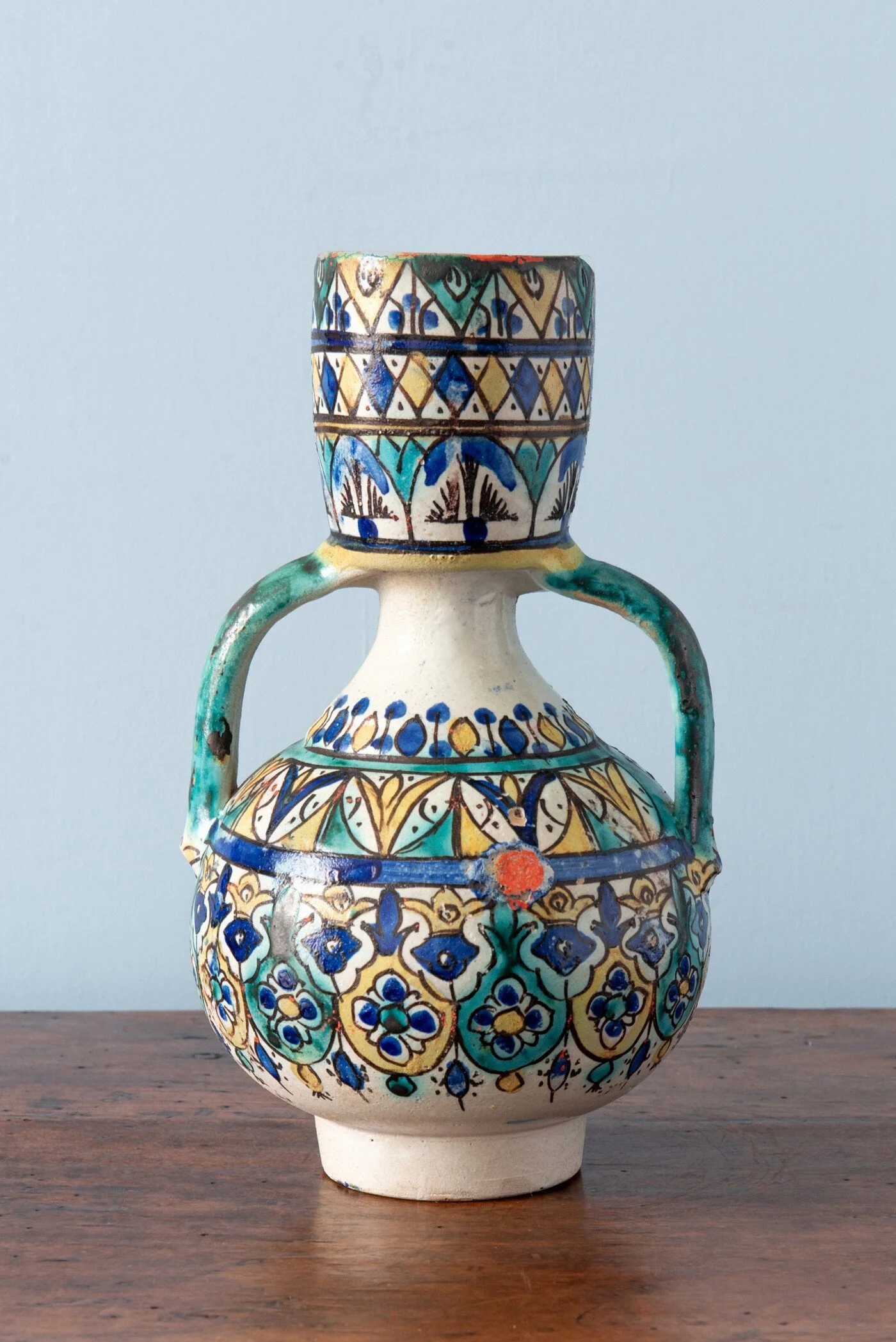
An early 20th-century Moroccan pottery berrada from Fez, of traditional form with round body, narrow neck and wide spout, framed by two handles. Used to pour water, it features an internal strainer to hold sediments.
It is decorated with flowers and lively geometric patterns in green, blue and yellow on a cream engobe, finished by touches of minium red on the body and over the edge.
A rare utilitarian vessel with striking shape and vibrant decoration, in excellent condition.
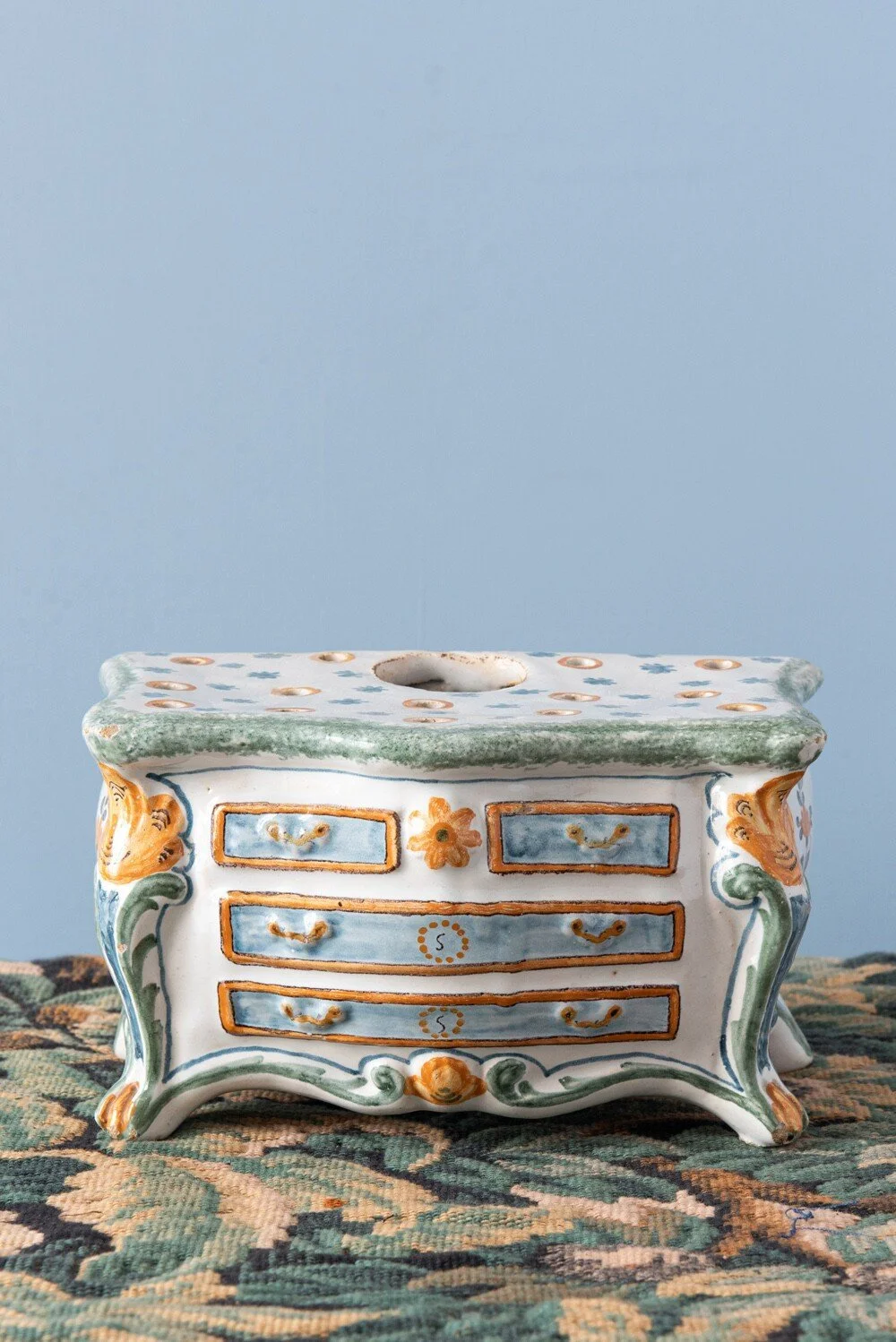
A rare 18th-century French faience bough pot from Nevers, modelled in the playful form of a commode. Complete with drawers, handles, and gilt-bronze accents, its rounded body is painted in a refined palette of celadon and blue, contrasting with vivid orange details. An imaginative mix of florals, scrolls, and stars enlivens the surface, with sprays of flowers on each side and the top scattered with orange stars. Designed with one large opening and fourteen smaller ones, this remarkable piece is ideal for elaborate floral displays and serves as a striking decorative object year-round
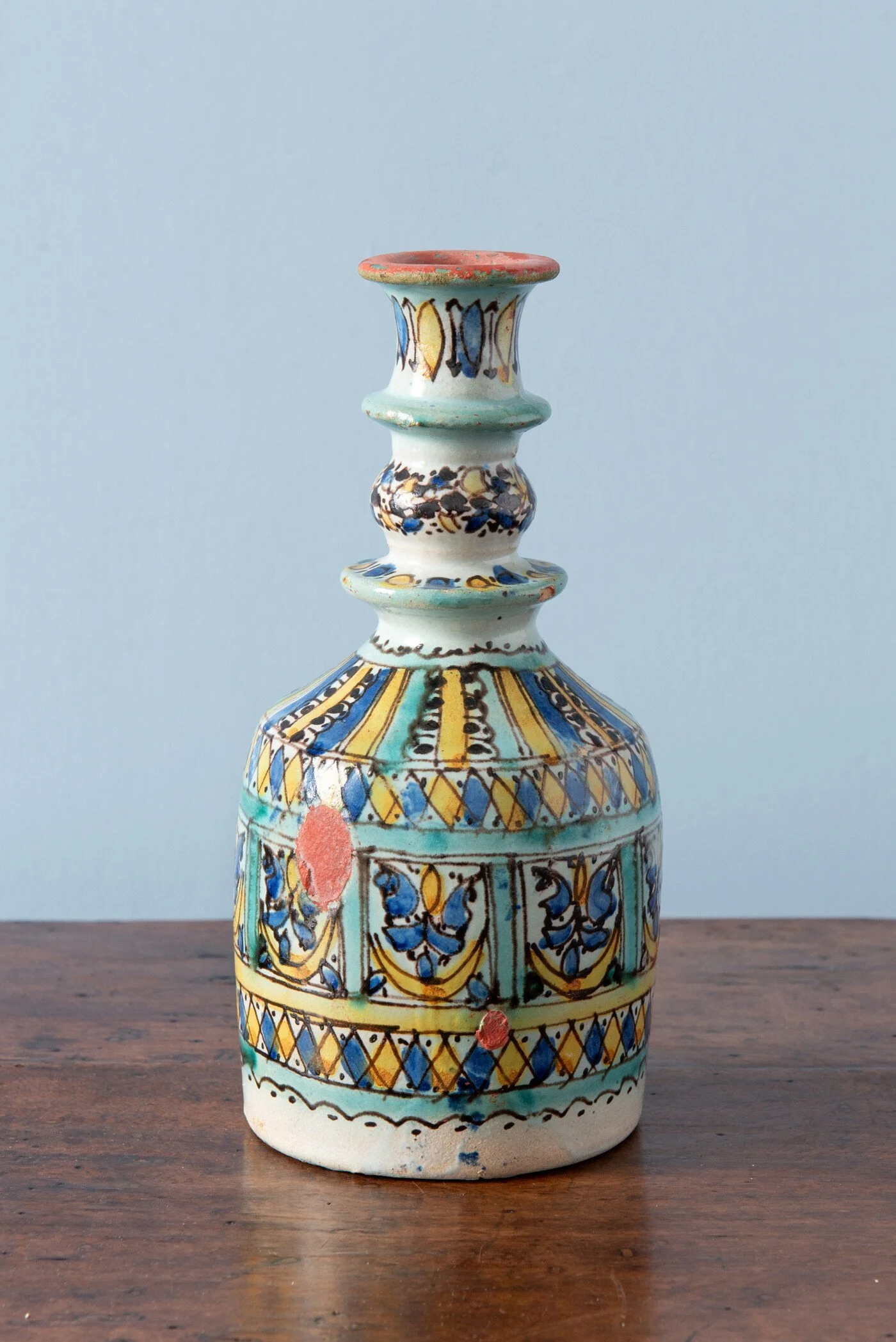
A late 19th-century Moroccan pottery bottle from Fez. The form is sculptural, with a wide lower body tapering to a ringed neck. The surface is decorated with vibrant bands of geometric and floral patterns in blue, green, yellow and manganese, with textured highlights of minium red on the body and lip adding contrast to the palette.
A rare piece, with an elegant shape and lively polychrome decoration characteristic of Fez.
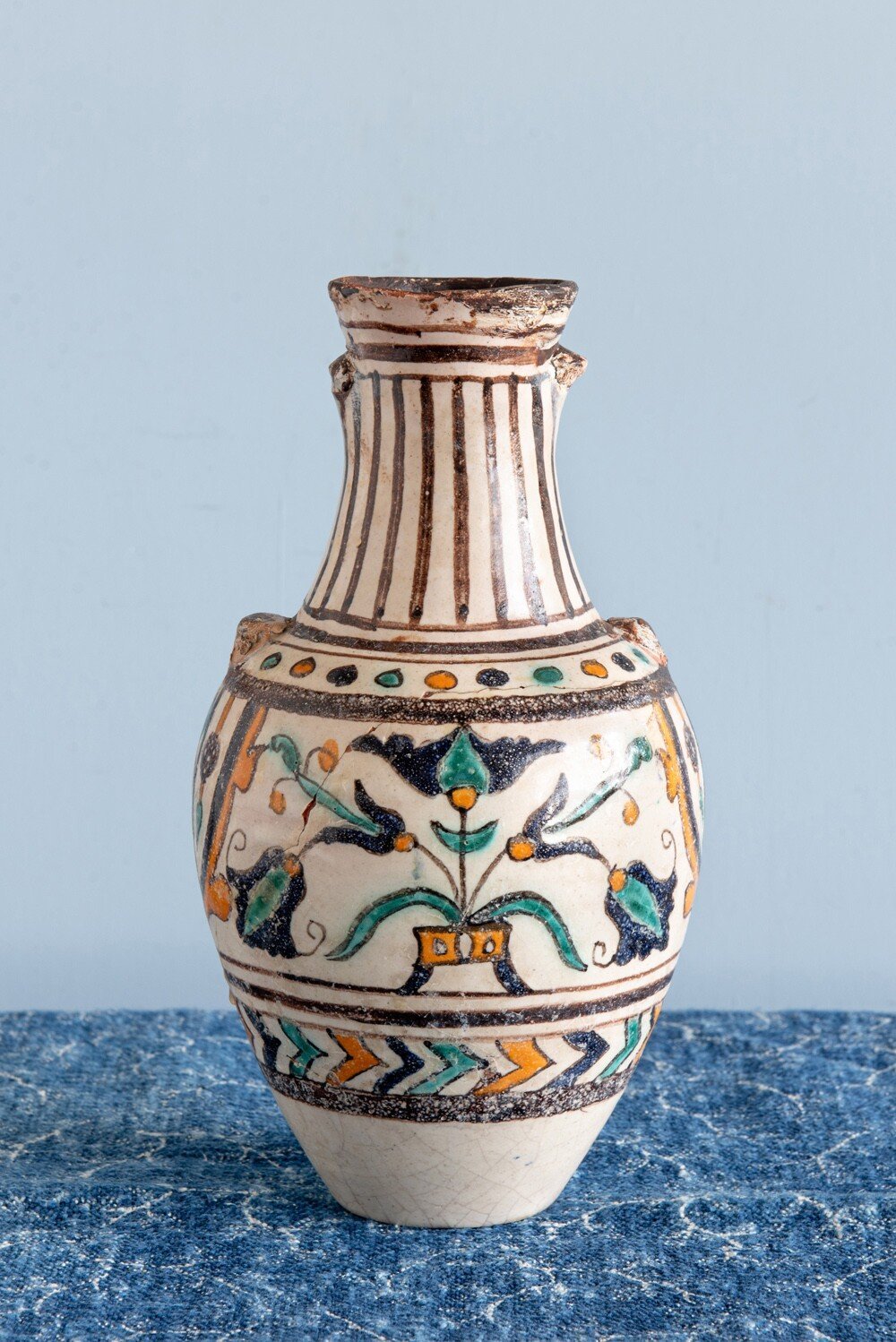
This 18th-century Tunisian pottery vase is decorated with flowers and stems of foliage, set against geometric patterns in the Qallalin style. It features a refined baluster shape and is painted in an elegant palette of green, blue, orange, and brown. With its beautiful textures, this rare Qallalin vase makes a timeless decorative accent.
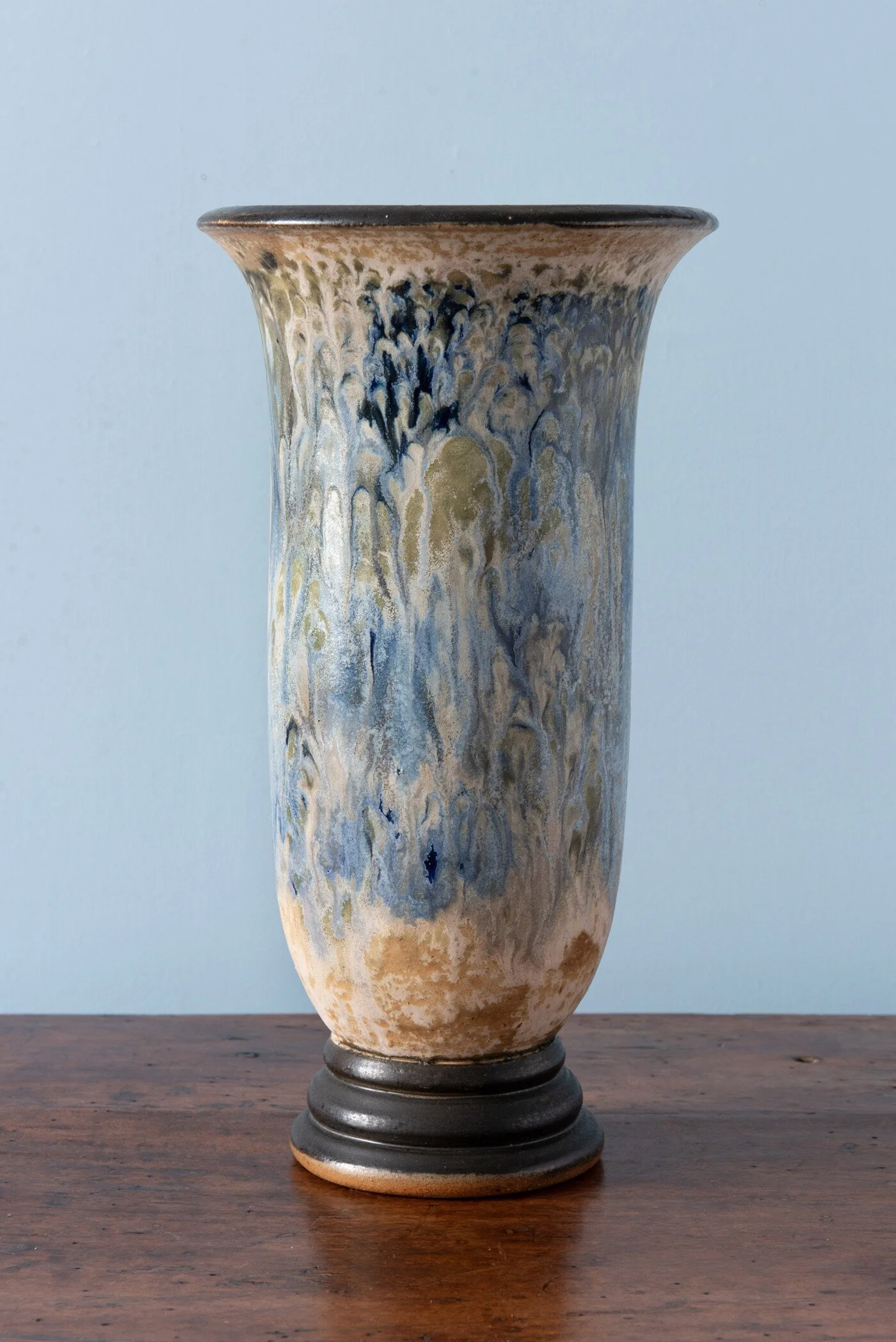
An early 20th-century glazed stoneware vase by Belgian ceramicist Roger Guérin (1896–1954). Of tall flared trumpet form with a stepped base, the elegant shape is characteristic of the Art Deco period.
The surface is decorated with blue and green glaze drips on an earthy ground, with contrasting black glaze to the base and inner lip — a muted but distinctive palette that highlights the verticality of the form.
A rare and sculptural Art Deco vase, in excellent condition, marked underneath.

An 18th-century Spanish albarello from Catalonia, adorned with a scrolled label inscribed in elegant black script, set within rich blue and white floral and foliate decoration. The piece exemplifies the traditional albarello form, with a tall cylindrical body, gently waisted profile, and broad rim, originally devised for the storage of apothecary goods. The contrast between the formal script and the loose, flowing ornament lends the jar a distinctive charm, combining utilitarian history with decorative appeal. Well-proportioned and visually striking, it makes a refined display piece and pairs elegantly with the companion albarello currently available in our collection.

An 18th-century Spanish albarello from Catalonia, adorned with a scrolled label inscribed in elegant black script, set within rich blue and white floral and foliate decoration. The piece exemplifies the traditional albarello form, with a tall cylindrical body, gently waisted profile, and broad rim, originally devised for the storage of apothecary goods. The contrast between the formal script and the loose, flowing ornament lends the jar a distinctive charm, combining utilitarian history with decorative appeal. Well-proportioned and visually striking, it makes a refined display piece and pairs elegantly with the companion albarello currently available in our collection.
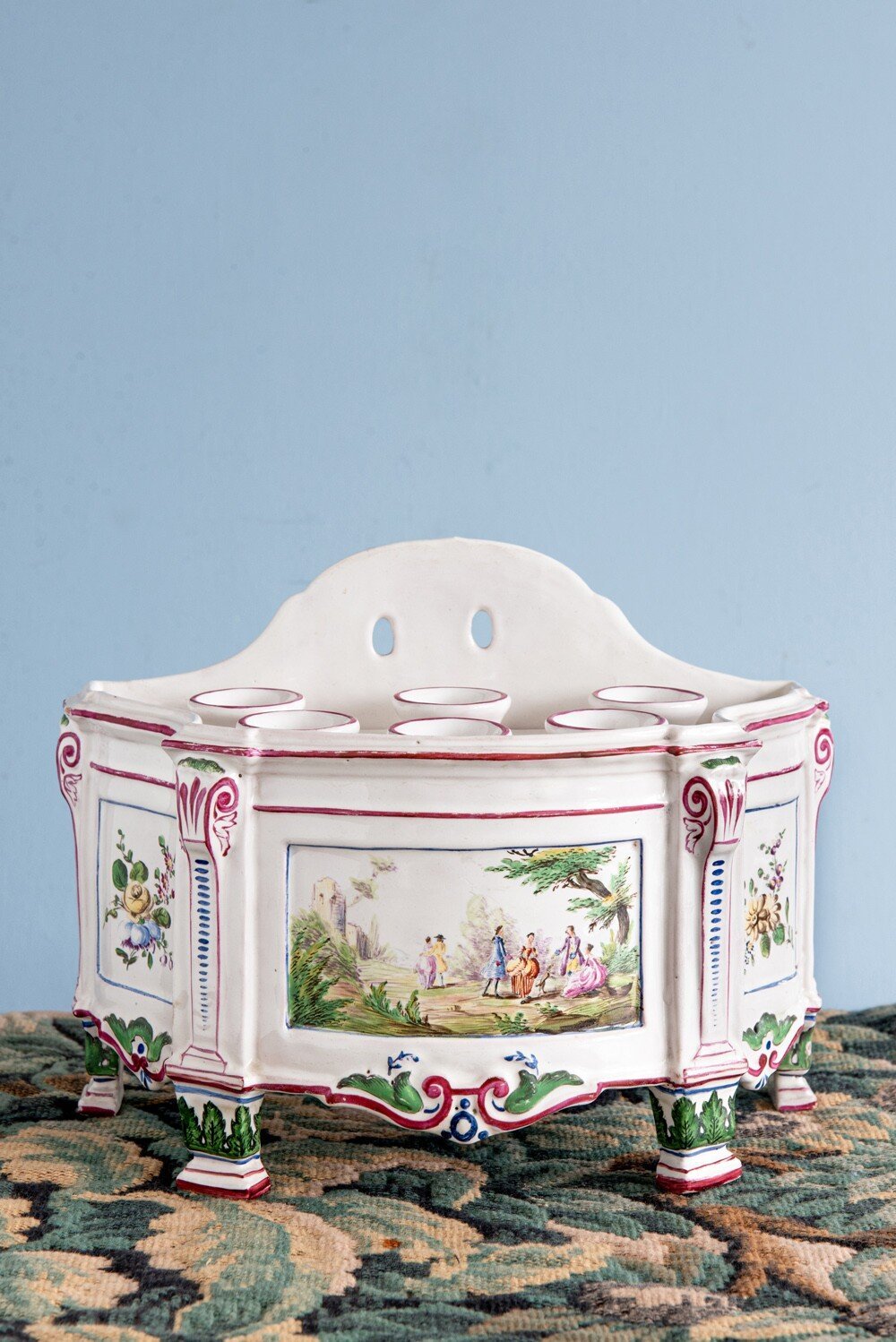
This rare 19th-century French faience bough pot from Samson features an elegant serpentine shape with bold relief ornamentation. It is decorated in pink and green, with an exquisite polychrome pastoral scene painted in a reserve, depicting figures in 18th-century attire set among trees and a ruin, along with sprays of flowers on both sides. The large body can hold water, and the top lifts off, with six openings to hold stems of flowers. This exquisite bough pot is ideal for displaying fresh flowers and serves as a stunning decorative piece year-round.

An exquisite 18th-century French faience bough pot from Moustiers, decorated with abundant flowers in pink and green. With a half-moon shape, it features a fluted body, a domed top with 18 openings on its upper part to hold stems of flowers, and two handles in the shape of animal heads on the sides. Its gorgeous polychrome decor showcases an elegant drawing with lush rose petals surrounded by deep green leaves and smaller flowers in blue and yellow.
With a vibrant shape full of intricacies, this rare piece of Moustiers faience is typical of the work of the Fabrique Ferrat and is the perfect vase to display fresh flowers as well as an exquisite decorative piece on its own.

An 18th-century French faience bottle from Nevers, decorated in yellow and black on a white base. It showcases a variety of patterns, with sprays of flowers surrounded by strokes and squiggly lines. The upper part of its body is covered with a contrasting spongeware decor and its thin neck features lively geometric ornaments. With a characteristic bottle shape and small handles, it is the perfect vase for spring flowers and a gorgeous decorative accent.


An almost identical pair of late 17th-century French faience jasmine vases from Nevers, of elegant baluster form flanked by striking rope-twist handles highlighted in blue brushwork. They are decorated in blue and white with painterly scrolls and foliage forming lambrequins, framed by horizontal lines at the top and bottom, the scrolling brushwork echoing the shape of the handles and lending a sense of movement to the vases.
The form is typical of jasmine vases and includes drainage holes, attesting to their use as planters: produced in Nevers from 1660, similar vases, often of larger scale, adorned the gardens of Versailles under Louis XIV to hold jasmine shrubs.
A rare pair of graceful vases, unrestored and in very good condition.