
Home / Antique Landscape Oil Paintings
French Antique Landscape Oil Paintings
Broad brushstrokes, soft afternoon lights, and lush natural forms are artfully combined in evocative antique landscape oil paintings, adding a sense of place and abundance to any room.

A 1940 Belgian watercolour on paper, depicting a coastal village. A road in the foreground, bordered by houses and buildings, leads to the shore on the left of the scene, while further houses and a church are scattered among rocks in the background, the whole surrounded by a deep blue sea. The houses are rendered in bold geometric shapes, their pitched roofs echoing the shape of the rocks, while the flatness of the sea adds a sense of abstraction. Its captivating palette of seaweed greens, reds and browns is combined with the deep blue of the sea to evocative effect, amplified by the impressive scale of the work. Glazed in a wood frame with a metallic front and black side, under a green fabric mount.
An evocative coastal village scene with immersive scale and distinctive colour.

An early 20th-century oil painting on canvas by French artist Fernand Combes (1856–1943), depicting a mill with a large wooden wheel, surrounded by trees and buildings, the scene viewed from below with a slope of grass and rocks in the foreground. A warm palette of ochres, browns and green contrasts with the blue of the sky, the striking perspective highlighting the hilly position of the cluster of buildings, with a stream running through the wheel towards the back of the slope. The warm palette, together with the repetitive brushwork of the rocks and stone wall, evokes the regional character of the architecture from the South of France, its dark tones lending the scene an evocative atmosphere. Signed to the lower part of the artwork.
The painting is mounted in a striking, impressively scaled Montparnasse frame of cassetta form, with egg-and-dart and rope patterns highlighted in red and gold. Signed to the lower part of the artwork.
An evocative country scene, paired with a striking sculptural frame.
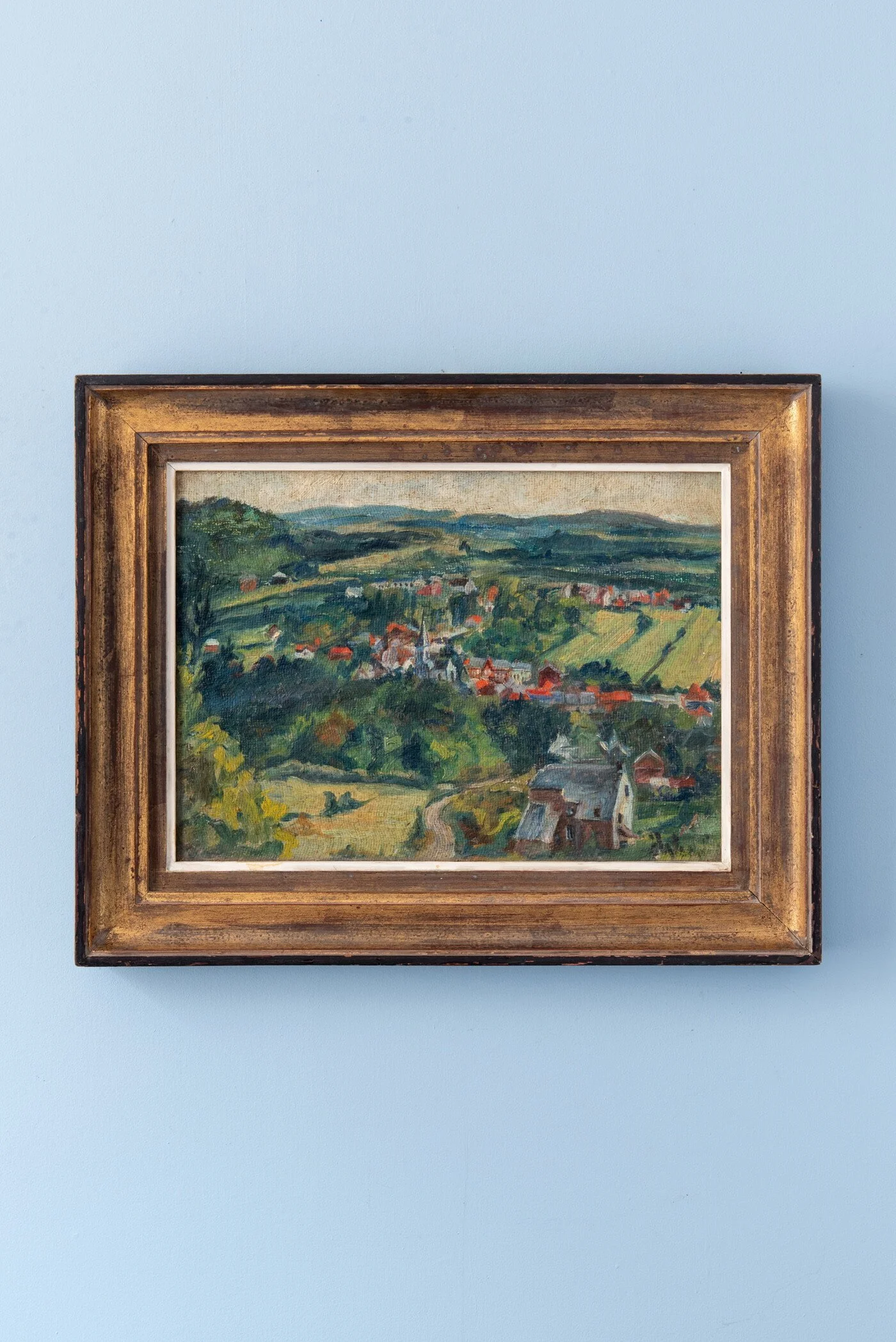
A 1949 Belgian oil painting on board, depicting the village of Barvaux-sur-Ourthe in the Ardennes from a high vantage point. The composition is centred on the village church and its surrounding streets, nestled among rolling hills, trees and fields, with a path and farm building in the foreground. Characterful details lend life to the landscape, from the architecture of the church spire to the functional forms of the farm buildings in the foreground.
A fresh palette of green, grey and orange combines the lush nature of the region with the characteristic architecture of brick, tile and slate roofs, rendered in broad brushwork that echoes the softness of the landscape.
Signed lower right, retaining its original giltwood frame, dated 1949 and located on the reverse. An evocative mid-century country landscape.
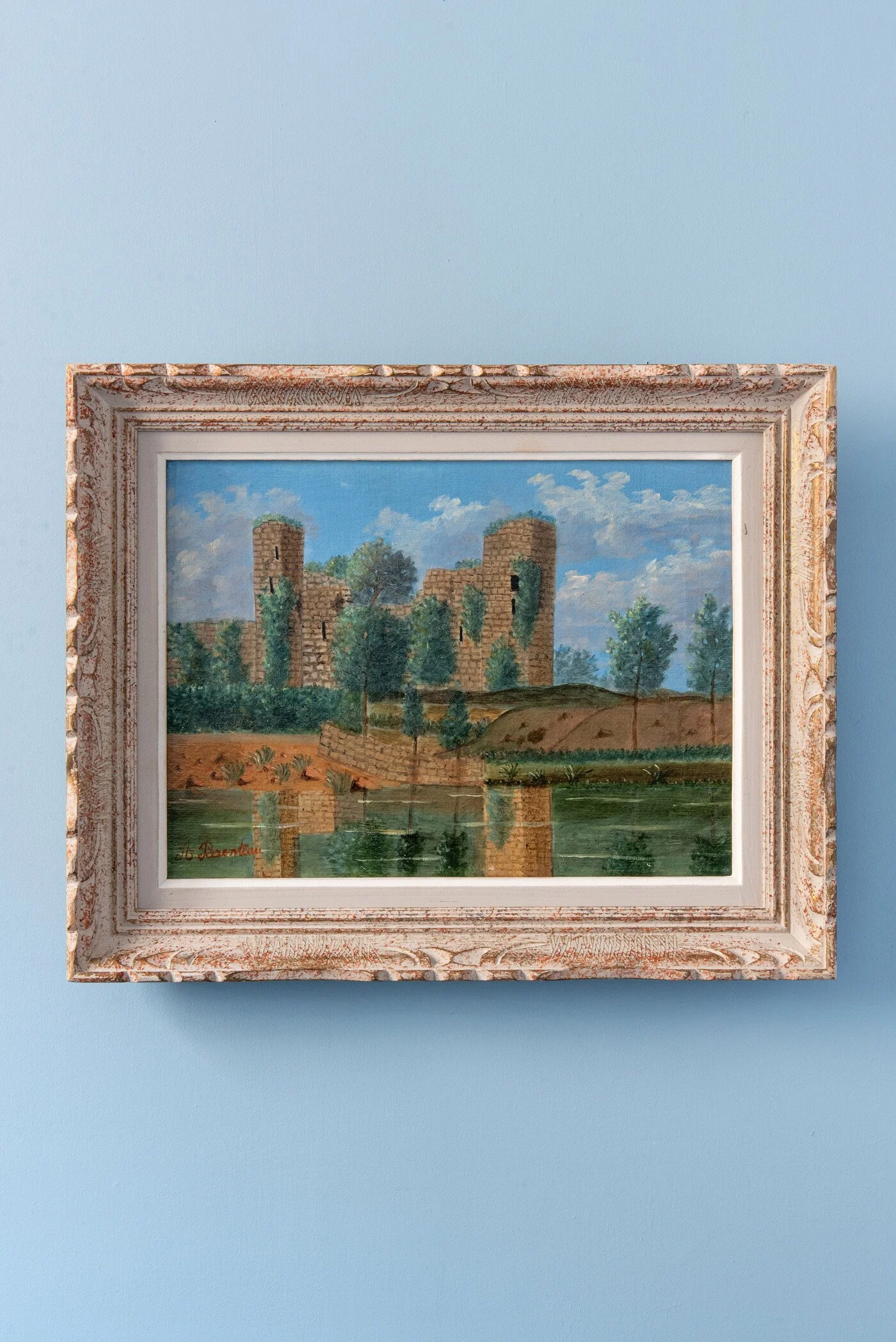
A late 19th-century oil painting on canvas by the French artist Amélie Parenteau (1835-1923). The composition depicts a ruined medieval castle flanked by towers and ramparts, set among trees and dense foliage along the bank of a river, with the architecture reflected in the water below.
The palette is vibrant and earthy, combining warm yellows and browns with greens, blues, and touches of white. Short, lively brushstrokes articulate the stonework of the castle, the movement of clouds and the texture of leaves through an emphasis on pattern, giving this calm rural scene a gently naive and evocative quality.
Signed ‘A. Parenteau’ in red in the lower left corner and presented in an antique Montparnasse frame. The location is inscribed on the reverse as La Salbart, Deux-Sèvres, most likely referring to the 13th-century fortress of Château de Coudray-Salbart in Poitou.
Amélie Parenteau worked from the late 19th to the early 20th century in a naturalistic landscape tradition, depicting rural paths, village views and rivers with a quiet, observational approach. Her work recalls the realism of the Barbizon school, tempered by looser, impressionist brushwork and vivid colours, viewed from a distinctly local perspective.
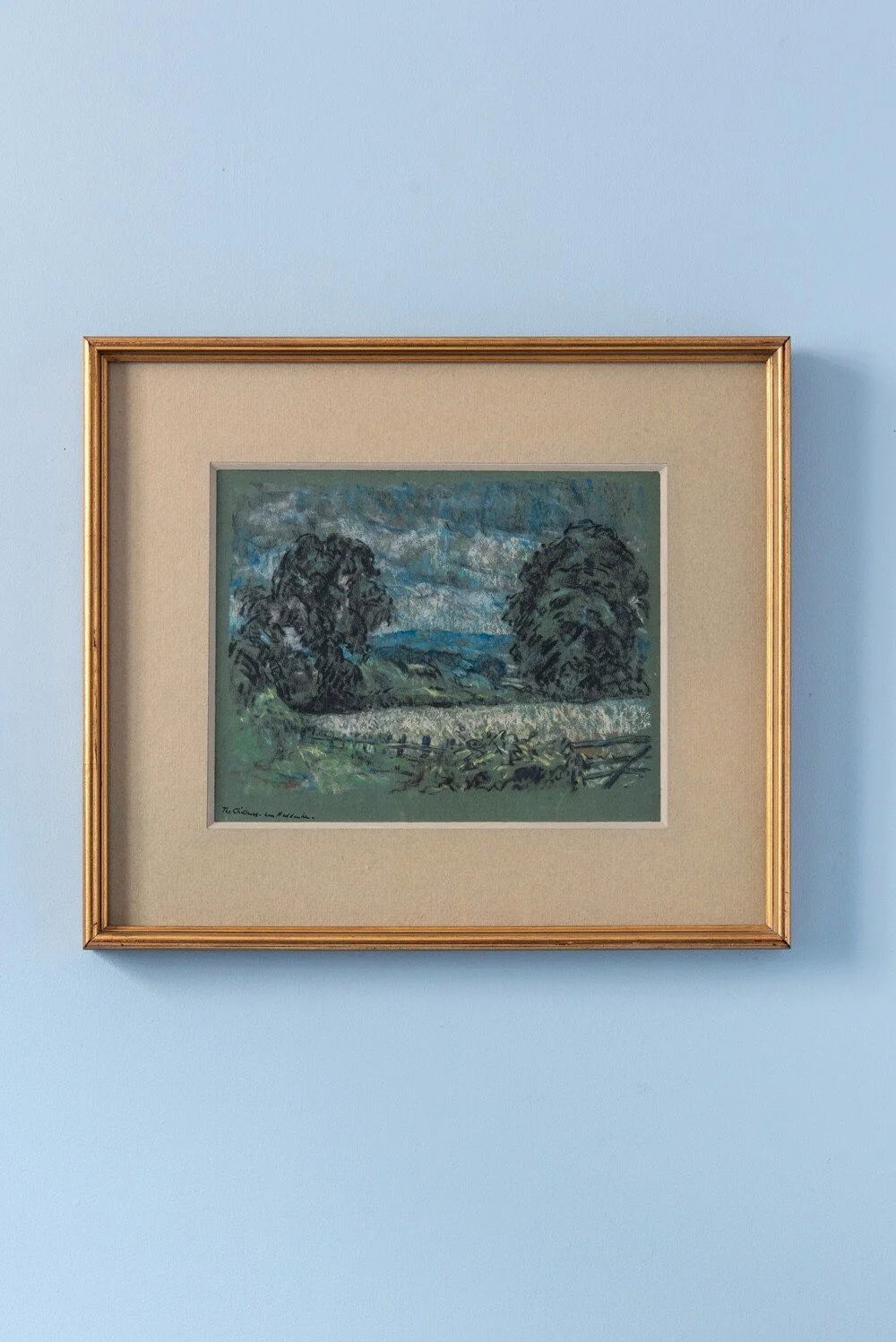
This early 20th-century pastel on paper by Walter Durac Barnett (1876–1961) depicts a tranquil country landscape, with a field bordered by wooden fences in the foreground, framed by tall trees and rolling hills in the distance. Executed on green paper, it features a distinctive palette of greens, whites, and blues — the pale tones of the field echoing the clouds above, while the blue hills dissolve into the sky.
Expressive pastel strokes lend movement to the trees and structure to the composition, creating a serene atmosphere evocative of a cool evening. Located lower left, and presented glazed under a green mount within a gilded wood frame. An evocative country scene in fresh, harmonious colours.
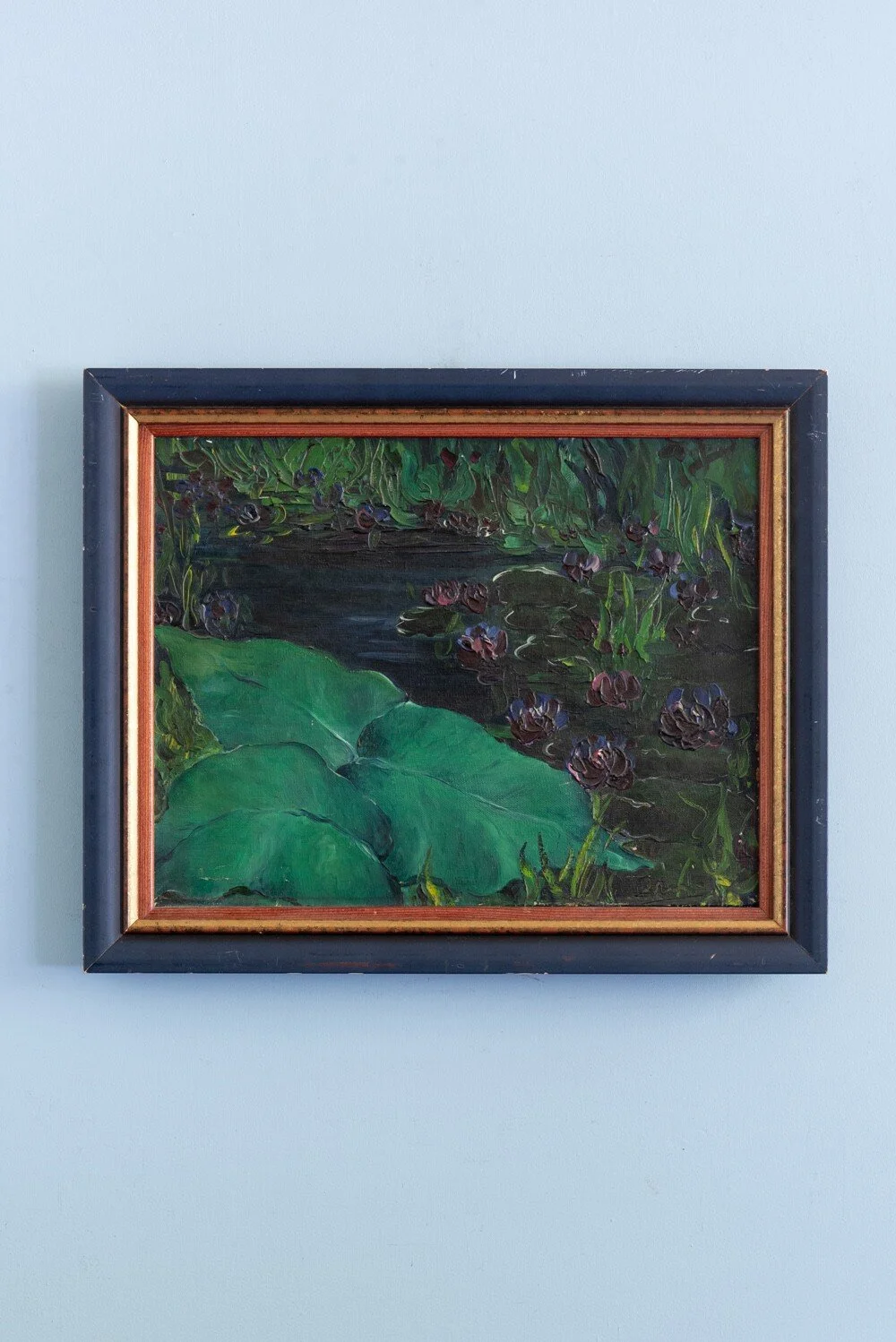
An early 20th-century oil on canvas by French artist Marcel Pottier (1908-1949), offering a striking close-up view of a pond. Broad waterlily leaves dominate the foreground, with delicate blooms floating across the surface and aquatic plants rising softly in the background. The scene is rendered in a rich, atmospheric palette of deep blues, verdant greens and contrasting violet tones, capturing the quiet depth of water and light. Signed and presented in a painted wooden frame of soft blue and gold. A captivating and immersive composition.
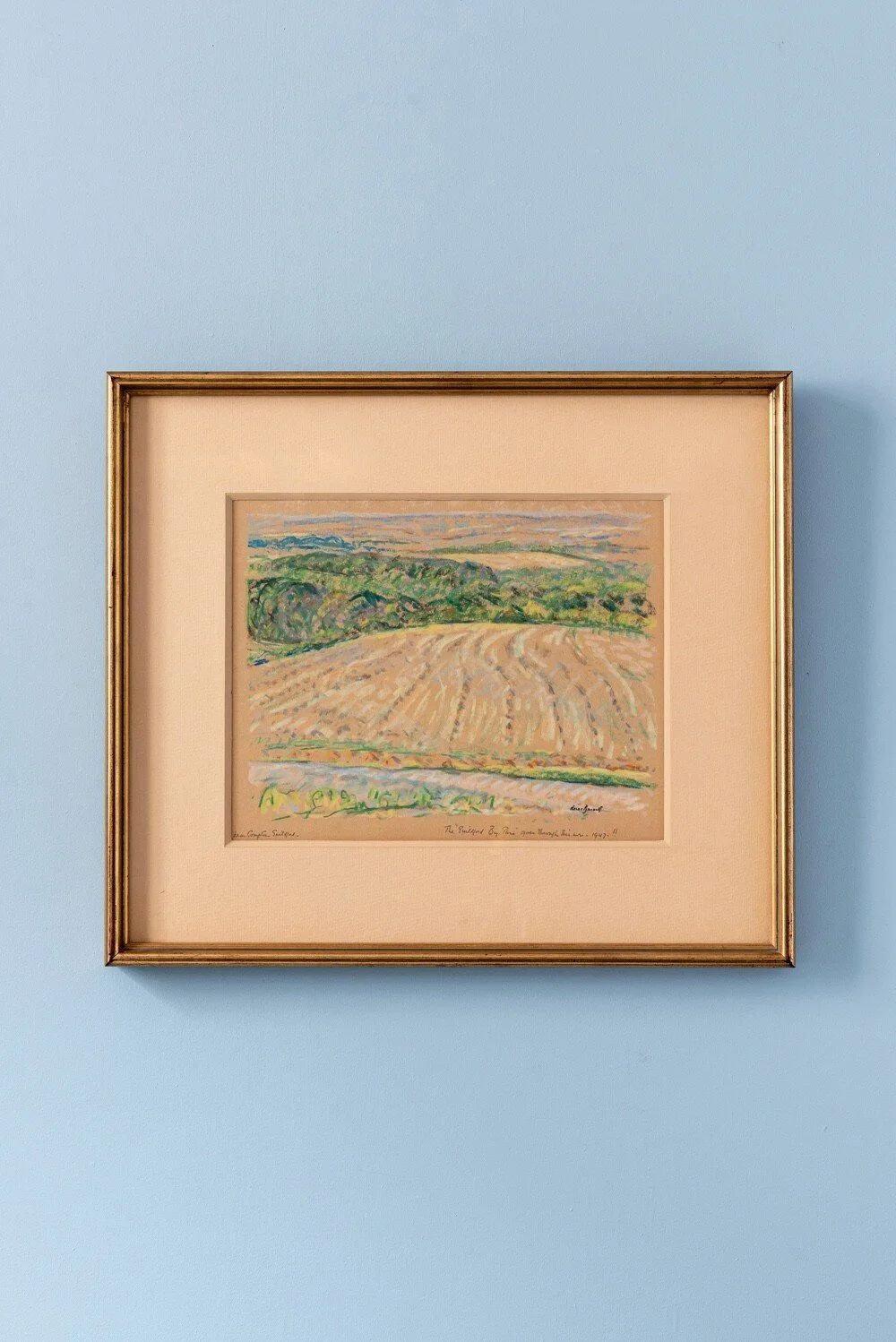
This early 20th-century pastel on paper by Walter Durac Barnett (1876–1961) depicts a rolling country landscape with a field in the foreground and woodland beyond. Executed on hay-coloured paper, it features a warm palette of greens, blues, and yellows that captures the atmosphere of a summer day. The varied shades of green convey the vibrancy of the foliage, while sinuous pastel strokes emphasise the outline of the hills and the gentle movement of the trees.
With a distinctive composition, the open field draws the eye toward the woods and distant hills, creating a sense of depth and calm. Located lower left, signed lower right, and presented glazed under a cream mount within a gilded wood frame. A serene and uplifting pastoral study with bright colour.
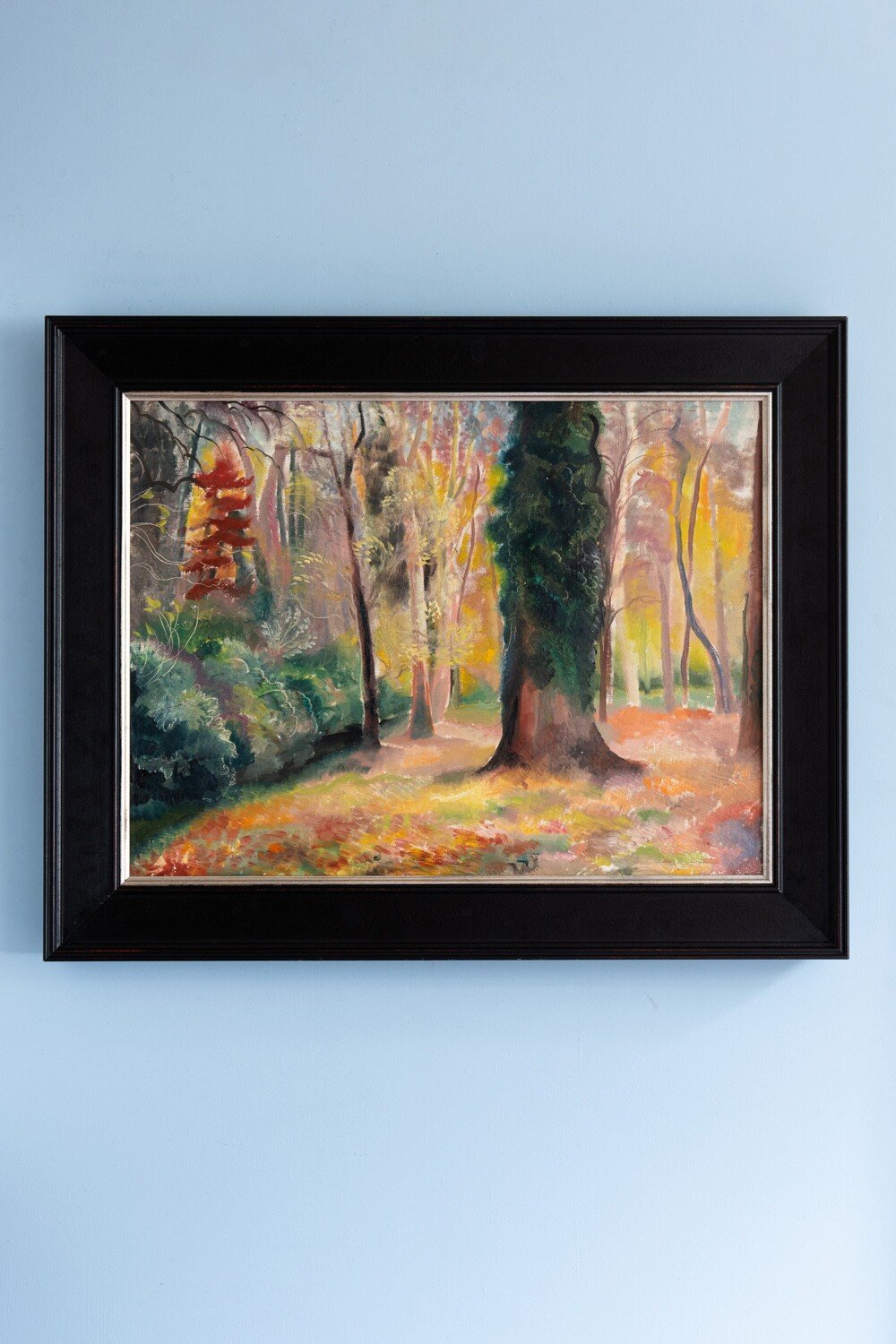
This 1930s oil painting on canvas by French artist and decorator Camille Roche (1894-1948) depicts a forest undergrowth, featuring a large tree covered in foliage, surrounded by slender trees and dense bushes. Its sumptuous palette of deep greens and reds contrasts with the softer yellows and pinks, capturing the rich variations of autumn colours. Painterly brushwork adds texture to the grass, foliage, and bushes, while the elongated shapes of the trees bring movement to the scene. Delicate lines are incised into the surface of the painting, introducing an additional layer of structure over hazy patches of colour. Roche employs a striking array of techniques to convey depth and texture, creating a poetic and immersive depiction of nature. Coming from the artist’s studio, this rare work is presented in a black and gold frame.
Camille Roche (1894-1948) was a French Art Deco artist and decorator renowned for his keen observations of nature and animals. A regular exhibitor at the Salon d’Automne, he created striking frescoes and painted decors for notable figures such as the writer Colette and Coco Chanel. In the 1930s, Roche frequently collaborated with his brother, renowned designer Serge Roche, contributing frescoes to various projects. His artistic range encompassed oil paintings, frescoes, screens, and glasswork, demonstrating his remarkable adaptability across different mediums
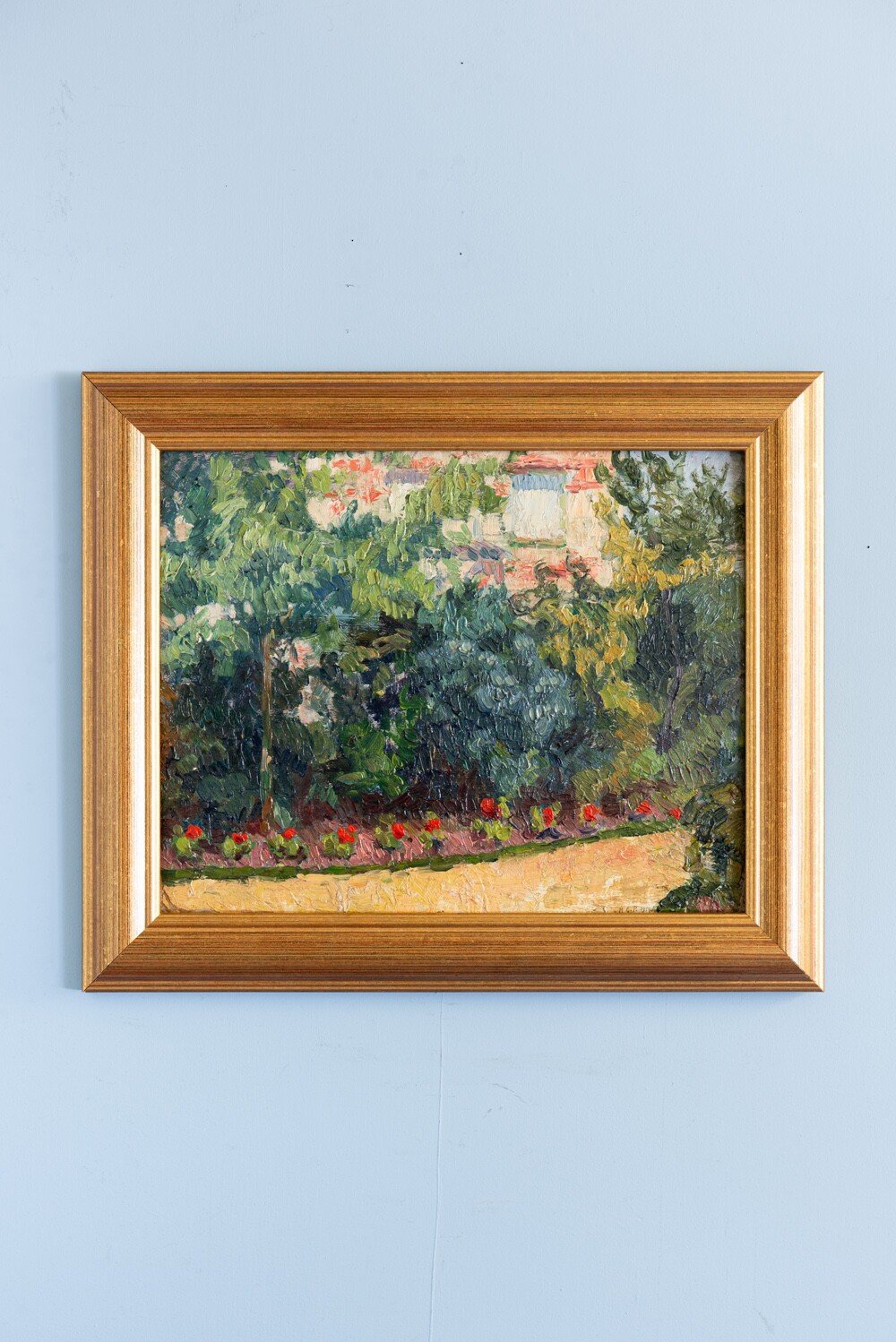
This early 20th-century oil painting on board by French artist Maurice-Georges Poncelet (1897-1978) depicts the patio in the artist’s garden located in the Parisian suburb of Chelles. A charming path, bordered by small red flowers, leads the viewer through abundant trees and lush bushes rendered in a harmonious camaïeu of greens. The architecture of a house, featuring typical French decorative brickwork in soft pink, is visible in the background, adding depth to the composition. Dynamic brushstrokes blend nature and architecture, adding movement to this serene scene. This vibrant artwork is signed and dated 1914 at the front, while the location noted at the back.


An early 20th-century oil painting on canvas by French artist Pierre Borgomano, depicting a tree in summer, its branches falling softly toward a path bordered by grass and shrubs beyond. The composition crops the top of the tree, placing the viewer beneath its lush foliage, while dynamic, pattern-like brushwork animates the movement of nature. The dark trunk stands against lush greens, with patches of light green and orange rendering the play of light through the leaves, and strong shadows against warm sunlight on the path conjure the stillness of a summer evening. Signed 'P. Borgomano' lower right. Presented in its original black moulded wood frame.
An evocative summer scene with an immersive composition and a lively rendering of light.