
Home / New in
New Arrivals
Explore our latest additions, from antique French faience to Dutch Delft, early 20th-century paintings, and French provincial furniture. Curated for their individuality, craftsmanship and aesthetic presence.
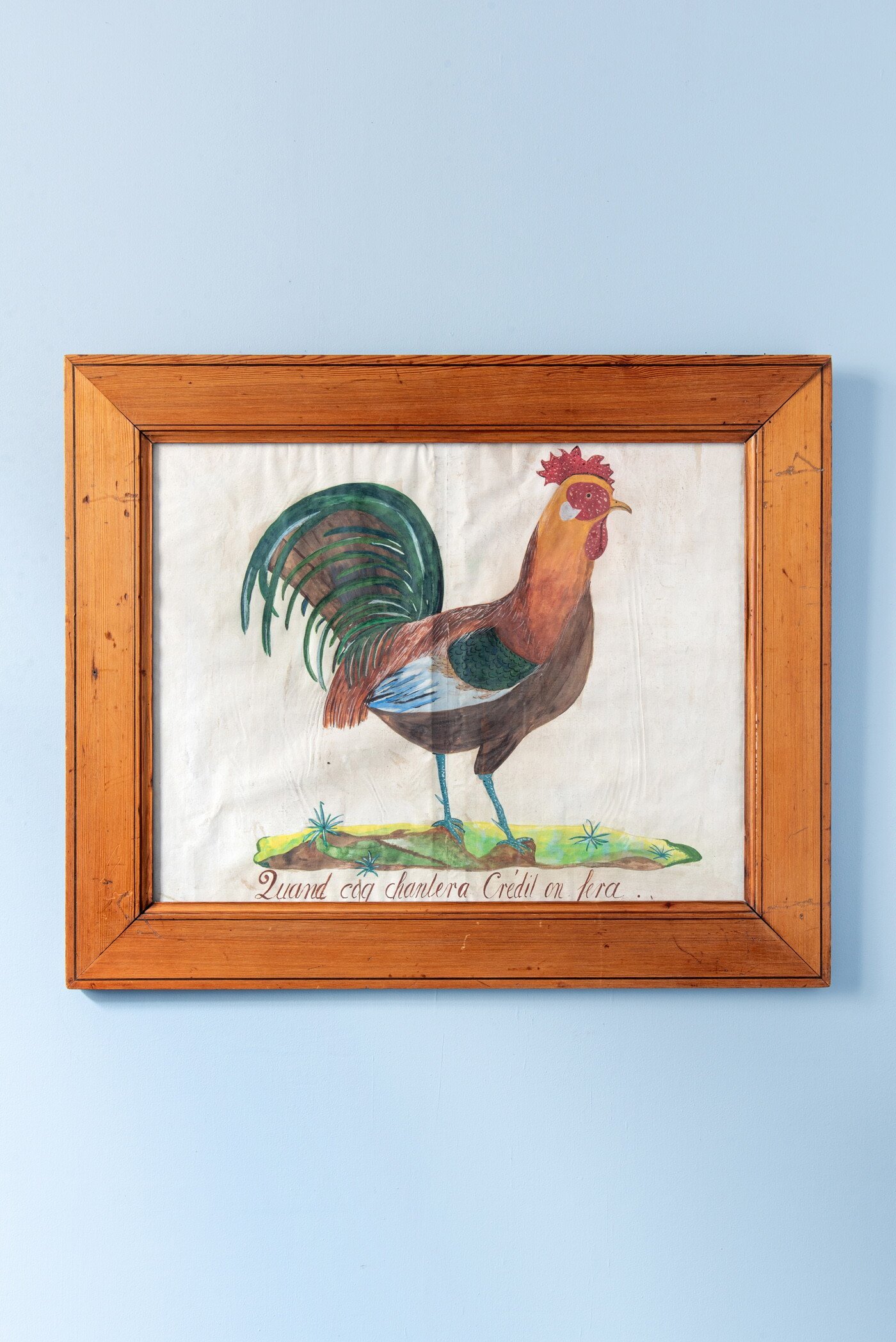
A 19th-century French gouache on paper, depicting a rooster with the words 'Credit will be given when the rooster crows' ('Quand le coq chantera, crédit on fera'), a motto in French popular culture that was written alongside depictions of roosters and hung in cafés and shops as a humorous way to deter customers from asking for credit. The rooster is rendered in bright colours on a textured off-white background, the green and blue of its sickle and wing feathers set against its red comb and brown body. It stands on a ridge in brown, red and yellow, surrounded by shrubs, just above the motto rendered in elegant lettering.
A captivating level of detail sets this work apart from other folk depictions of roosters, with fine white strokes, dots and dark green patterns on the wing adding depth and texture, while long painterly brushwork accentuates the curves of the feathers. It is painted on two sheets, glazed in its original pitch pine frame.
A rare French folk work, with attention to colour and detail.
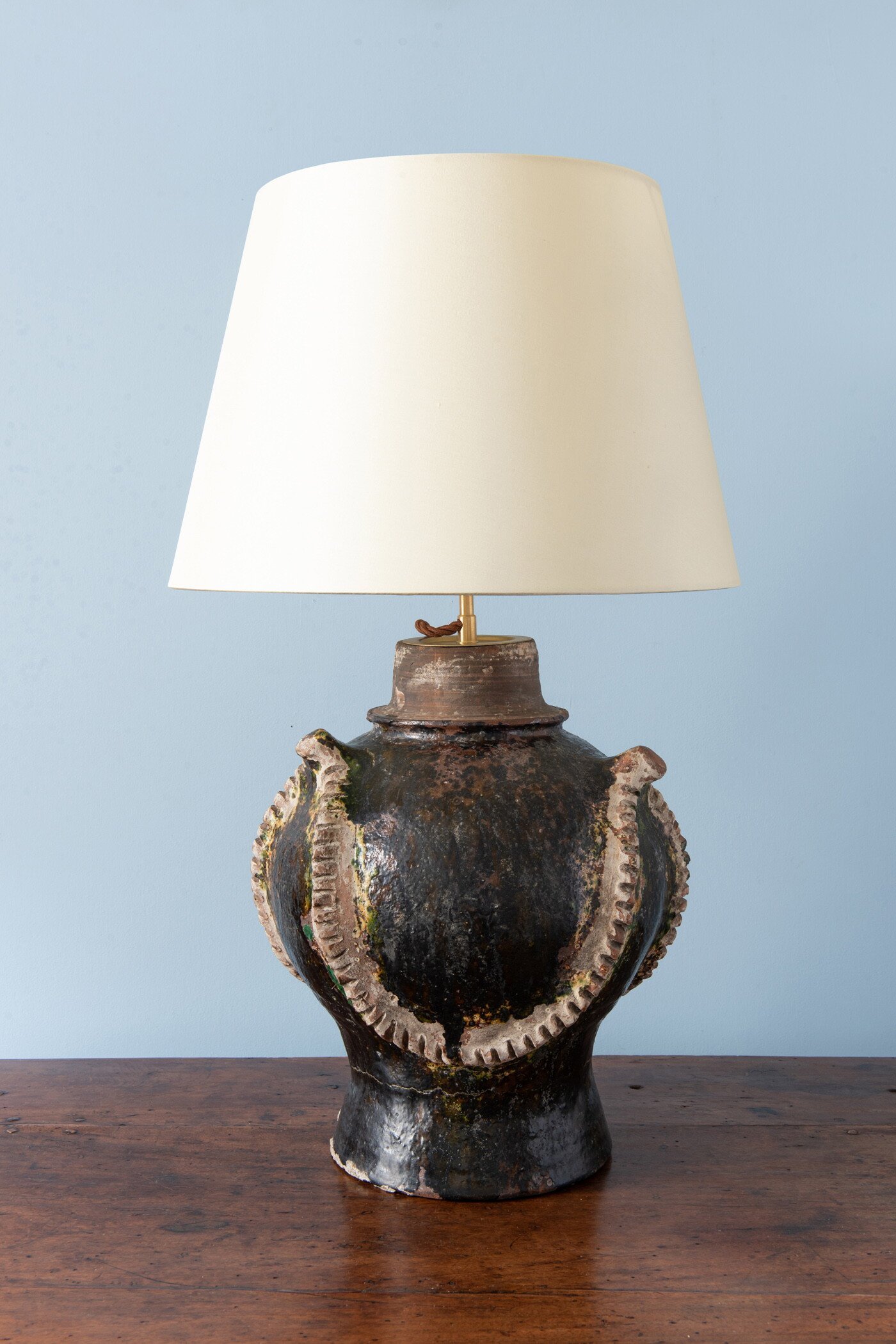
A 17th-century French glazed earthenware roof finial from Sauxemesnil, converted to a table lamp, featuring an elegant baluster shape decorated with swagged ribbons hanging all around. This finial bears the characteristic brown glaze of Sauxemesnil, showcasing oxidised hues of yellow and green, a captivating patina caused by the elements. Weathering has caused the glaze on the ribbons to run off, creating a striking contrast between the exposed clay and the dark ground.
Sauxemesnil, in the Cotentin peninsula, was renowned for producing roof finials with elaborate folk decoration, made of up to five stacked spherical shapes. Placed at the extremity of a roof, they protected it from water damage, added decorative interest to the house and asserted the social status of its owner.
A rare folk ceramic table lamp, of generous proportions and striking decorative presence.
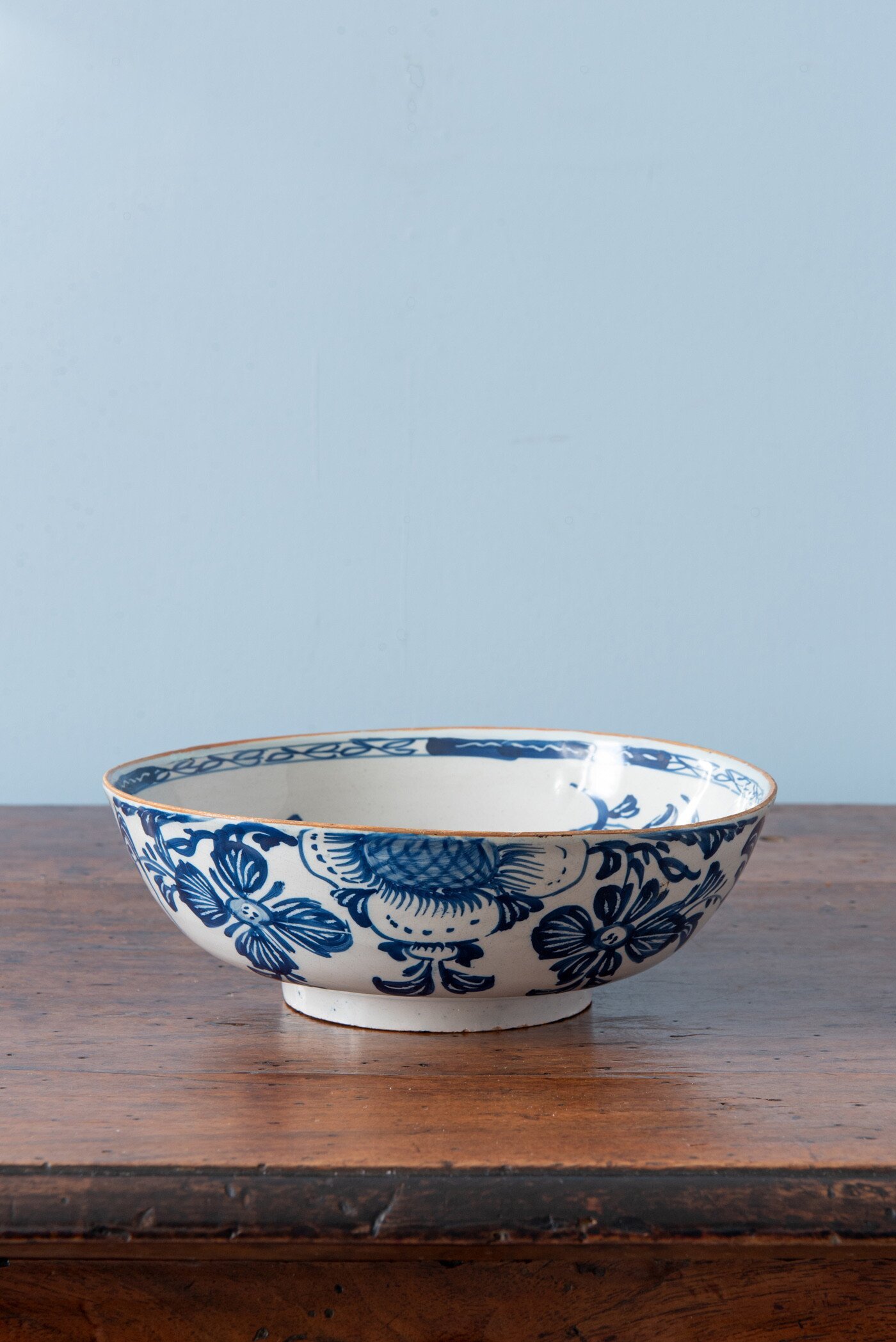
An 18th-century English Delft bowl, possibly Lambeth, decorated in blue and white with large blooming flowers and trailing foliage on the outer body. The inside of the bowl features sprays of flowers and foliage, finished by a frieze of geometric patterns and an orange line on the rim. Painterly, loose brushwork adds a graceful movement, while the deep blue tones and orange lines create a bright contrast with the off-white ground. The bowl has a refined round shape, with tall walls on a small foot.
A rare floral bowl, unrestored and in excellent condition.
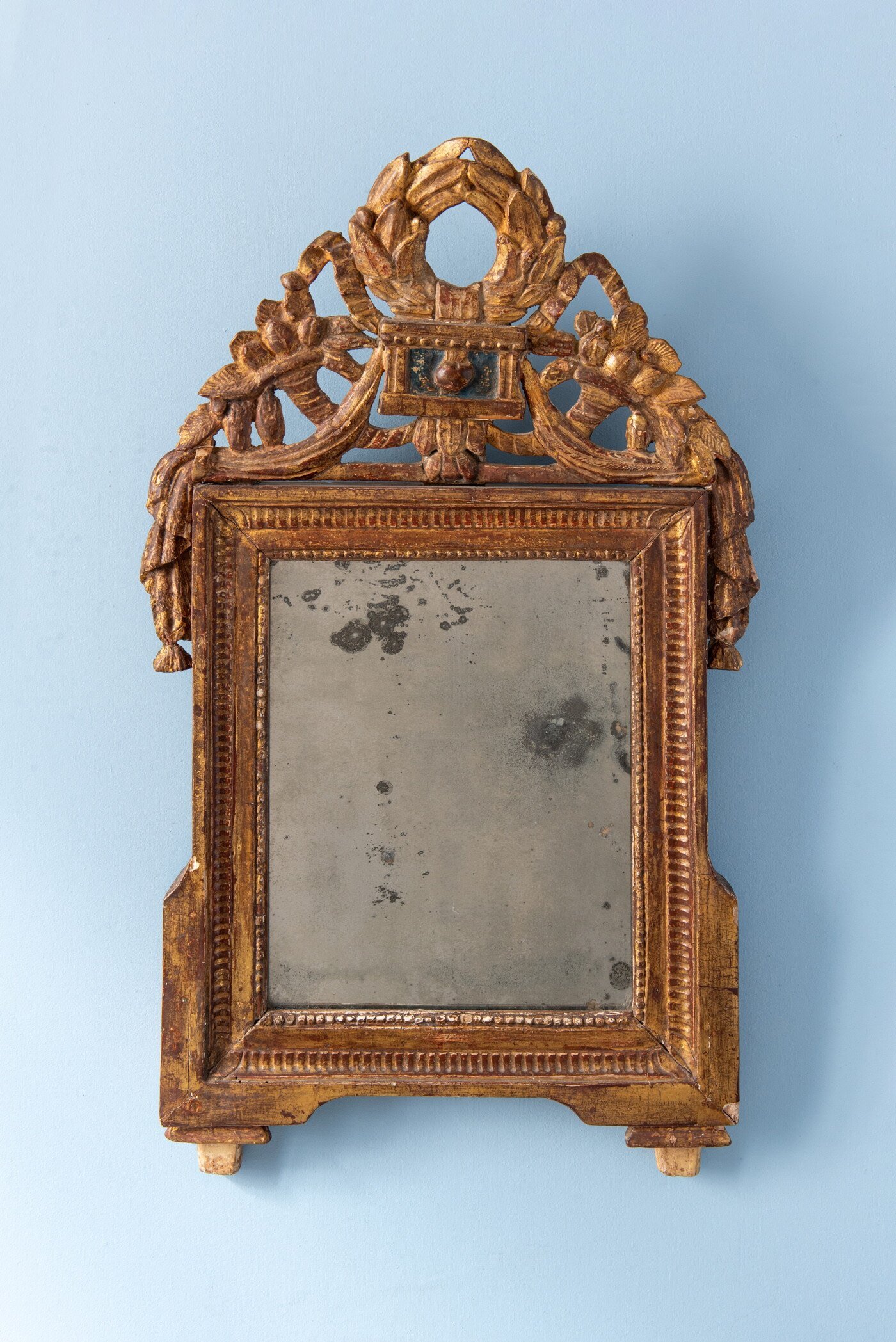
A late 18th-century French giltwood mirror in the Louis XVI style, decorated with a striking crest of cornucopias and ribbons, topped by a laurel wreath and flanked on either side by drapes. At the centre, a rectangular reserve holds a flaming heart in red against a blue background. The rectangular fluted cove frame features an elegant frieze of beads. Lively details and compelling carving animate the leaves of the cornucopias, heart and drapes. The giltwood surface bears a warm patina, revealing the red bole underneath, while the original mirror plate retains its authentic foxing.
A medium-sized mirror with balanced proportions and refined provincial carving.
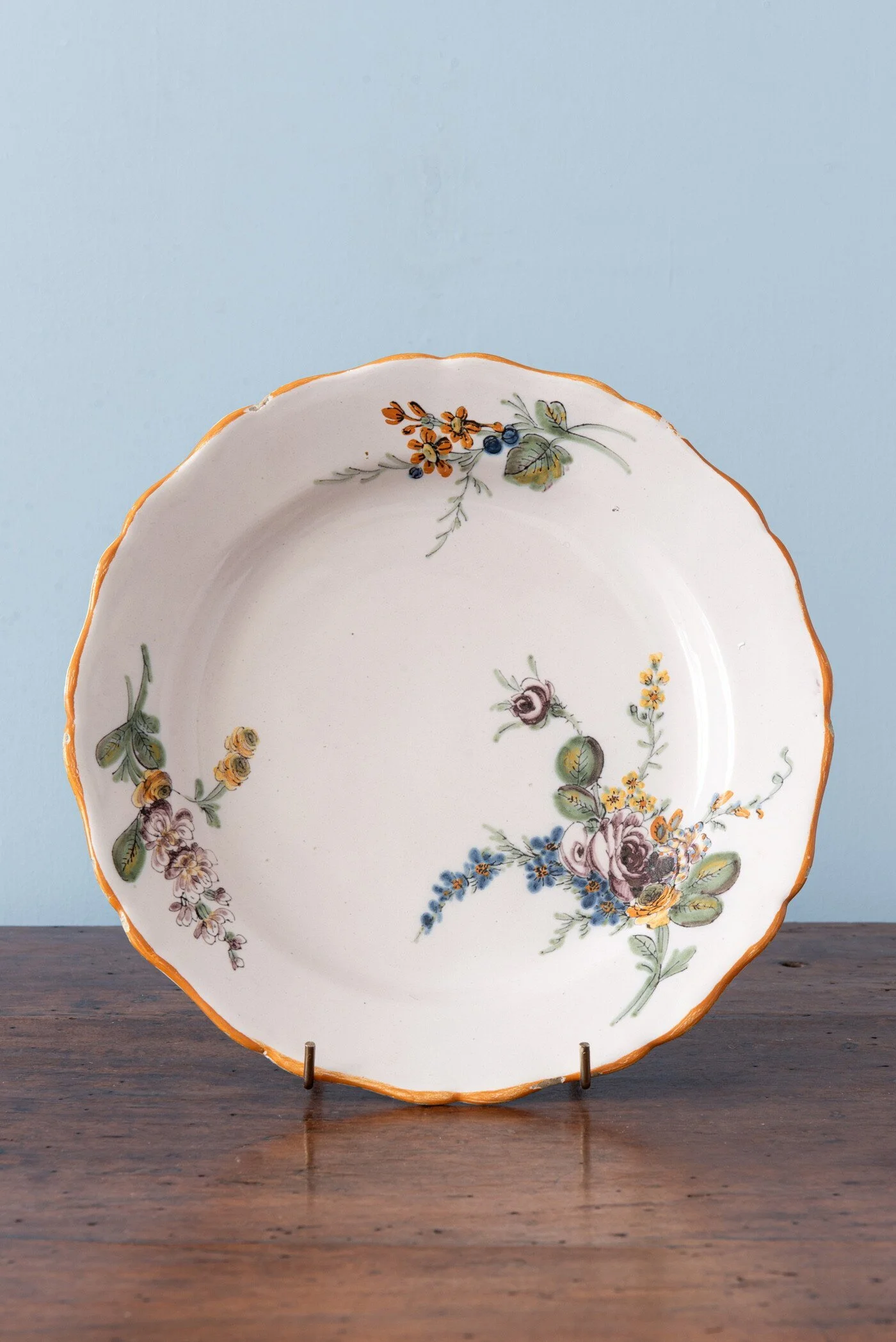
A mid-18th-century French faience plate from Marseille, c. 1760, decorated with a bouquet of roses in manganese and yellow, surrounded by wild flowers and foliage. The edge is delicately shaped and highlighted by an orange line, while the lip is decorated with sprays of wildflowers and foliage. The blooming flowers are rendered in exquisite, naturalistic detail, adding botanical interest. Vibrant colours and soft brushwork create an elegant painterly effect, while the off-centre placement of the main bouquet introduces movement, the remaining flowers scattered gracefully across the lip.
The manganese rose decor was invented in Marseille by Joseph II Fauchier in the mid-18th century, its scattered florals in refined colours gaining particular popularity in the South of France.
A rare Marseille faience plate, in very good condition and unrestored.
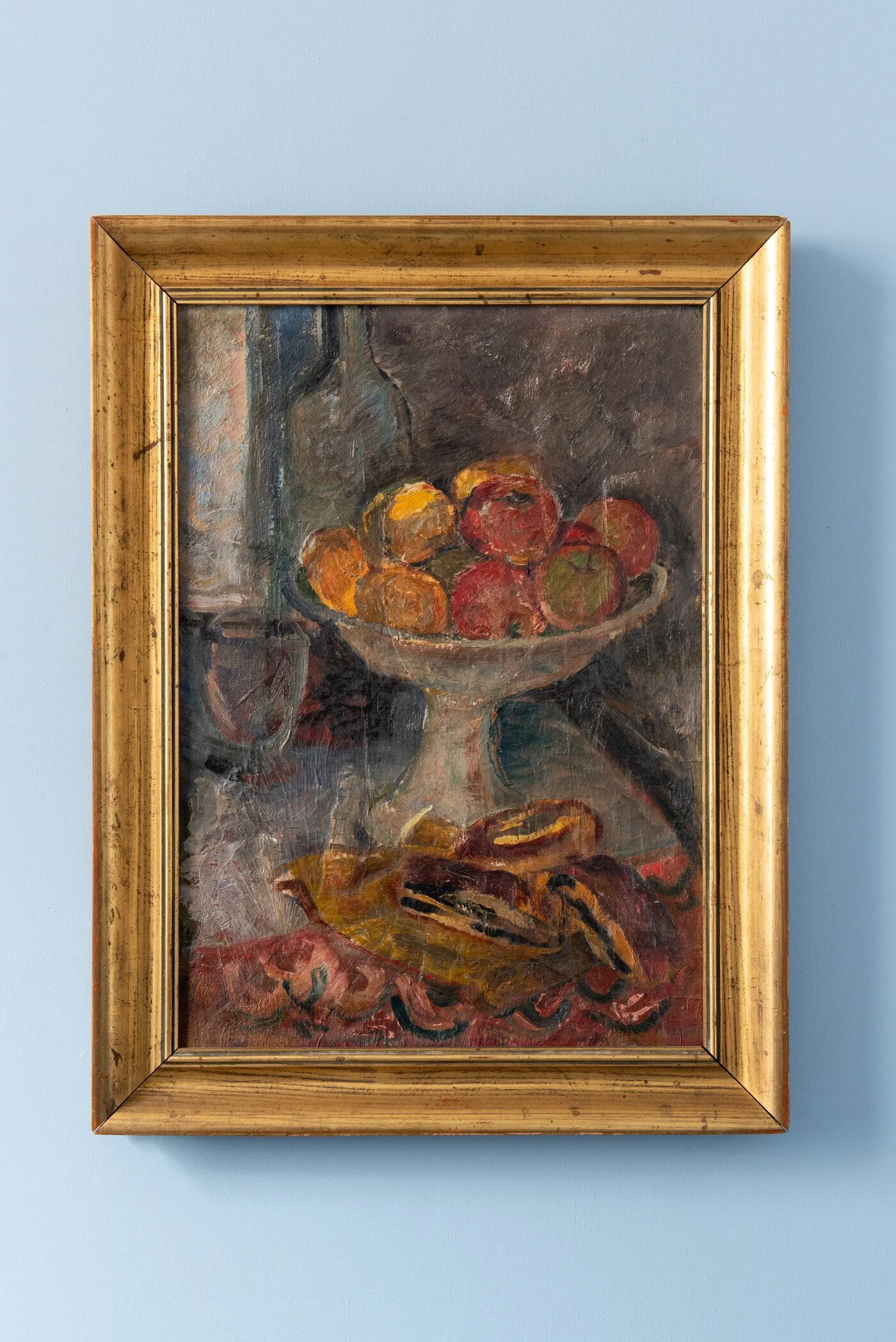
An early 20th-century French oil painting on canvas, depicting a still life of fruits in a compotier, with a wine glass and bottle beyond and game on a cloth in the foreground. The composition is set in a warm palette of red, orange and brown against a cool grey background. Dynamic, considered brushwork animates the scene, amplifying the materiality of the fruits and lending texture to their surroundings. The pattern of the draped cloths introduces a fluid movement, while the bottle and glass anchor the composition vertically. With its elegant wide bowl and stemmed base, the compotier is a recurring motif in modern still life, its refined shape set in charming contrast with the everyday character of the bread, fruit and glassware.
Presented in a period giltwood frame, a characterful modern still life with considered colour.
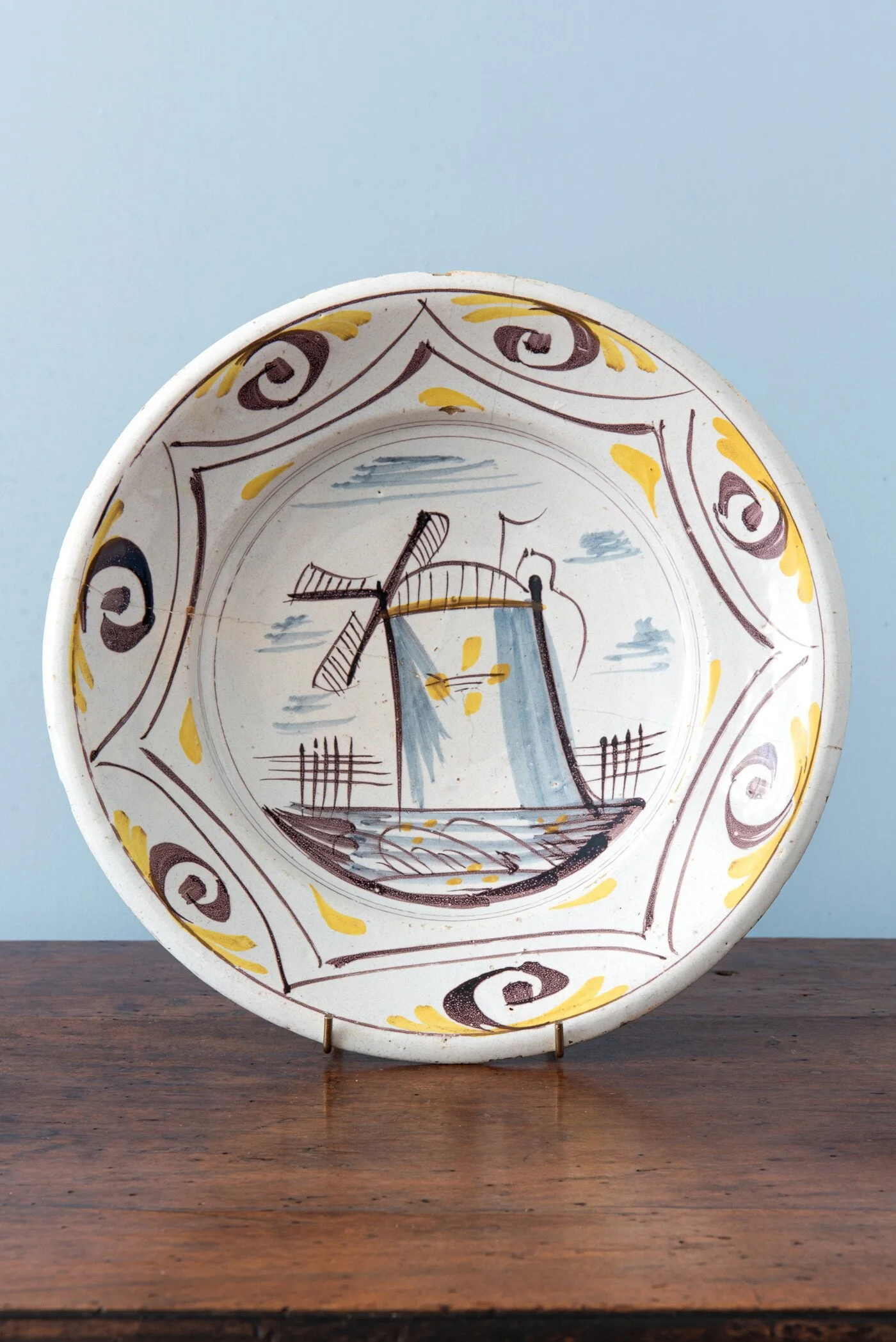
An 18th-century Dutch Delft dish, decorated with a windmill in a landscape, surrounded by country fences under a cloudy sky in blue, yellow and manganese. The lip is adorned with a patterned frieze of scrolls and sprays of foliage. Bold brushwork is paired with vibrant colour to create dynamic movement while characterful architectural details in the windmill lend an evocative quality to the scene. The underside features a darker ivory glaze.
A Delft country dish with a lively sense of pattern.
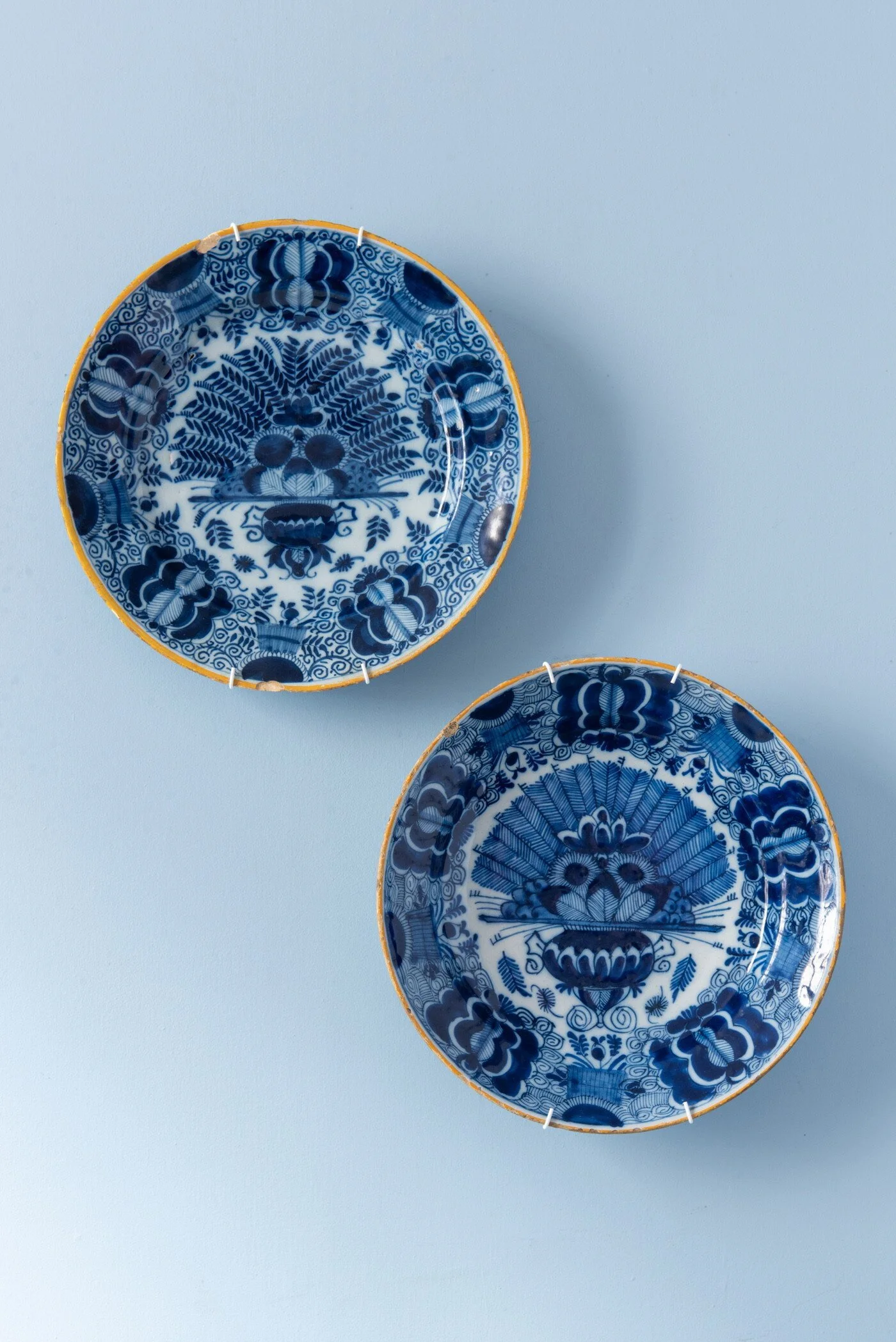
A rare pair of 18th-century Dutch Delft plates, decorated with a luxurious peacock pattern in blue and white, featuring a cup overflowing with feathers, flowers, and foliage. The lip is adorned with an ornate frieze of scrolls and similar motifs, while a yellow line elegantly accents the edge. Marked to the underside for the De Klaauw factory.
A sought-after pair of Delft plates with a rich, intricate design.
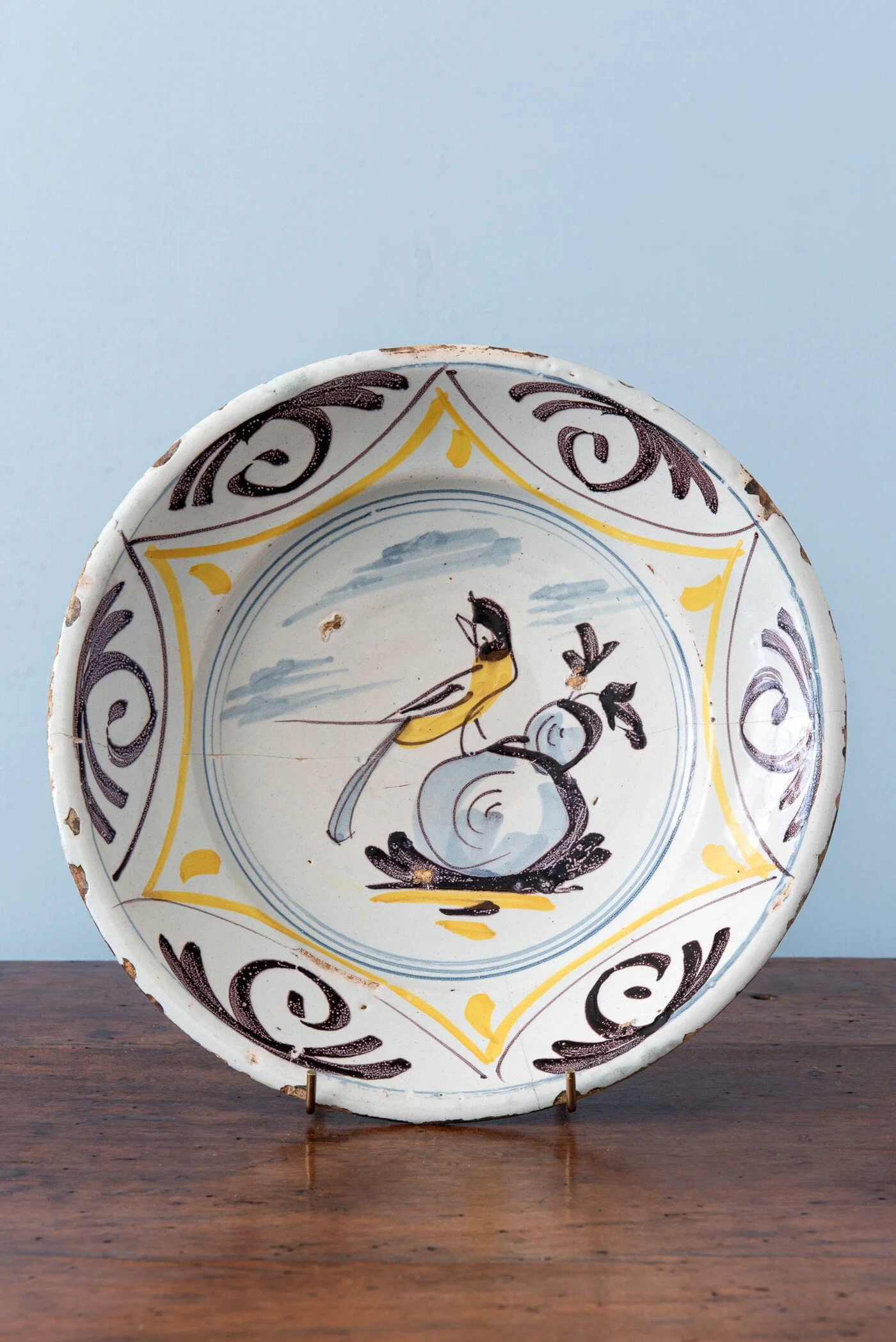
An 18th-century Dutch Delft dish, decorated with a bird perched on rocks, surrounded by shrubs under a cloudy sky in blue, yellow and manganese. The lip is adorned with a patterned frieze of scrolls and sprays of foliage. Bold brushwork is paired with vibrant colour to create dynamic movement, while characterful details in the rendering of the bird and rocks lend a folk quality to the scene. The underside features a darker ivory glaze.
A Delft country dish with a lively sense of pattern.
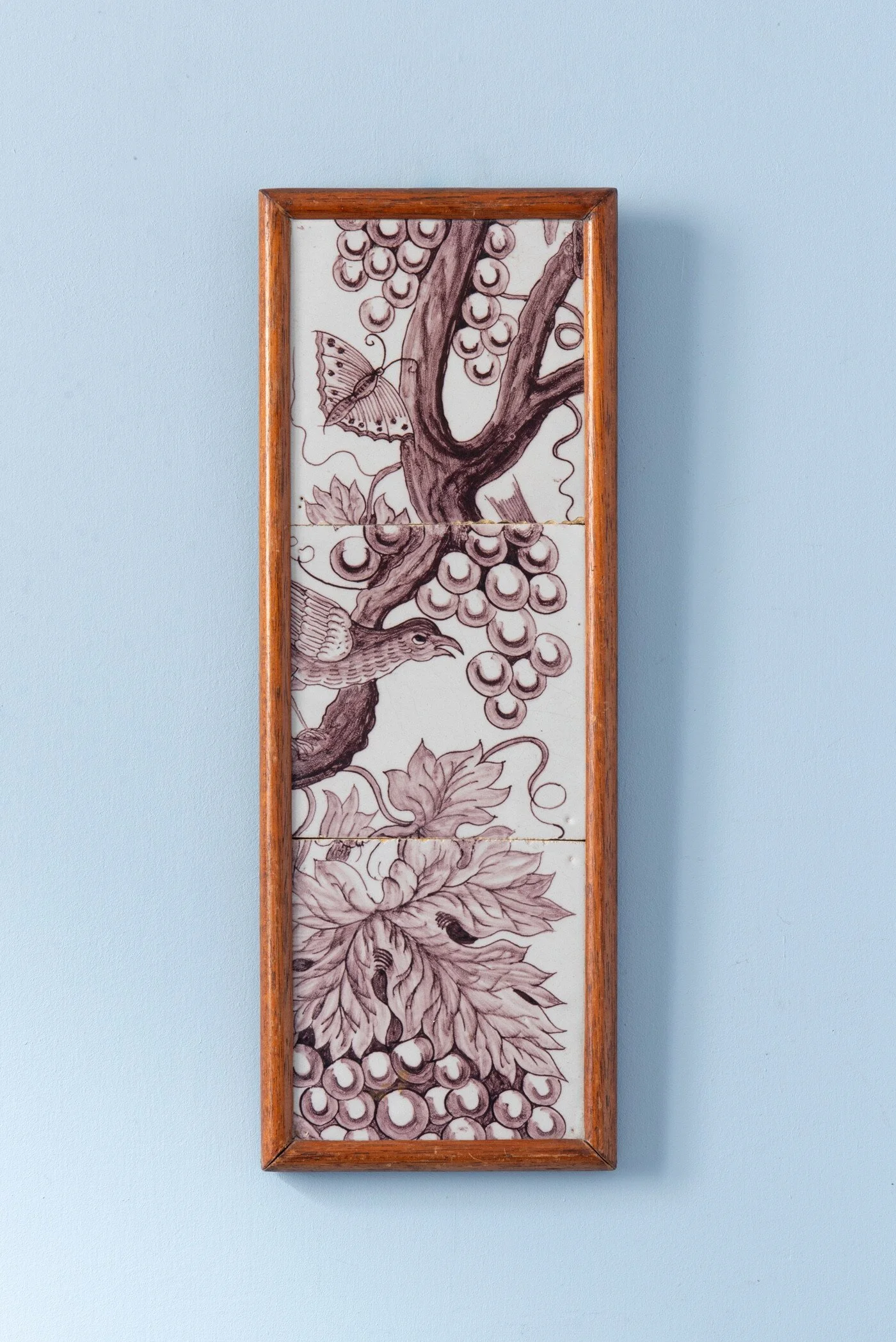
An 18th-century Dutch Delft tile mural, depicting a bird among grapevines, surrounded by foliage, grapes and a butterfly. Possibly part of a larger mural, the fragmentary nature of the composition adds dynamism, with the body of the bird and some of the grapes cropped by the tiles, playing with the vertical format. Characterful details and curving forms, from the large, perfectly round grapes to the detailed leaves and butterfly, add movement to the rectangular composition. Painted in an elegant camaïeu of manganese, the transparency of the brushwork adding relief to the scene.
A characterful mural, mounted in a stained wood frame, in excellent condition.
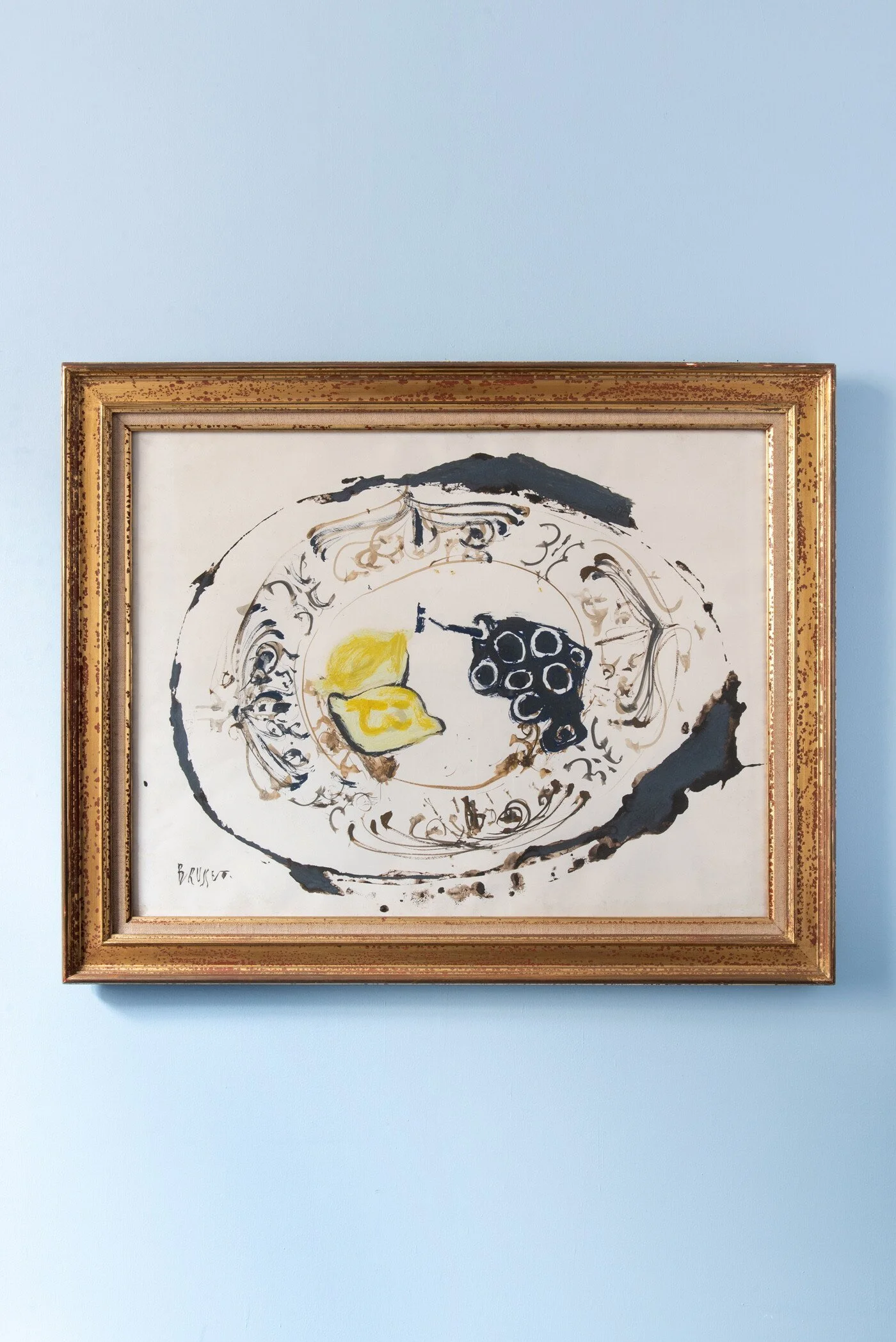
A French midcentury gouache and ink on paper, depicting a still life of two lemons and a bunch of grapes on an ornate dish. Lively brushmarks highlight the elegant scrollwork on the lip of the plate, contrasting with the organic shapes of the lemons and grapes, while a bold painterly line surrounds the plate, adding depth. The deep black of the ink is set against the colourful yellow of the lemons and the white of the paper, lending a dynamic, graphic quality to the artwork. Signed lower left, glazed in a giltwood frame with a fabric slip.
A dynamic still life with captivating movement.
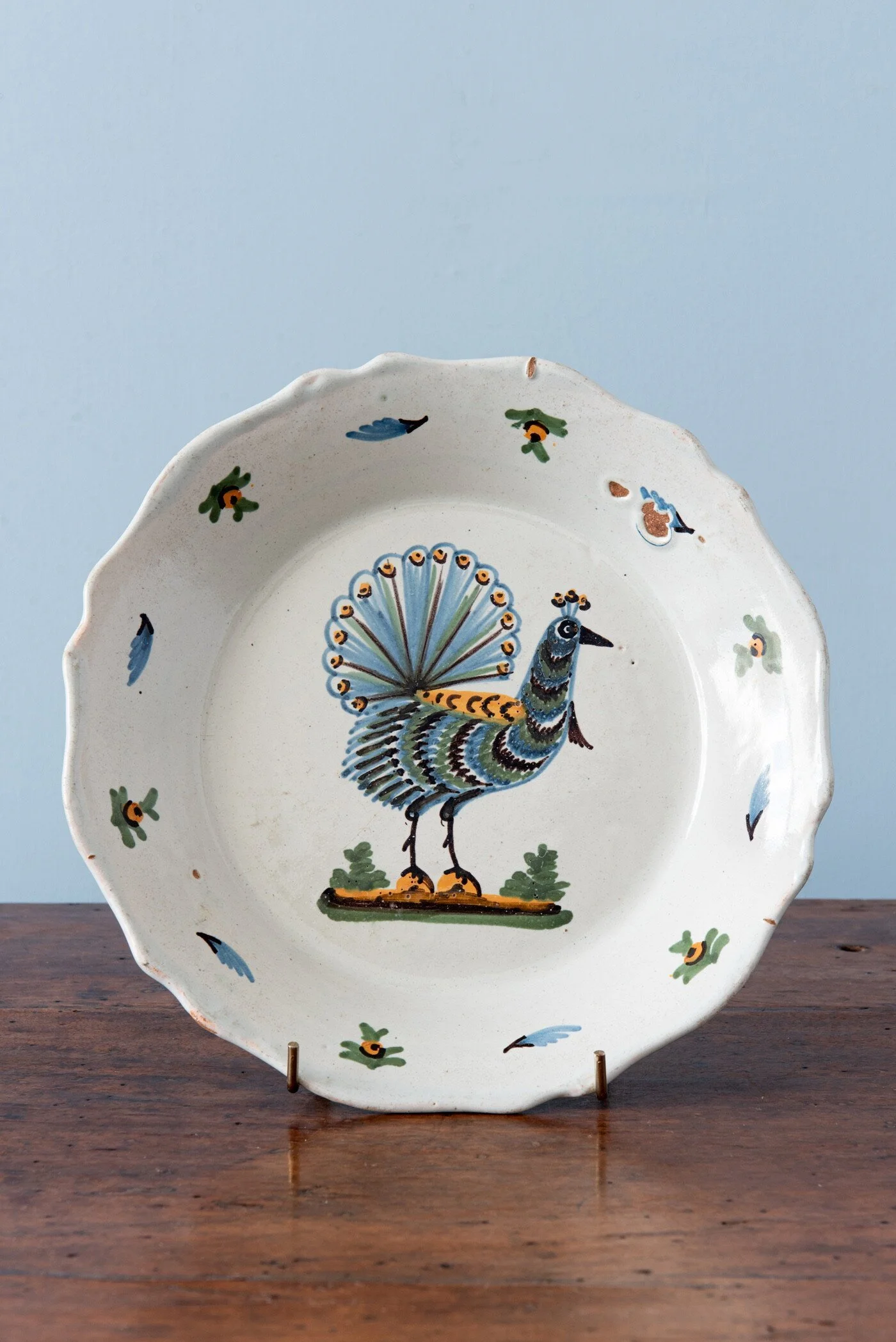
A late 18th-century French faience plate from Nevers, decorated with a peacock surrounded by small shrubs, in a vibrant palette of blue, green, yellow and manganese. The edge is delicately shaped, the lip featuring small floral ornaments. The feathers of the peacock are rendered in fine, pattern-like brushwork, the colourful fullness of the detail contrasting with the off-white ground, while characterful touches, from the beak and small feathers to the peacock's expression, lend the piece provincial charm.
A rare, charming Nevers plate, in very good condition and unrestored.
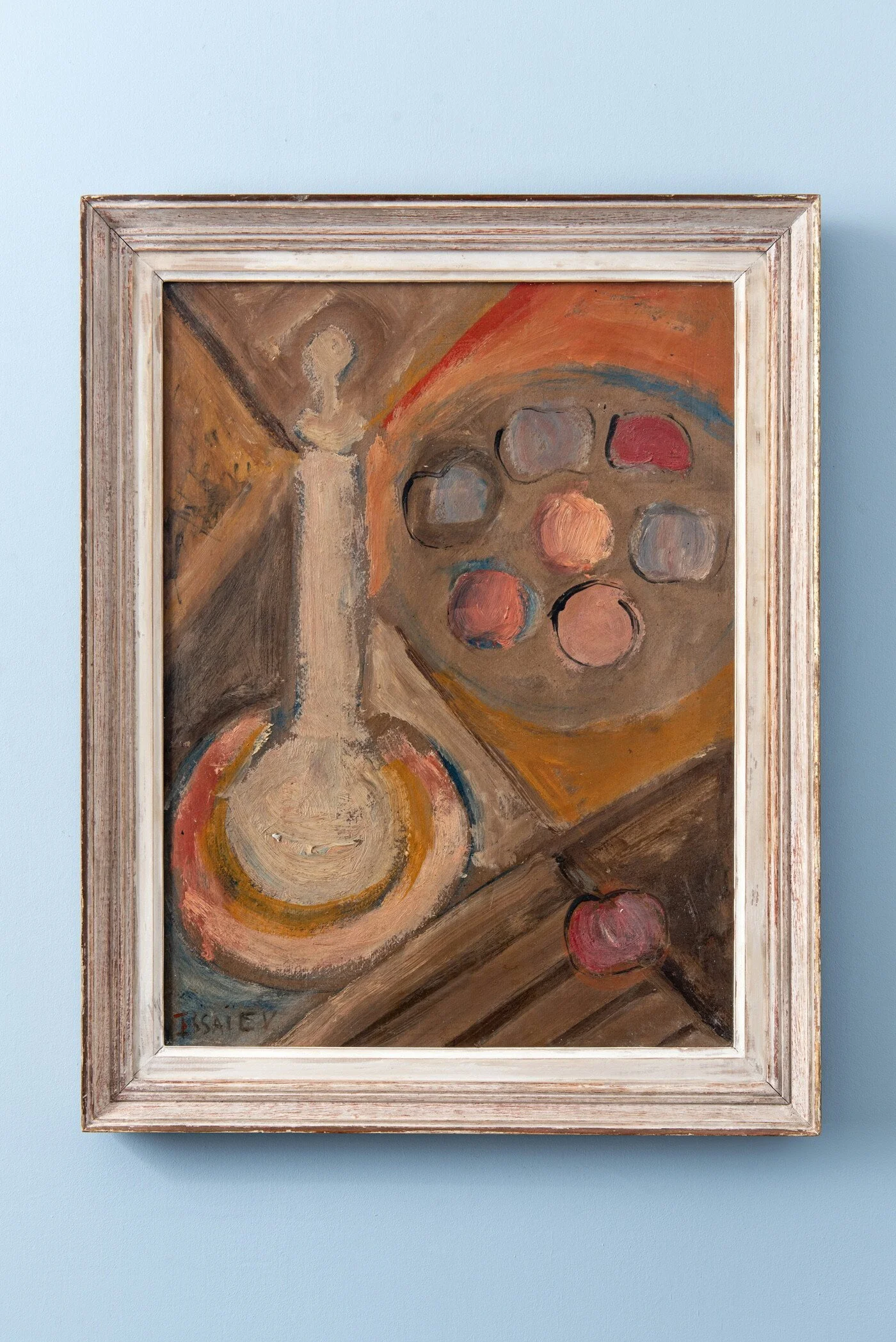
A midcentury gouache and oil on board by French-Russian artist Nikolai Issaiev (Odessa, 1891 – Ivry, 1977), depicting a still life of fruits in a bowl with an elongated bottle in the foreground, on a checked background. An earthy palette of purple, pink and grey is set against bright highlights of red, orange and blue, expressive brushwork creating layered, painterly textures where dry brush marks alternate with flat patches of colour. Strong diagonal lines and circles lend the composition a geometric sense of abstraction, while dark outlines and touches of white add volume, amplifying the organic shapes of the fruit and the striking form of the bottle.
Born in Odessa in 1891, Nikolai Issaiev graduated from the Odessa School of Arts and moved to Belgrade in 1919, working as a theatre decorator and holding his first solo exhibition in 1924. In 1925 he settled in Paris, working in Montparnasse and exhibiting alongside Natalia Goncharova and Ossip Zadkine, and showed at the Salon d'Automne, the Salon des Indépendants and the Salon des Tuileries, alongside solo exhibitions in Belgium and Serbia. From the late 1950s, he exhibited in galleries in Paris and New York and took part in a major exhibition of Russian artists of the School of Paris. Focusing on still lifes and landscapes, his work combines geometric forms on the verge of abstraction with an earthy, colourful palette.
Signed 'Issaev' lower left, glazed and mounted in a period grey and red wood frame. A colourful modernist still life, its characterful elements rendered with a strong sense of geometry.
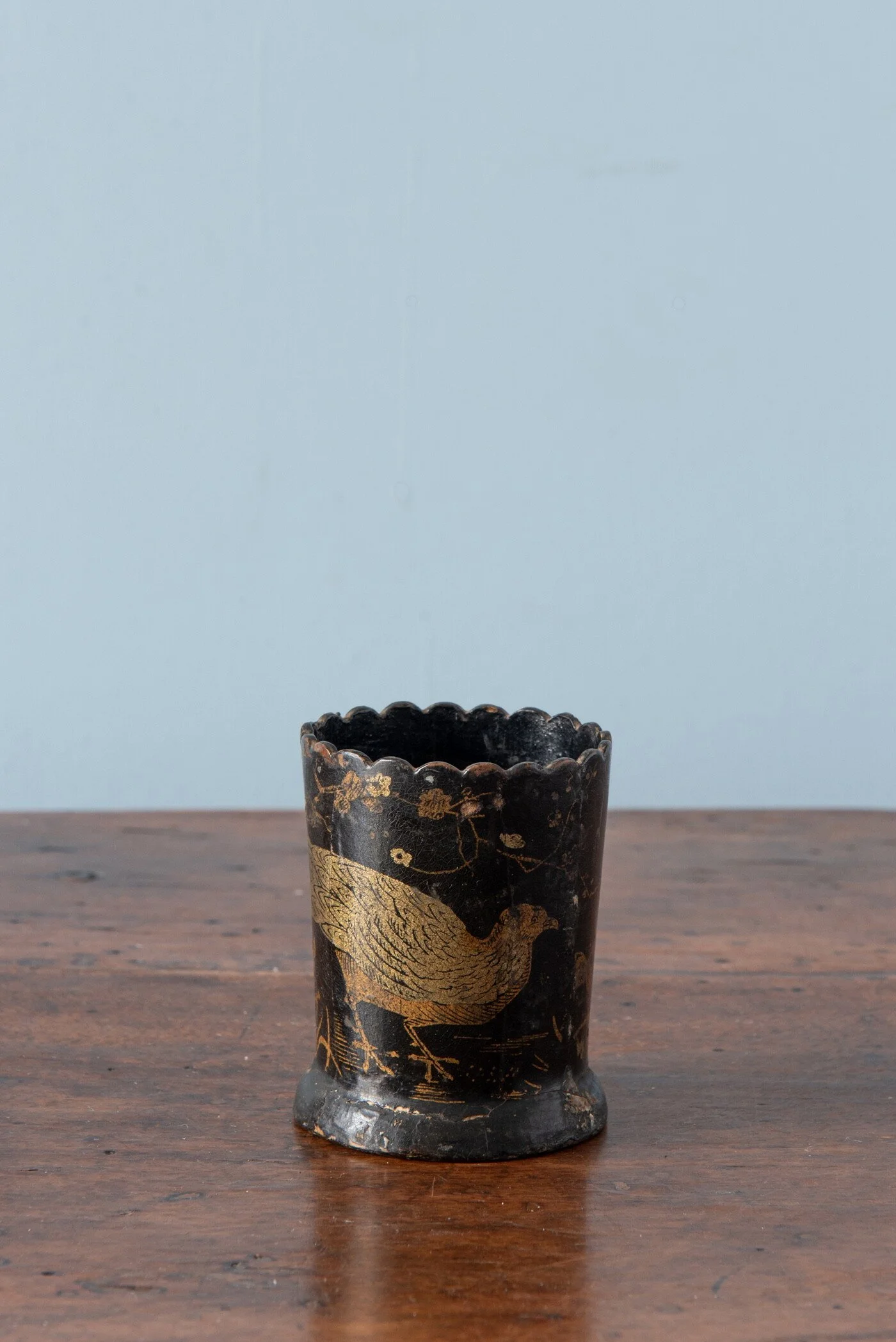
A mid-19th-century French papier-mâché pencil holder in the Napoleon III style, decorated in gold with a partridge and butterfly among grasses and flowering branches before a lake, on a black ground. With a charming petite size, the piece has a wide base and a delicately scalloped top edge. Refined details, from the partridge's feathers to the layering of grasses and shrubs, lend interest throughout, the typical Napoleon III palette of black and gold elegantly combined with the handmade texture of papier-mâché.
An elegant decorative piece with functional charm.
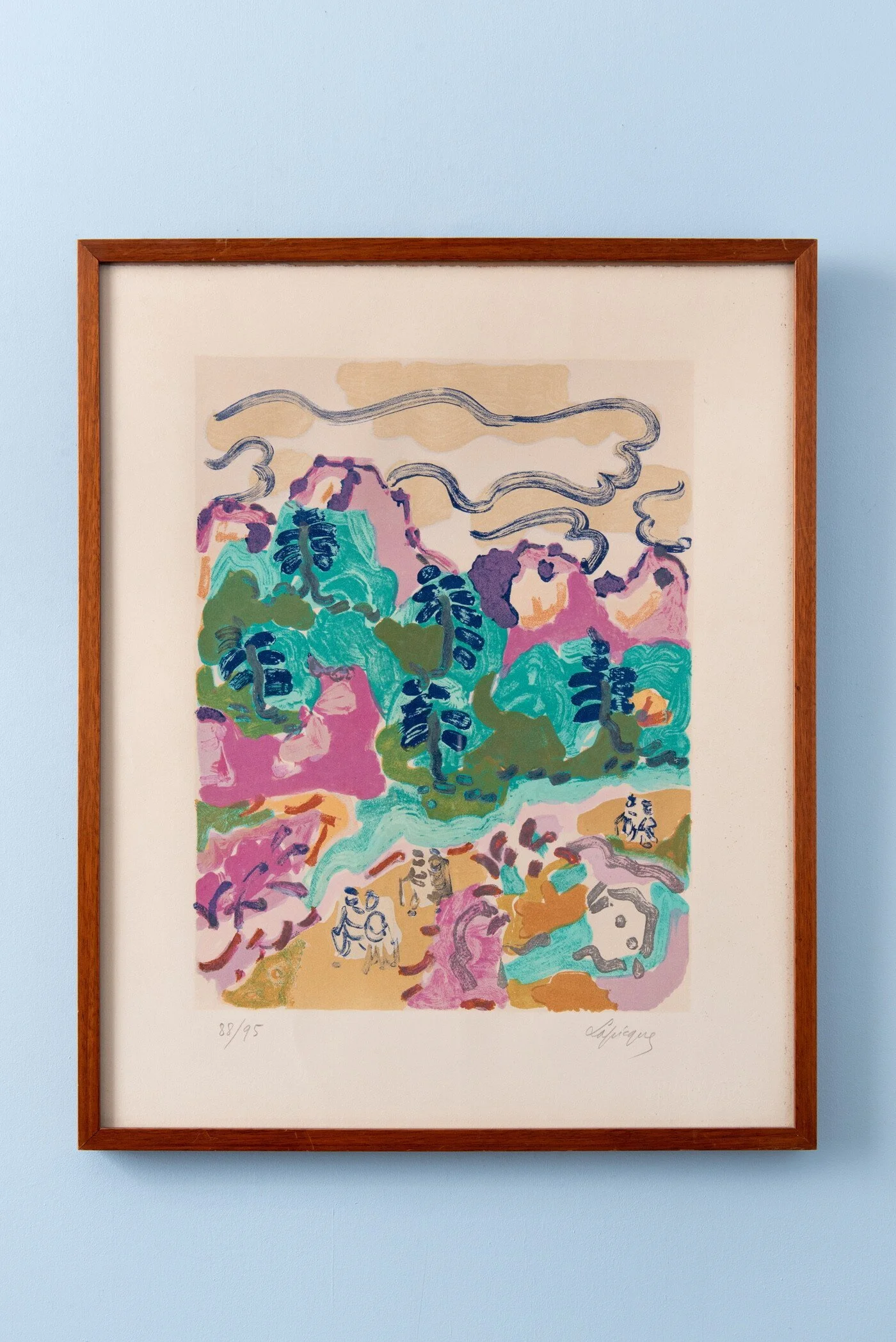
A midcentury lithograph on paper by French painter and printmaker Charles Lapicque (1898-1988), depicting figures walking down a path through a lush forest beneath a cloudy sky. A contrasting palette of pink, blue, green and sand creates a bright atmosphere, patches of colour alternating with expressive brushwork to a joyous, pattern-like effect that lends the scene a sense of abstraction. Characterful details add lightness throughout, from the figures walking in pairs to the lush rendering of the forest and the squiggly shape of the clouds. Numbered 88/95 lower left and signed 'Lapicque' lower right. Glazed in a stained wood frame.
A characterful lithograph with bright colour and painterly shapes.
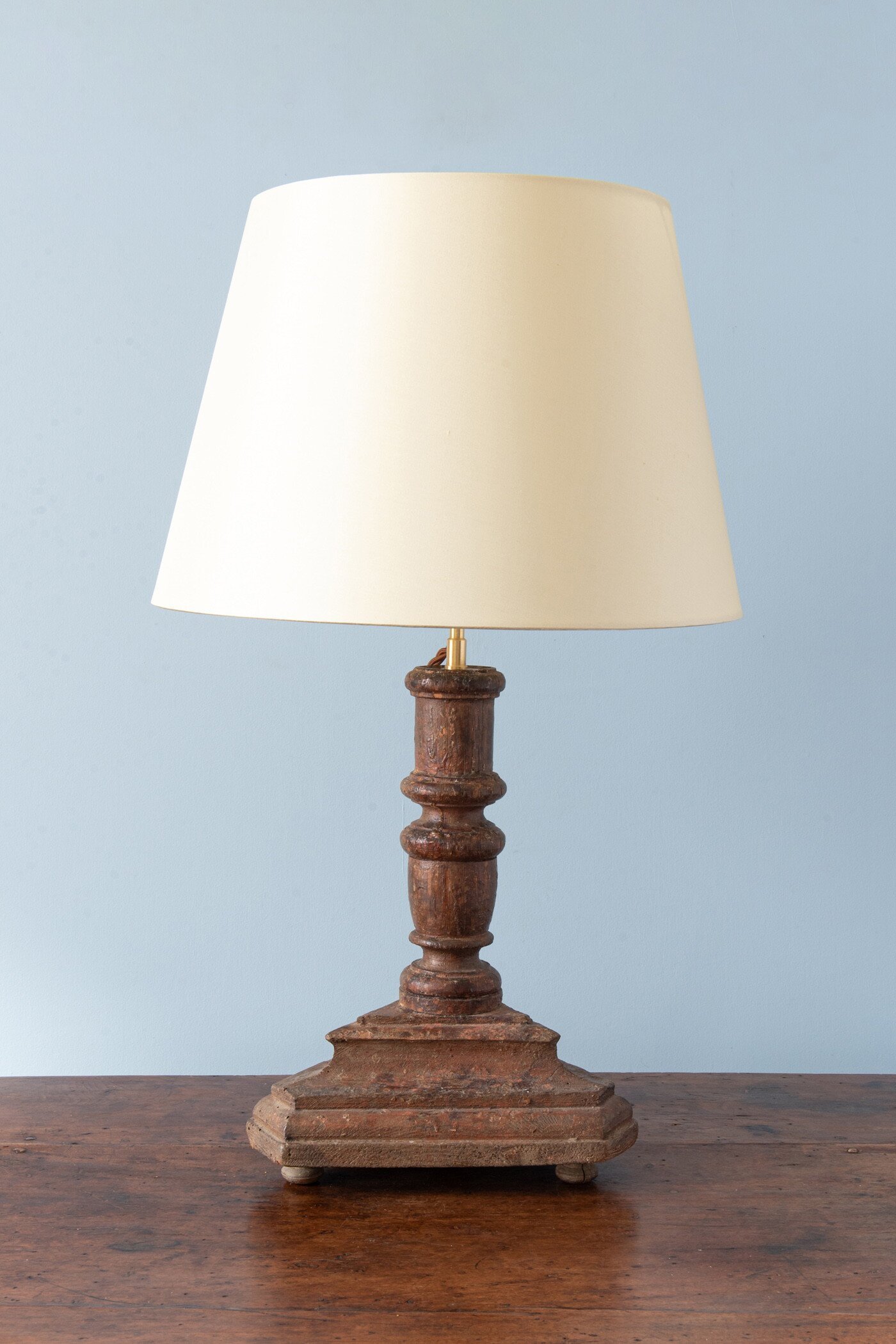
An 18th-century French fir wood candlestick of provincial origin, converted to a table lamp. The turned wood column stands on a wide triangular base, raised on three, likely later, feet. The stained wood surface has a warm patina, with distinctive wax stains and marks.
A textured table lamp with elegant architectural form.
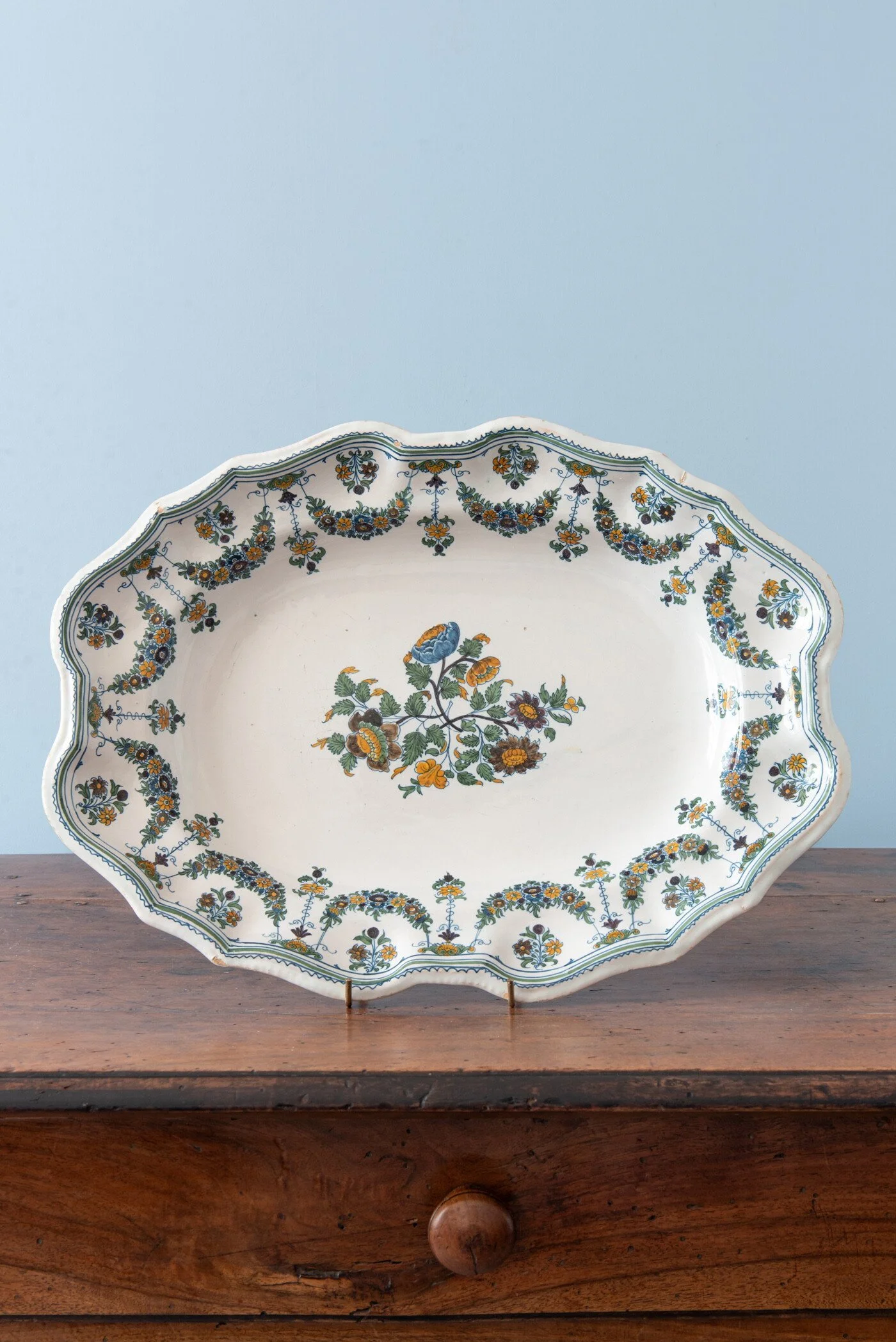
An 18th-century French faience oval dish from Moustiers, c. 1750, decorated in the centre with elegant sprays of nightshade surrounded by foliage, in a vibrant polychromy of manganese, orange, green and blue. The lip carries an abundant frieze of garlands and small flower sprays, alternating with trailing blooms cascading from scrolling ornaments. The larger central blooms allow for lush colour and refined naturalistic detail, adding botanical interest, set against the finer work of the border. The edge is delicately shaped, finished with several green bands and a scalloped line, the dish generously scaled with an oval, shallow form.
Floral decoration of this kind was introduced at Moustiers by Joseph Olerys from 1738, drawing on nightshades, potato flowers and Mediterranean plants, typically in a loose, centred composition with fuller sprays or garlands to the lip, rendered in bright colour.
A rare faience dish with exquisite botanical decoration, unrestored and in very good condition.
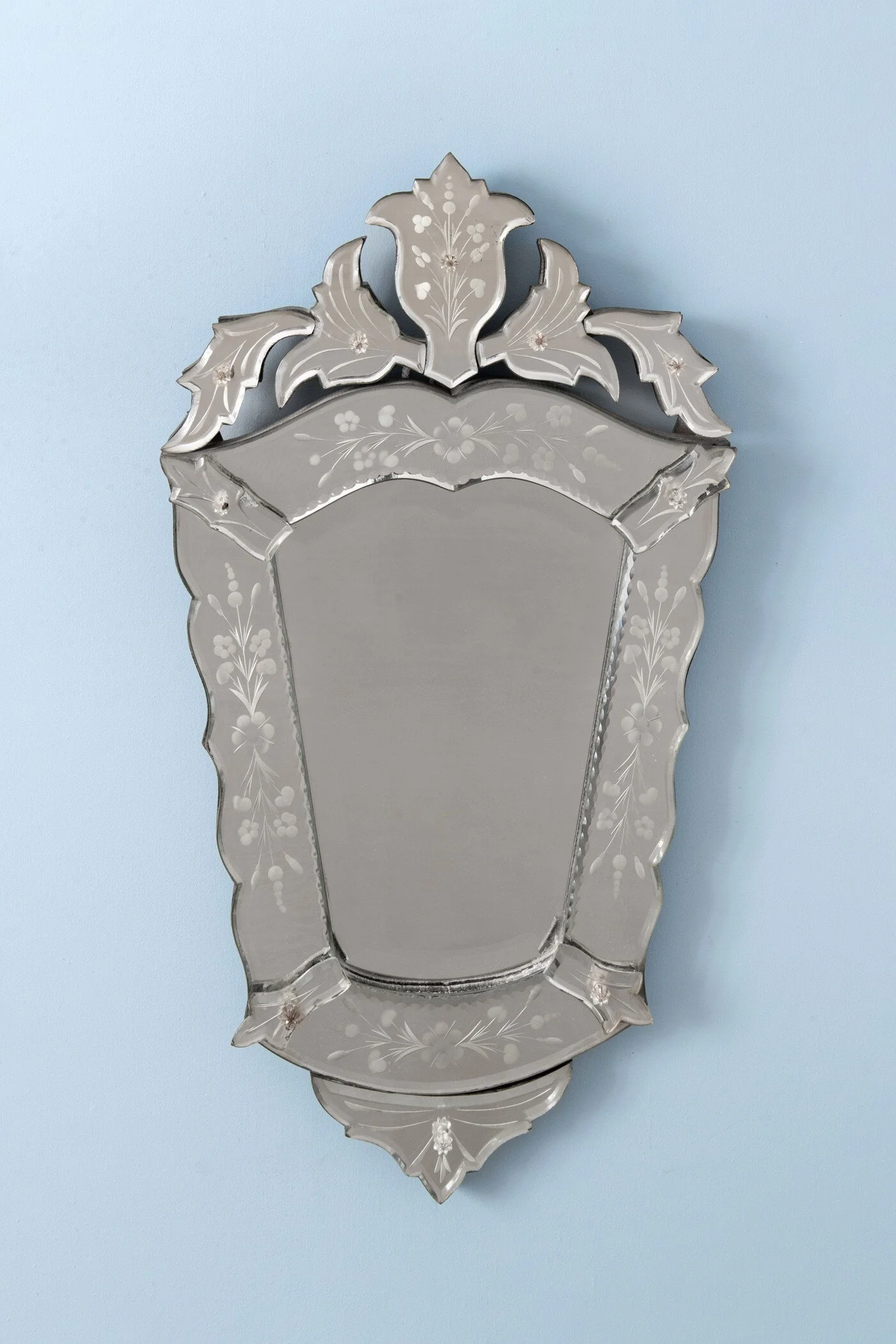
An early 20th-century Venetian mirror of tapered shape. The bevelled mirror plate is surrounded by a shaped mirrored frame, finished with four foliate elements to the corners and topped by an openwork crest of five foliate scrolls, ending with a shaped finial at the bottom. It is decorated throughout with etched flowers and foliage, as well as fluted glass beads, and finished with an ebonised backing.
A highly decorative mirror, its striking shape combined with delicate florals.
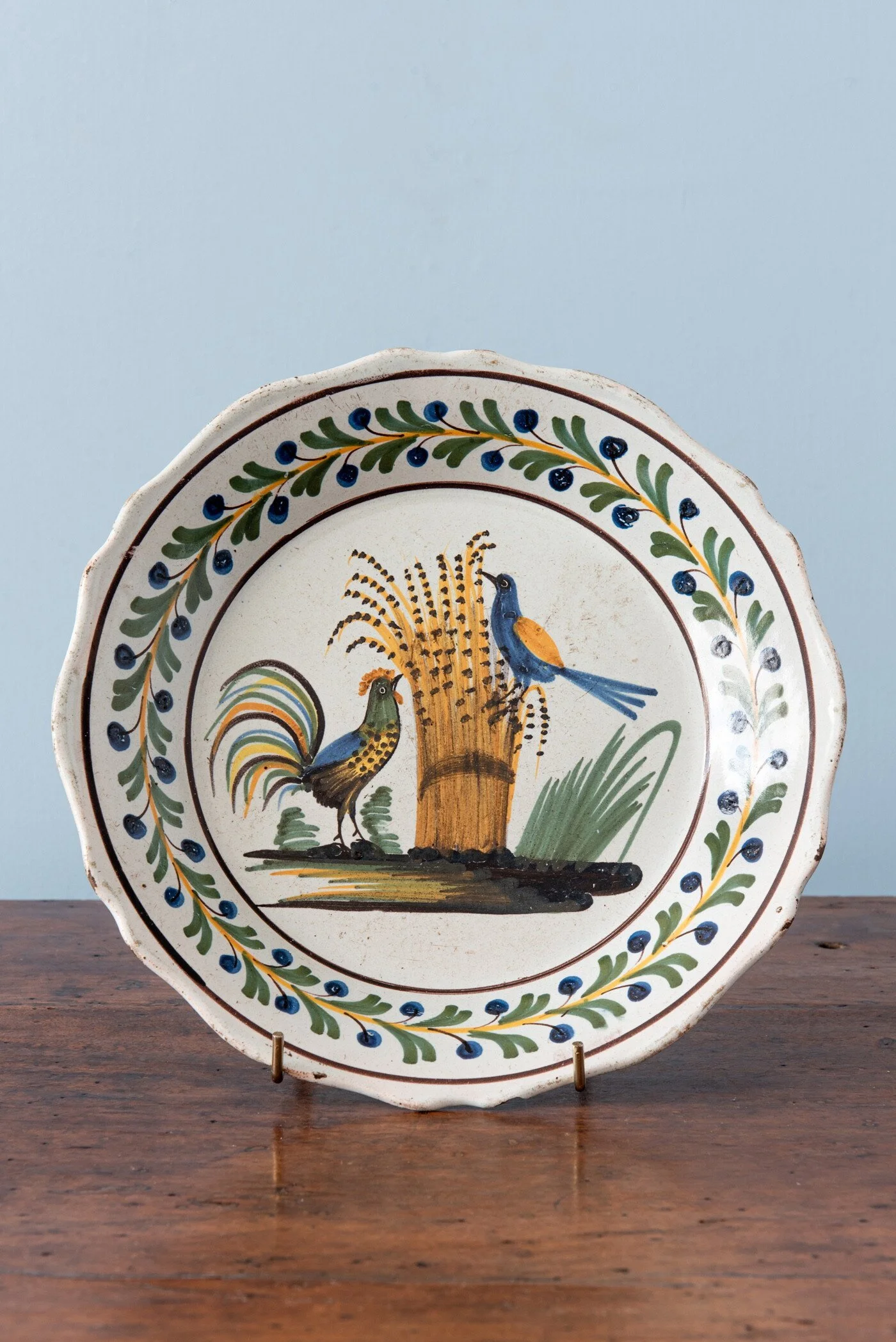
A late 18th-century French faience plate from Nevers, decorated with a cockerel and a bird on a wheat sheaf, surrounded by grasses, in a vibrant polychrome palette. The edge is delicately shaped, the lip decorated with a frieze of foliage and berries between two bands in manganese. Fine, colourful detail in the rendering of the birds' feathers, as well as the small black dots on the sheaf, adds a lively contrast.
A charming country plate, typical of Nevers.
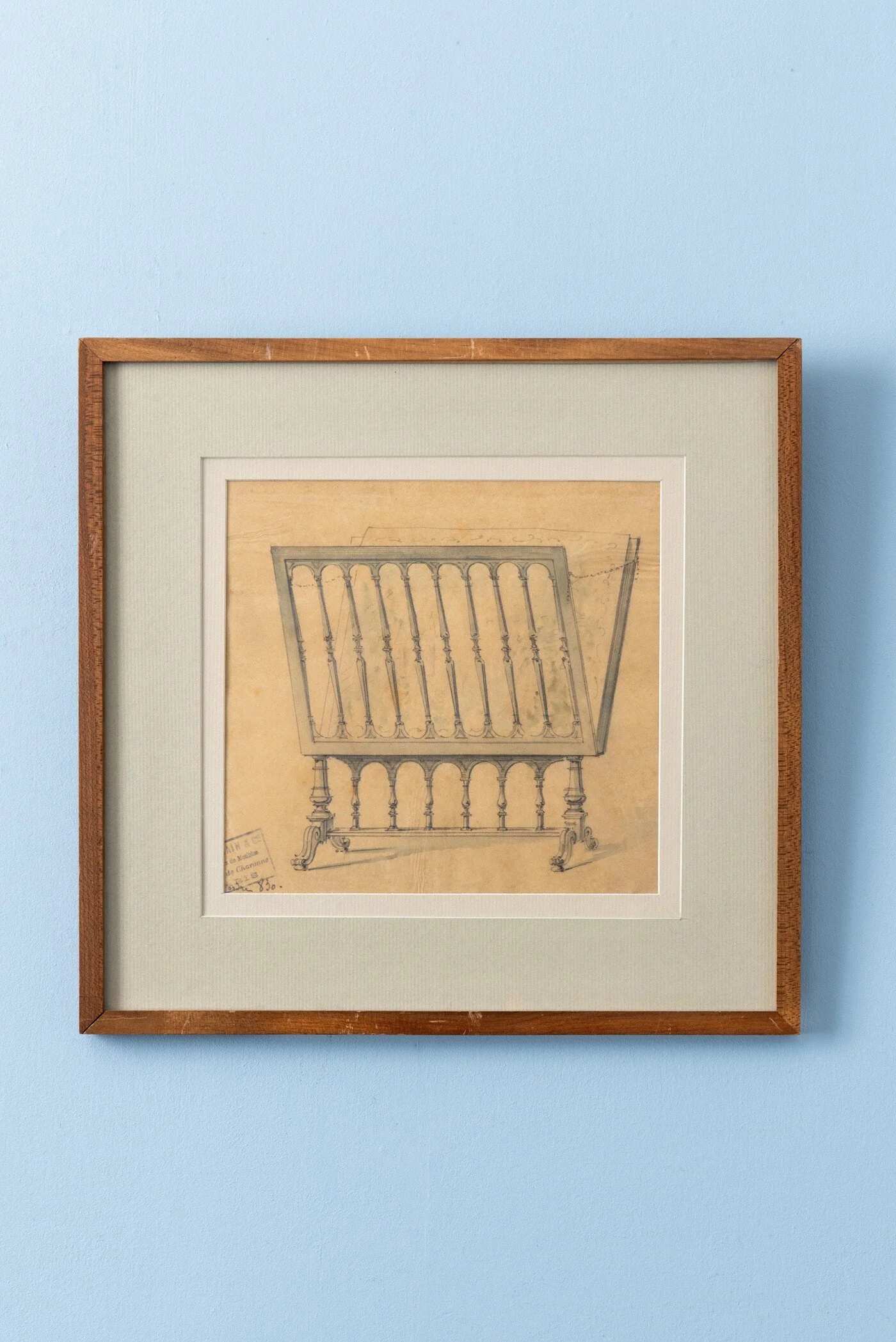
A 19th-century French watercolour and graphite drawing on yellow tracing paper, depicting a print rack containing several paper sheets, standing on a four-footed base, its two panels linked by a small chain. It is adorned with finely turned wood balusters, architectural arcading to the base and scrolling feet, the precision of the graphite line highlighting the intricate decoration of the rack, while watercolour lends a painterly wood texture and subtle shadow. A stamp to the lower left corner bears part of a firm name, the word "furniture" and an address on rue de Charonne in Paris, a neighbourhood famous for its furniture workshops, suggesting the drawing was an artistic impression for clients. Glazed in a stained wood frame under a double ivory mount.
Likely coming from a Parisian furniture workshop, a finely rendered drawing of an ornate print rack.
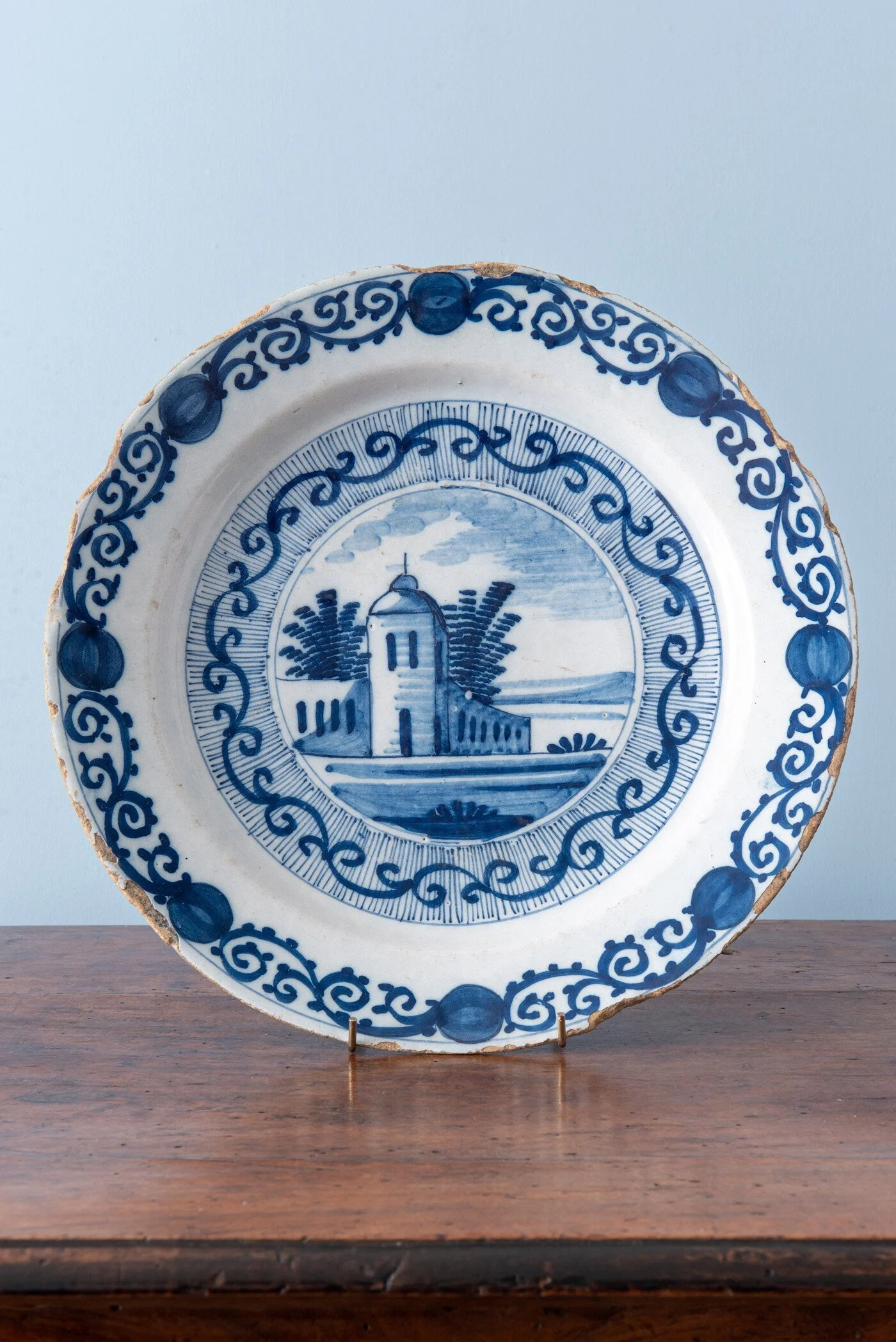
A pair of 18th-century Dutch Delft dishes, decorated in blue and white with a building in a landscape, surrounded by lush trees, enclosed within a round reserve and framed by a frieze of strapwork on a radiating striped ground. The lip is adorned with scrolls and foliage, alternating with circles. This abundant sense of pattern is set in contrast with the figurative nature of the scene, its characterful architectural details, lush trees and clouds composing a lively pastoral view.
A rare and captivating pair of Delft dishes.

An early 20th-century oil painting on canvas by French artist Fernand Combes (1856–1943), depicting a mill with a large wooden wheel, surrounded by trees and buildings, the scene viewed from below with a slope of grass and rocks in the foreground. A warm palette of ochres, browns and green contrasts with the blue of the sky, the striking perspective highlighting the hilly position of the cluster of buildings, with a stream running through the wheel towards the back of the slope. The warm palette, together with the repetitive brushwork of the rocks and stone wall, evokes the regional character of the architecture from the South of France, its dark tones lending the scene an evocative atmosphere. Signed to the lower part of the artwork.
The painting is mounted in a striking, impressively scaled Montparnasse frame of cassetta form, with egg-and-dart and rope patterns highlighted in red and gold. Signed to the lower part of the artwork.
An evocative country scene, paired with a striking sculptural frame.
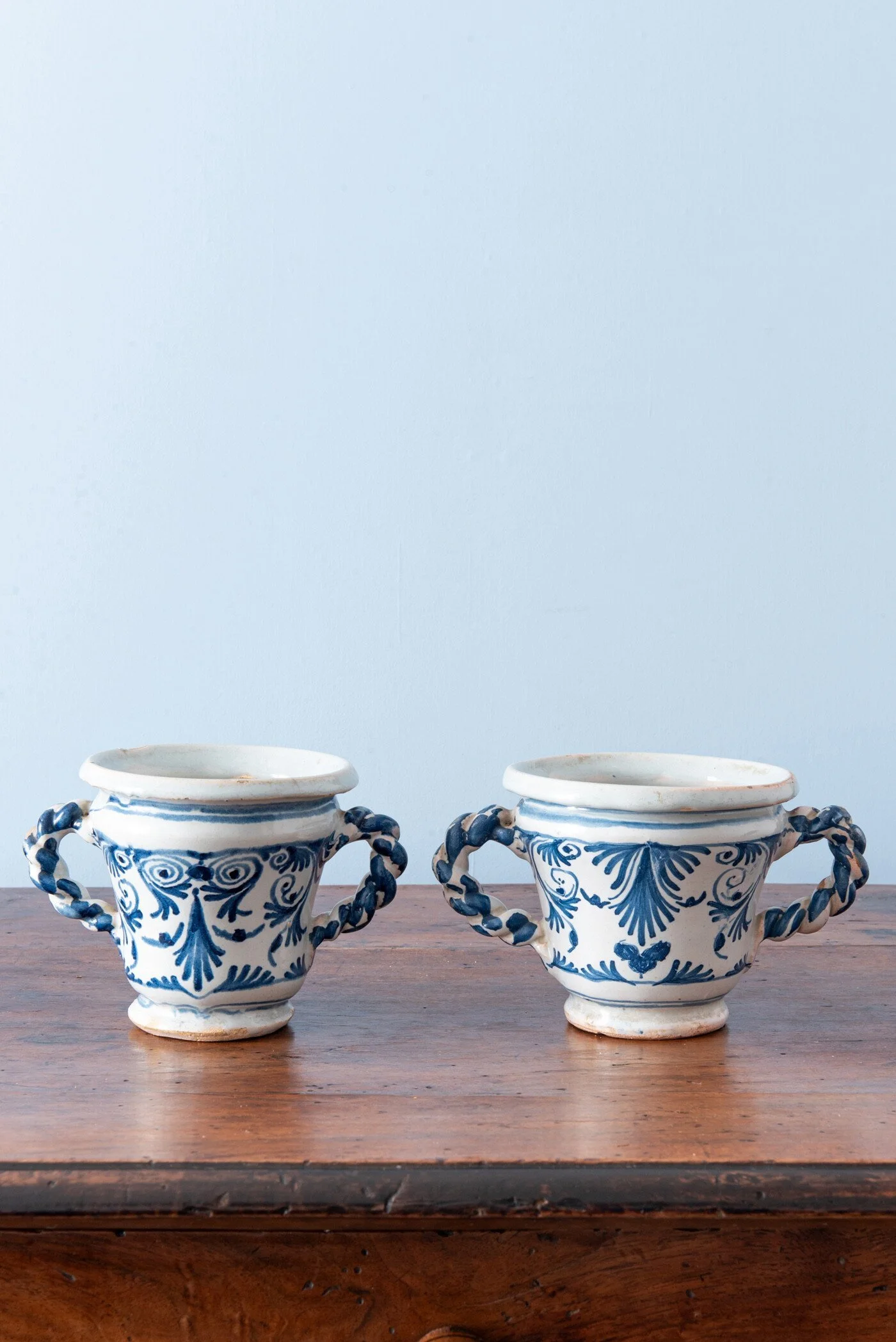
An almost identical pair of late 17th-century French faience jasmine vases from Nevers, of elegant baluster form flanked by striking rope-twist handles highlighted in blue brushwork. They are decorated in blue and white with painterly scrolls and foliage forming lambrequins, framed by horizontal lines at the top and bottom, the scrolling brushwork echoing the shape of the handles and lending a sense of movement to the vases.
The form is typical of jasmine vases and includes drainage holes, attesting to their use as planters: produced in Nevers from 1660, similar vases, often of larger scale, adorned the gardens of Versailles under Louis XIV to hold jasmine shrubs.
A rare pair of graceful vases, unrestored and in very good condition.

A 1940 Belgian watercolour on paper, depicting a coastal village. A road in the foreground, bordered by houses and buildings, leads to the shore on the left of the scene, while further houses and a church are scattered among rocks in the background, the whole surrounded by a deep blue sea. The houses are rendered in bold geometric shapes, their pitched roofs echoing the shape of the rocks, while the flatness of the sea adds a sense of abstraction. Its captivating palette of seaweed greens, reds and browns is combined with the deep blue of the sea to evocative effect, amplified by the impressive scale of the work. Glazed in a wood frame with a metallic front and black side, under a green fabric mount.
An evocative coastal village scene with immersive scale and distinctive colour.
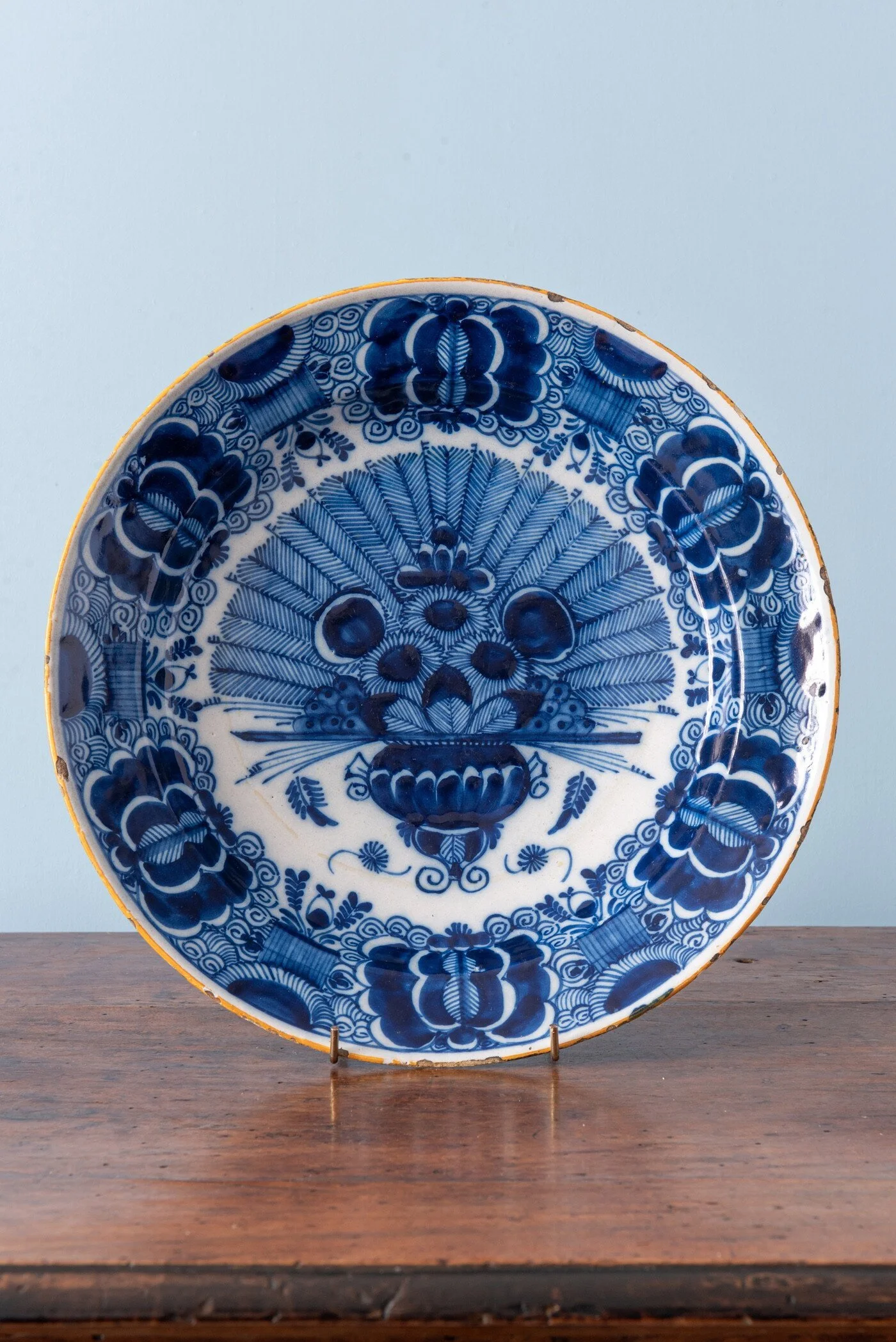
A rare 18th-century Dutch Delft dish, decorated with a luxurious peacock pattern in blue and white, featuring a cup overflowing with feathers, flowers, and foliage. The lip is adorned with an ornate frieze of scrolls and similar motifs, while a yellow line elegantly accents the edge. Marked to the underside for the De Klaauw factory.
A sought-after Delft dish with a rich, intricate design, unrestored and in very good condition.
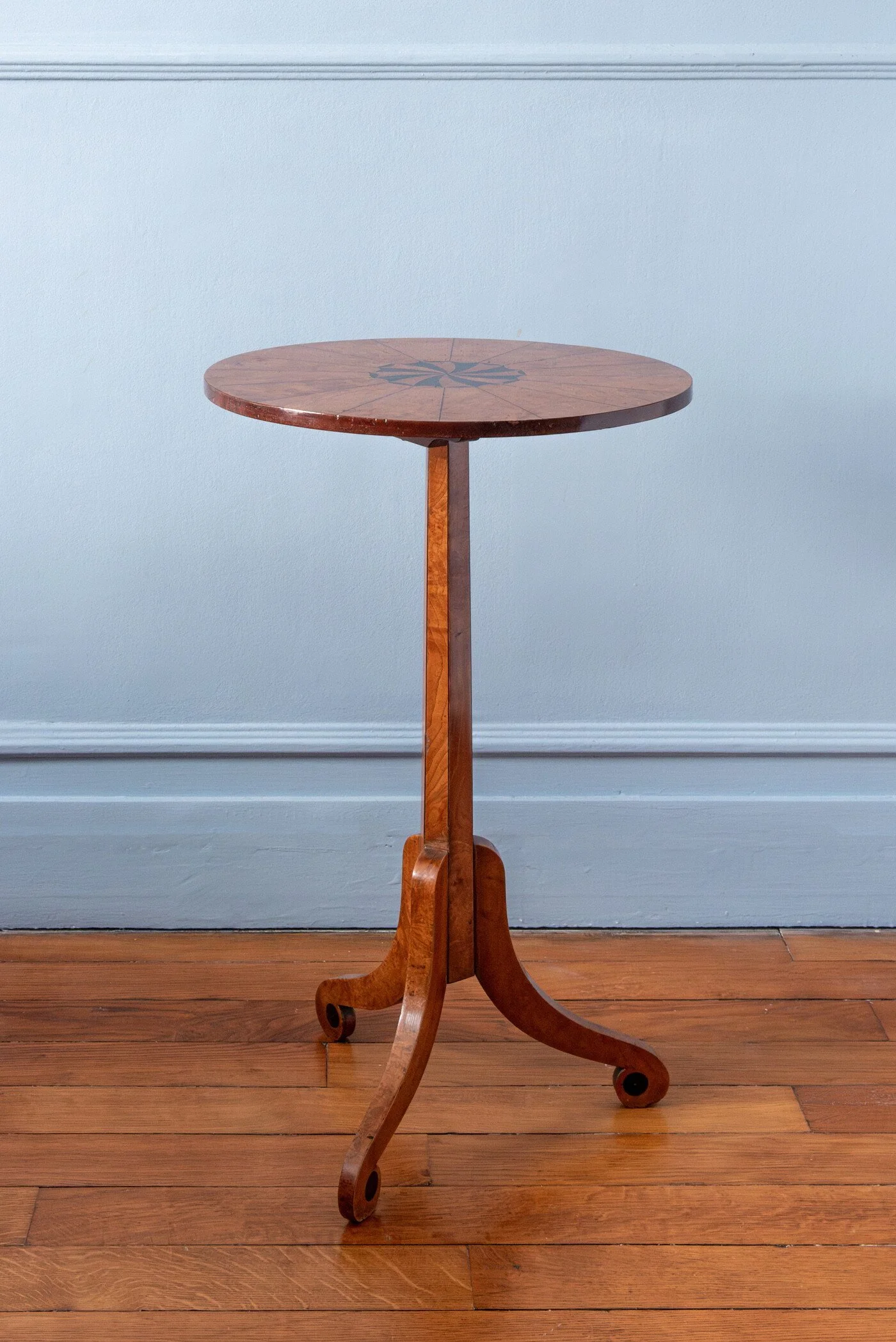
A 20th-century side table in the Biedermeier style. The circular top displays geometric marquetry with radial fruitwood veneer and an ebonised sunburst inlay at the centre, creating subtle movement through carefully selected figured wood. The edge is finished with a darker stained veneer border.
The chamfered column rises from a tripod base with three scroll feet, each centred by an ebonised circular inlay. The top tilts for practical use, combining functionality with decorative appeal.
The restrained proportions and balanced architectural lines exemplify the refinement typical of Biedermeier design, with its emphasis on fine veneers and geometric pattern. A quietly elegant, versatile side table.
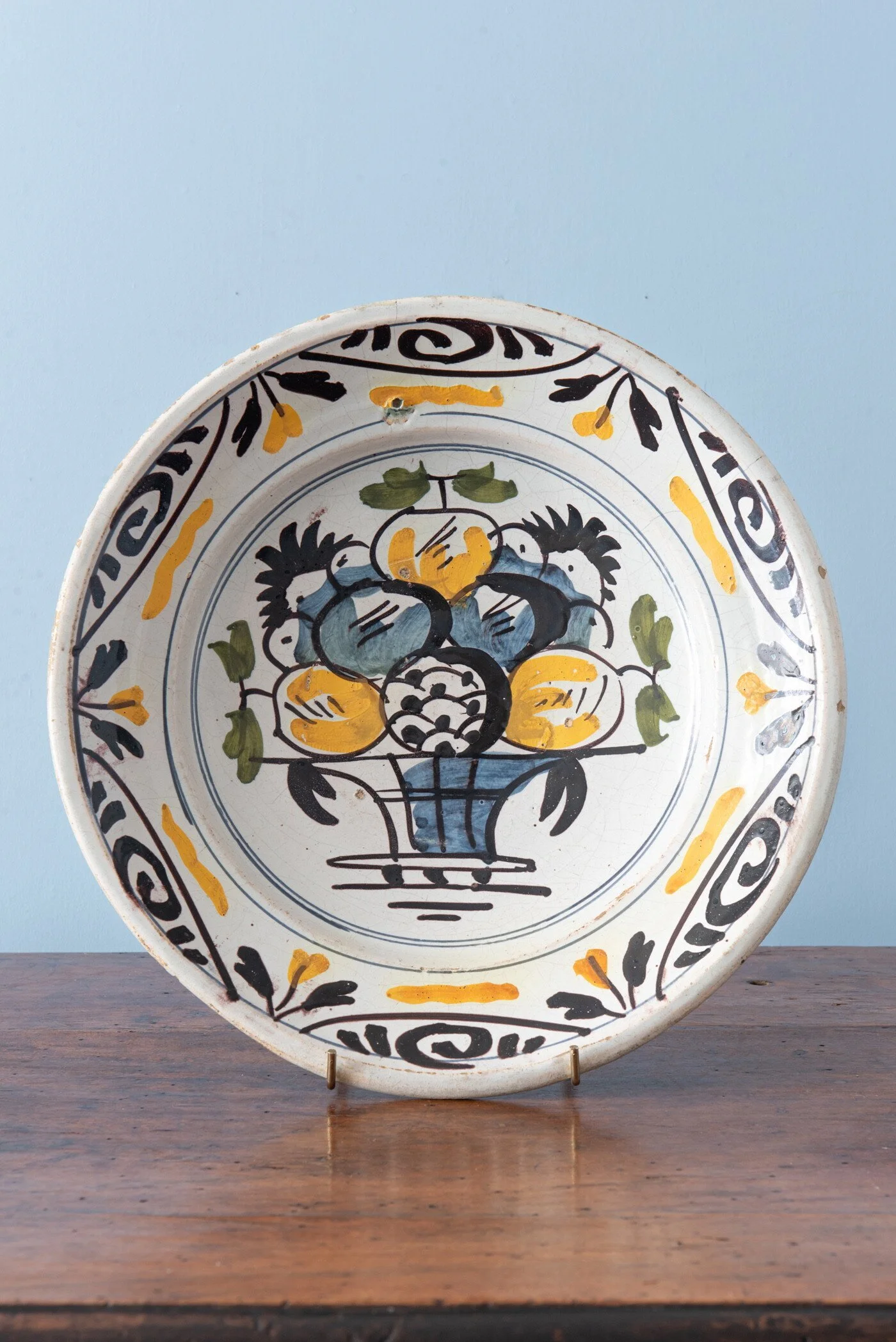
An 18th-century Dutch Delft dish, decorated with a basket of fruits and foliage to the centre, in blue, yellow, green and manganese. The lip is adorned with a frieze of scrolls and sprays of flowers. Bold, dynamic brushwork is paired with vibrant colour, adding to the sense of abundance of the fruits. The underside is finished in a darker, ivory glaze.
A rare and bright dish, unrestored and in very good condition.
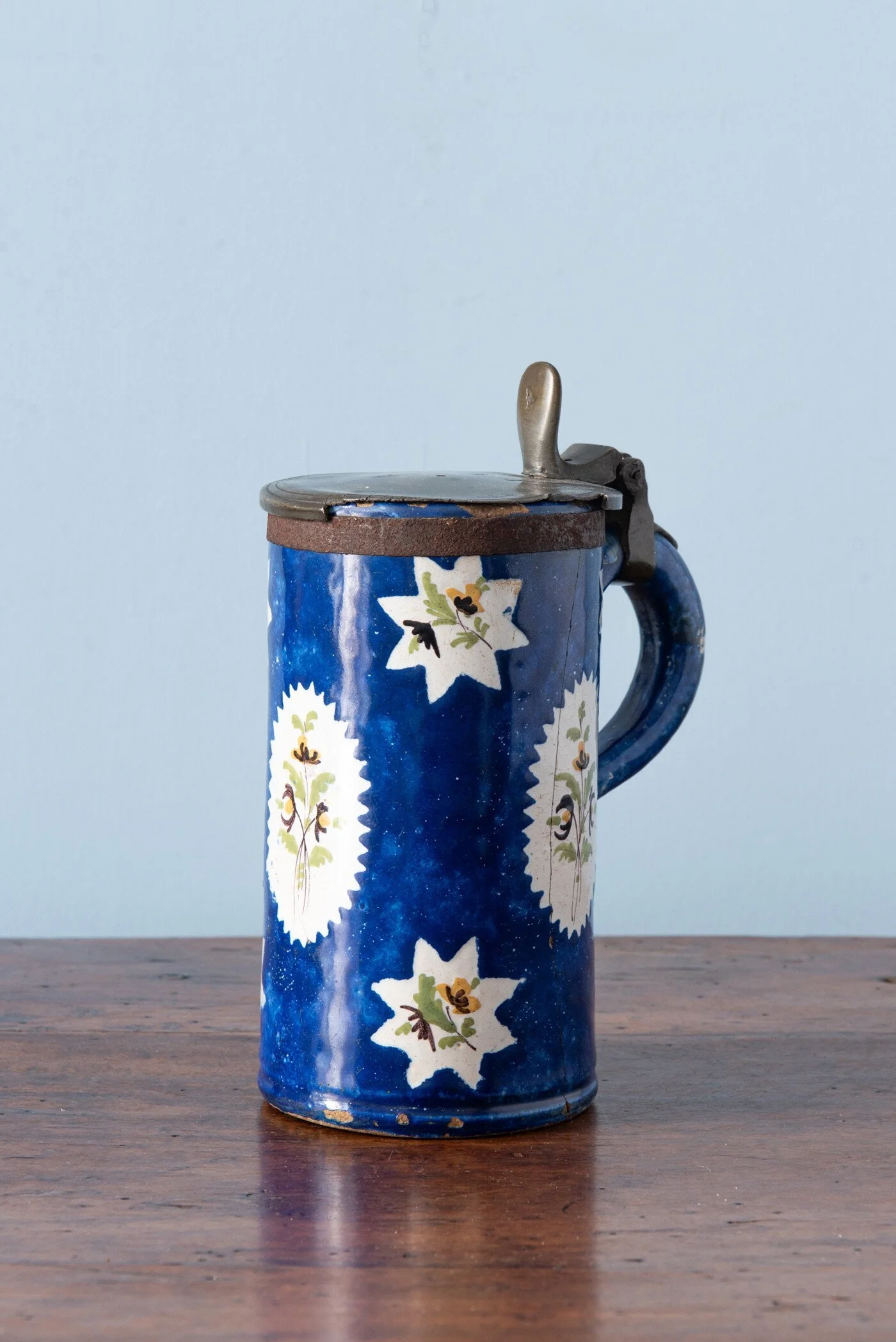
An early 19th-century Belgian faience spongeware beer stein from Brussels, decorated with a polychrome spray of flowers in star-shaped and saw-tooth reserves, scattered on a deep cobalt blue ground. Of tall, upright shape, finished by a handle in blue and a pewter lid marked with the letters L and I, adding historical interest and a pleasing functional character.
A rare beer stein with bright decorative patterns.
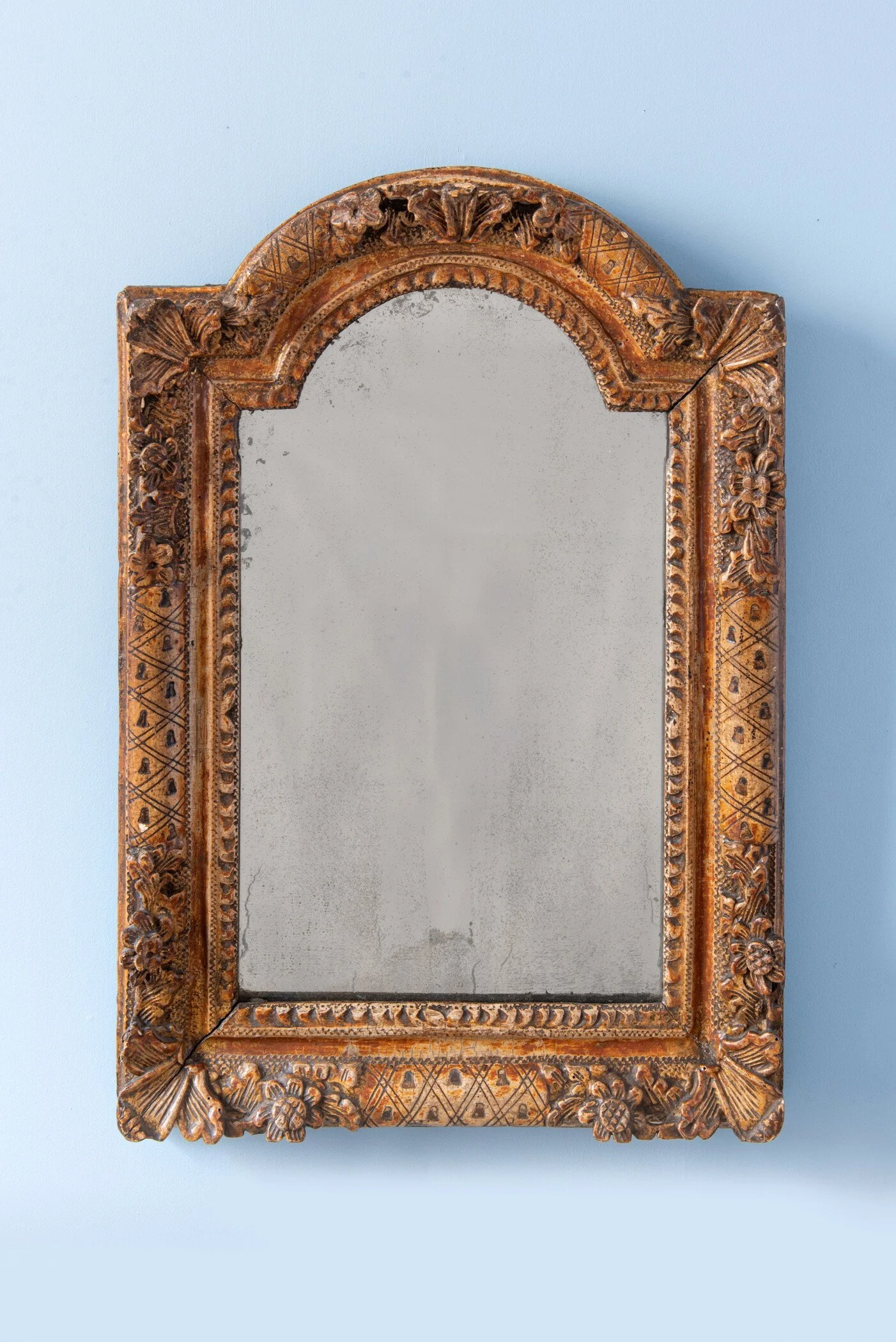
A French gilt gesso mirror of the Régence period, c. 1730, of rectangular form surmounted by an arched top. The frame is adorned with carved flowers and acanthus leaves at the corners and upper section, alternating with cross-hatched bands, and completed by a flat beaded inner slip. The original mercury plate and backing are retained, with gentle foxing. The original gilded finish displays a handsome patina, with the red bole showing through in places.
A rare mirror of medium scale, characteristic of the early Régence style in its combination of boldly carved ornament with the restrained geometry bridging the rigour of Louis XIV and the emerging curves of Louis XV.


An 18th-century Dutch Delft dish, decorated with a peacock perched on rocks, surrounded by bushes under a cloudy sky, in an elegant palette of blue on a light blue ground. The lip is adorned with a patterned frieze of scrolls and sprays of foliage. Bold brushwork is paired with characterful details in the rendering of the peacock, from the overly round shape of the rocks to the dots on its feathers, creating a dynamic sense of movement.
A bright Delft country dish in refined colour, unrestored and in excellent condition.