
Home / Dutch Delftware Pottery
Antique Delftware Pottery
Our collection of blue and white pottery combines everyday pieces and exceptional discoveries to celebrate the beauty and elegance of this timeless colour combination. With intricate hand-painted decors, antique Dutch delftware vases are perfect to arrange fresh flowers, while exquisite Delft plates look stunning on a kitchen shelf as a decorative accent.
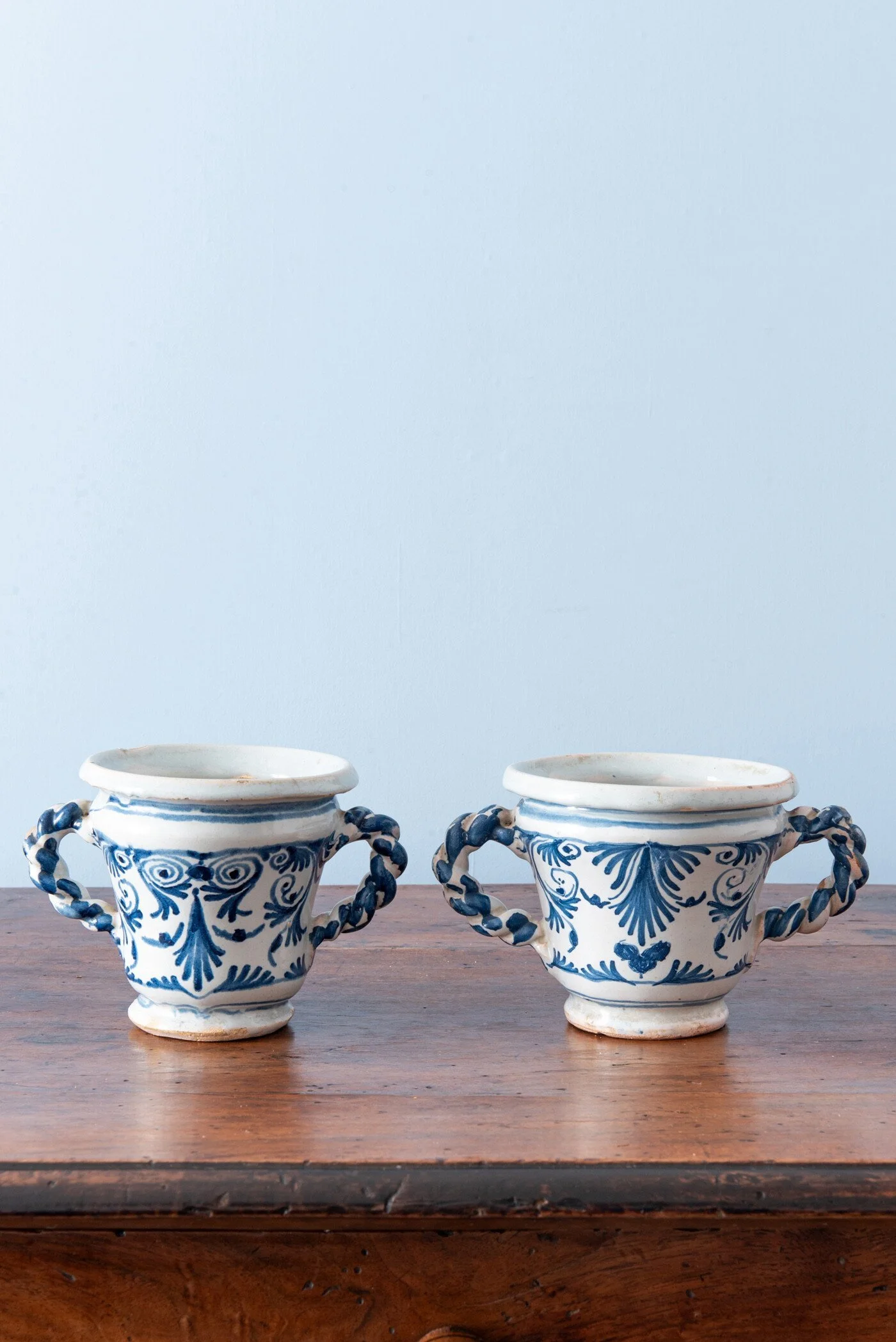
An almost identical pair of late 17th-century French faience jasmine vases from Nevers, of elegant baluster form flanked by striking rope-twist handles highlighted in blue brushwork. They are decorated in blue and white with painterly scrolls and foliage forming lambrequins, framed by horizontal lines at the top and bottom, the scrolling brushwork echoing the shape of the handles and lending a sense of movement to the vases.
The form is typical of jasmine vases and includes drainage holes, attesting to their use as planters: produced in Nevers from 1660, similar vases, often of larger scale, adorned the gardens of Versailles under Louis XIV to hold jasmine shrubs.
A rare pair of graceful vases, unrestored and in very good condition.
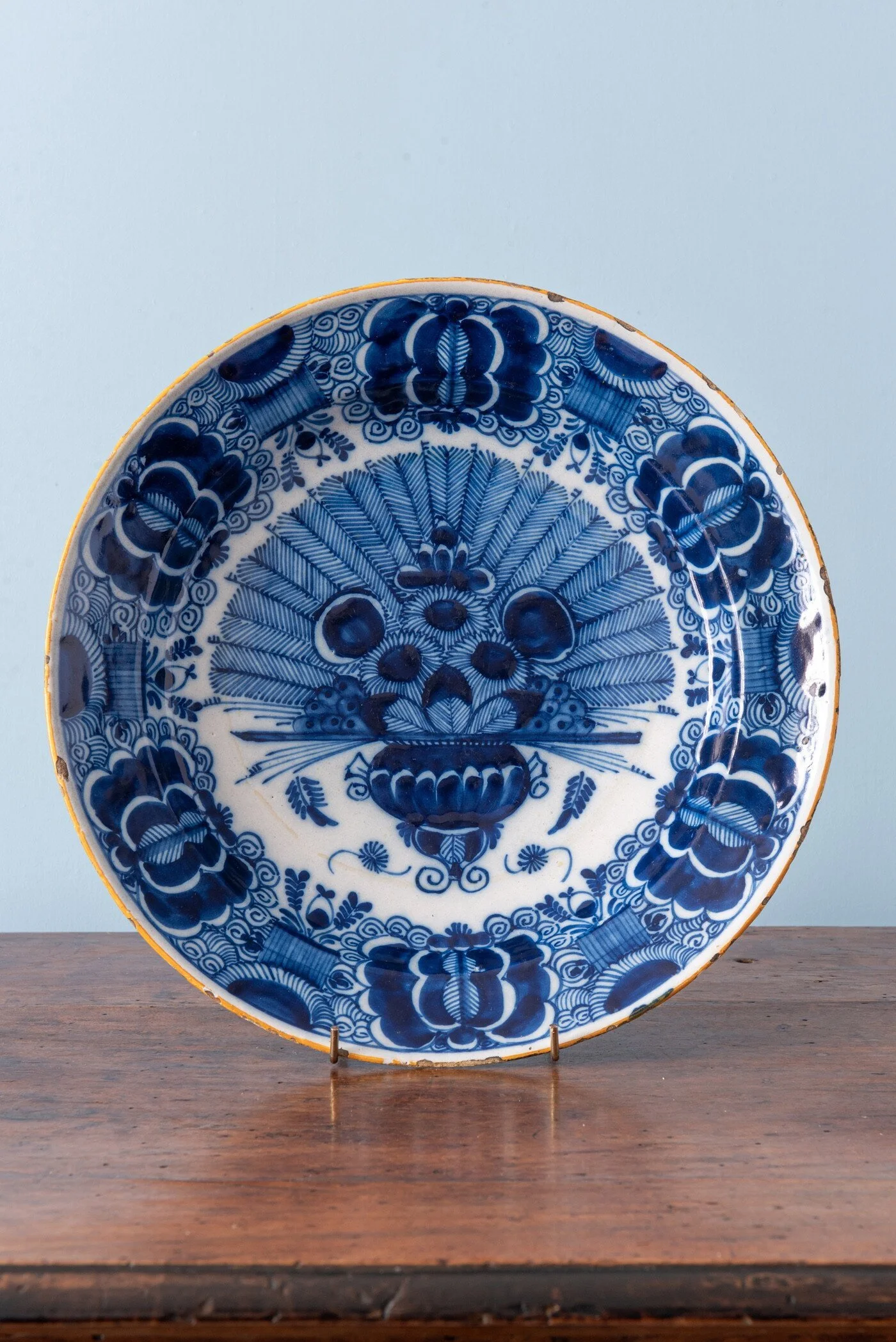
A rare 18th-century Dutch Delft dish, decorated with a luxurious peacock pattern in blue and white, featuring a cup overflowing with feathers, flowers, and foliage. The lip is adorned with an ornate frieze of scrolls and similar motifs, while a yellow line elegantly accents the edge. Marked to the underside for the De Klaauw factory.
A sought-after Delft dish with a rich, intricate design, unrestored and in very good condition.
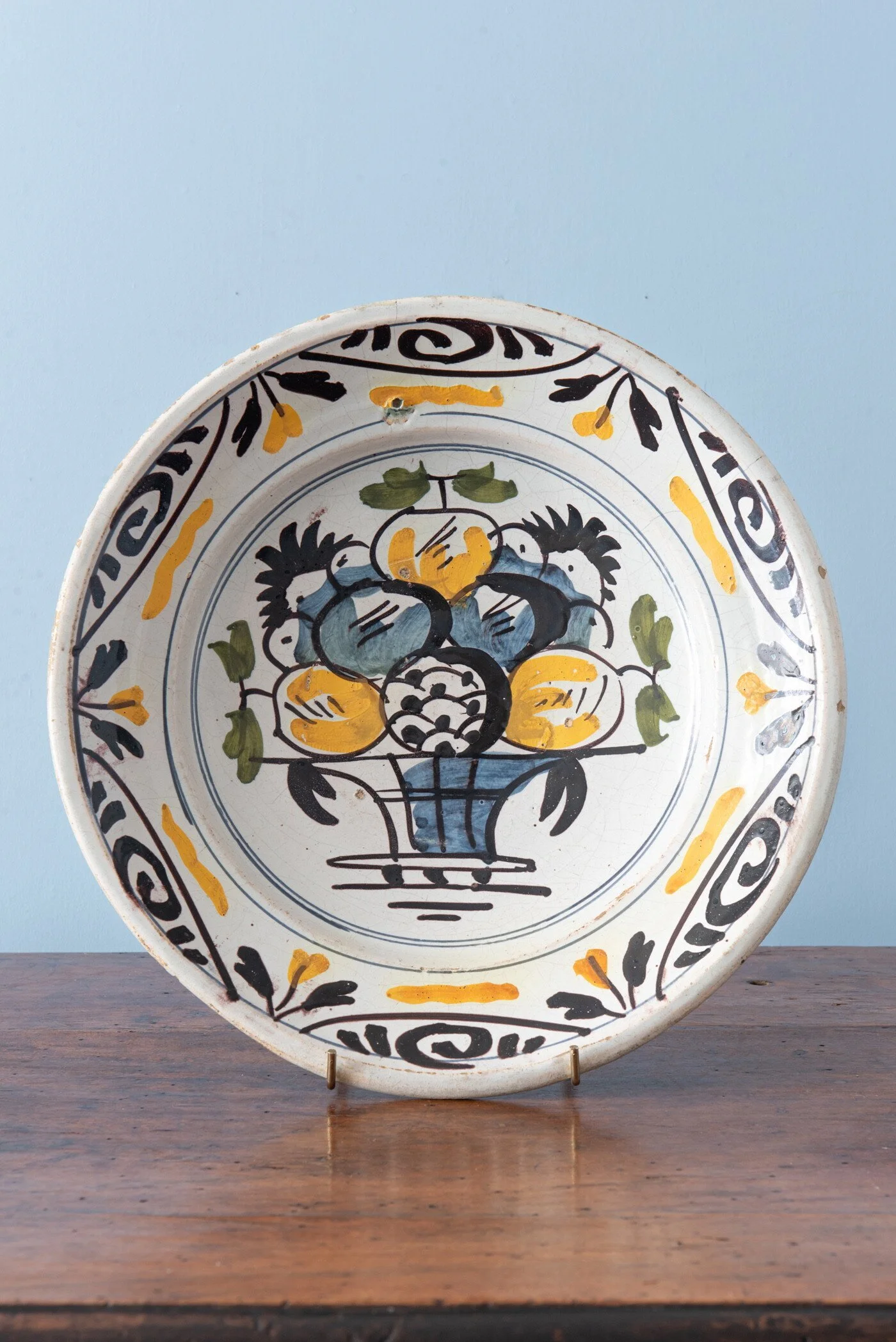
An 18th-century Dutch Delft dish, decorated with a basket of fruits and foliage to the centre, in blue, yellow, green and manganese. The lip is adorned with a frieze of scrolls and sprays of flowers. Bold, dynamic brushwork is paired with vibrant colour, adding to the sense of abundance of the fruits. The underside is finished in a darker, ivory glaze.
A rare and bright dish, unrestored and in very good condition.
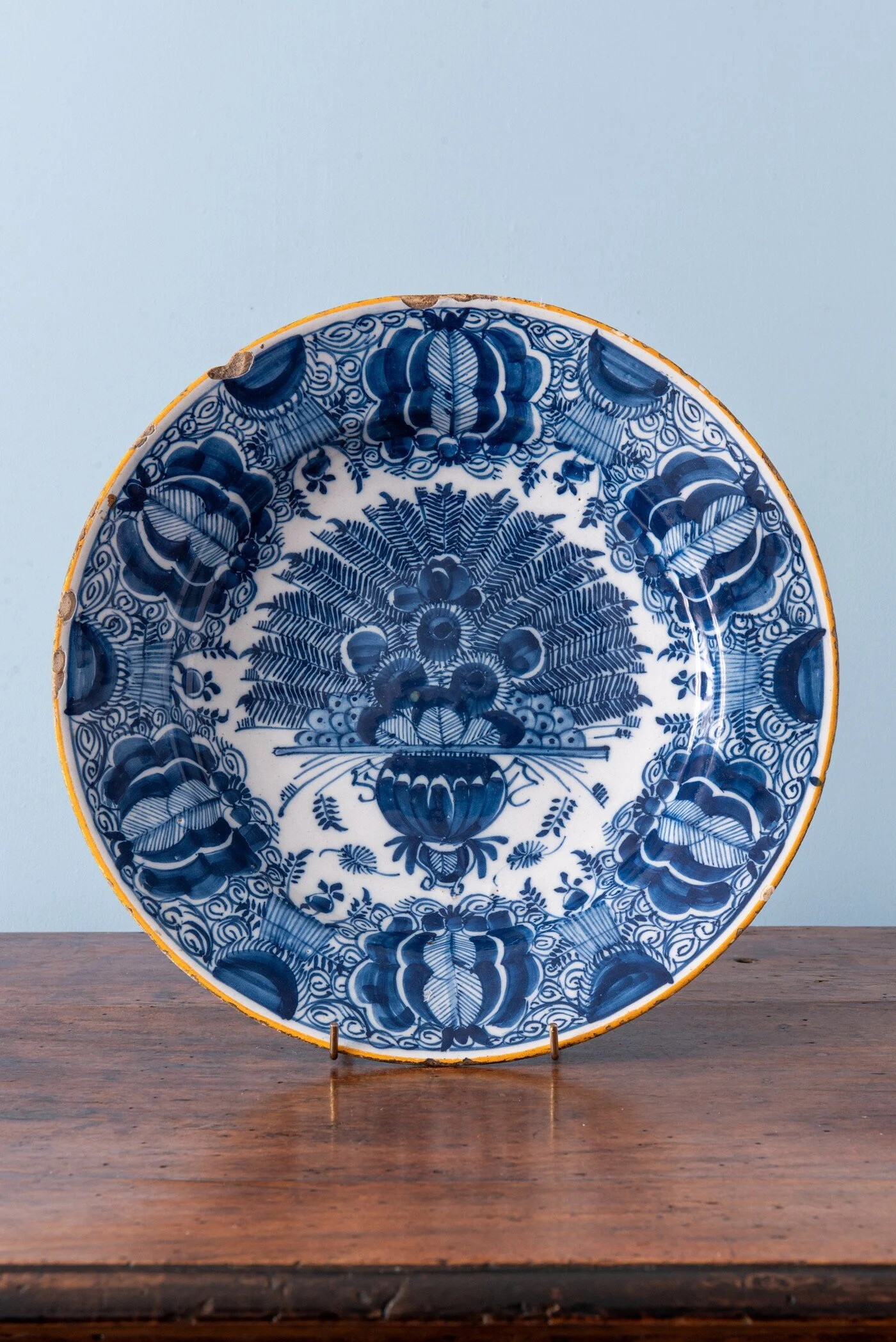
A rare 18th-century Dutch Delft dish, decorated with a luxurious peacock pattern in blue and white, featuring a cup overflowing with feathers, flowers, and foliage. The lip is adorned with an ornate frieze of scrolls and similar motifs, while a yellow line elegantly accents the edge. Marked to the underside for the De Klaauw factory.
A sought-after Delft dish with a rich, intricate design.
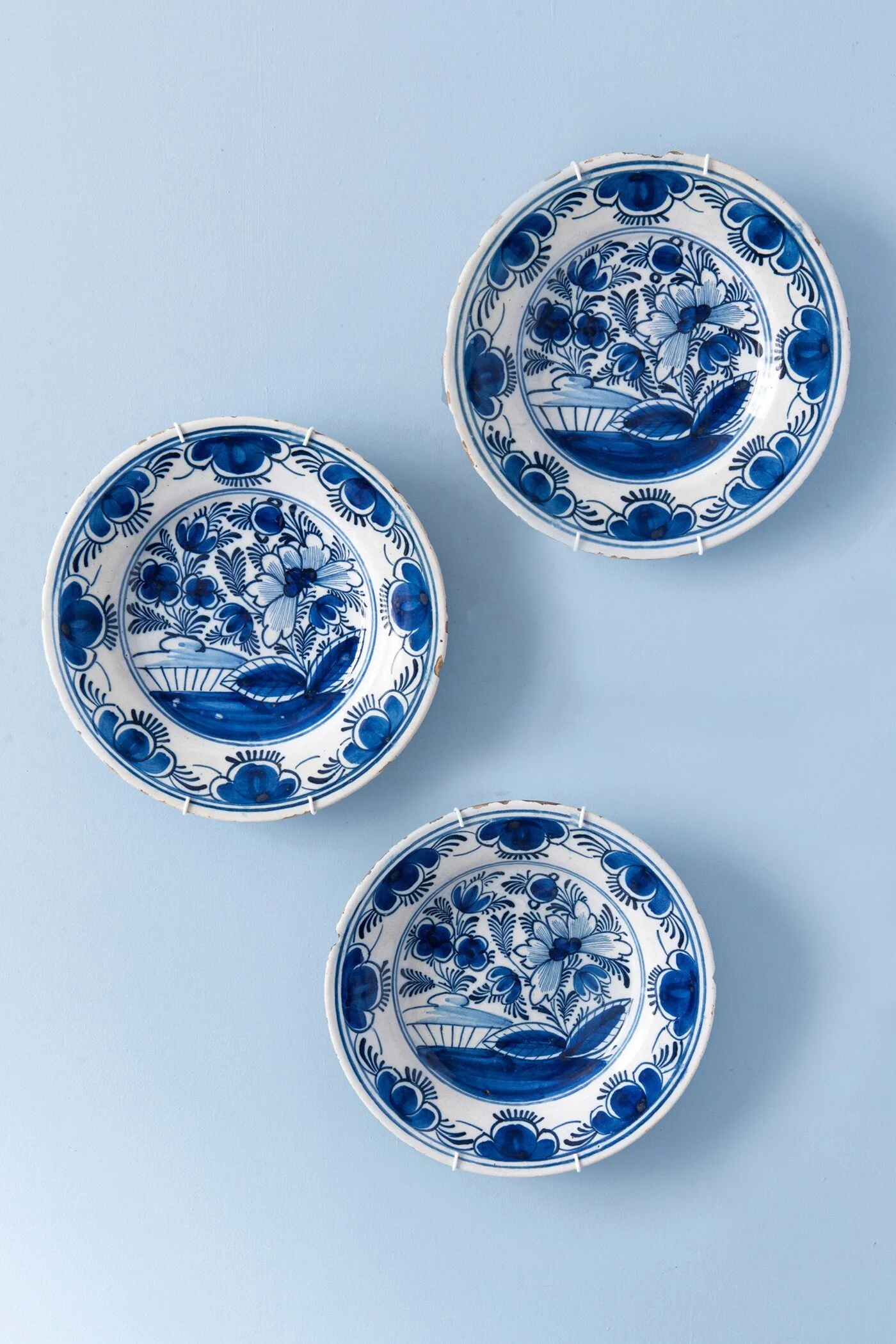
A set of three 18th-century Dutch Delft plates, decorated in blue and white with oversized flowers and foliage set beside a lake. A frieze of vivid floral motifs animates the lip, while large, painterly brushwork is set against the fine line drawing of the foliage, lending the decoration a lively sense of pattern and movement.
A rare set of three identical plates, with a charming country decor.
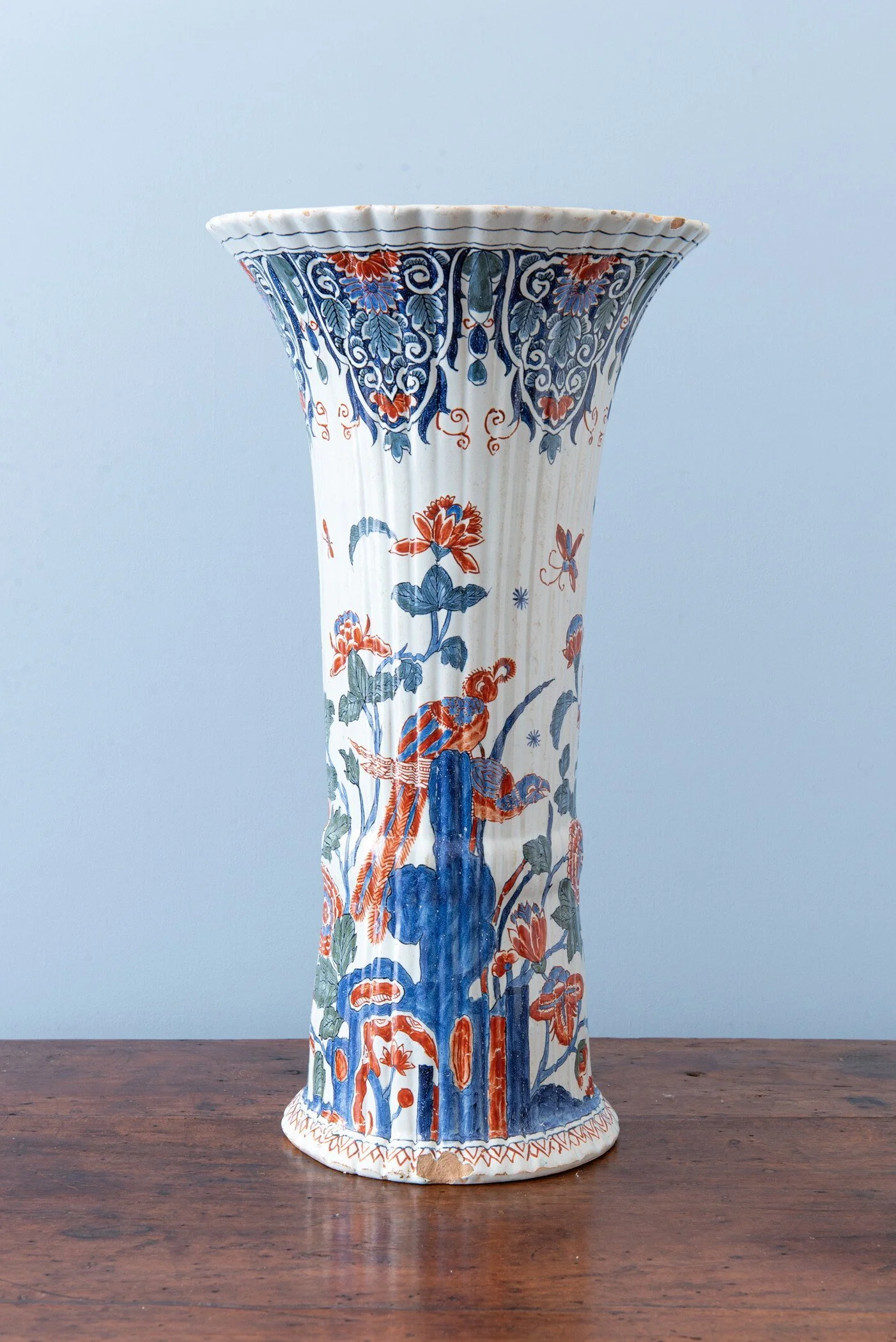
An 18th-century Dutch Delft vase of generous proportions and flared trumpet form with a fluted body. It is decorated in vivid cobalt blue, red and green on a white ground with birds perched on rocks, surrounded by oversized flowers, lush foliage and insects in the Chinoiserie taste. A frieze of scrolls and lambrequins adorns the upper edge. The graceful scrolling movement of the flowers and elongated stems accentuates the impressive verticality of the vase, while the bright polychromy, set against the white ground, renders the abundance of the decoration in a particularly compelling way. Marked to the underside.
A rare piece, with distinctive shape and refined decorative presence.
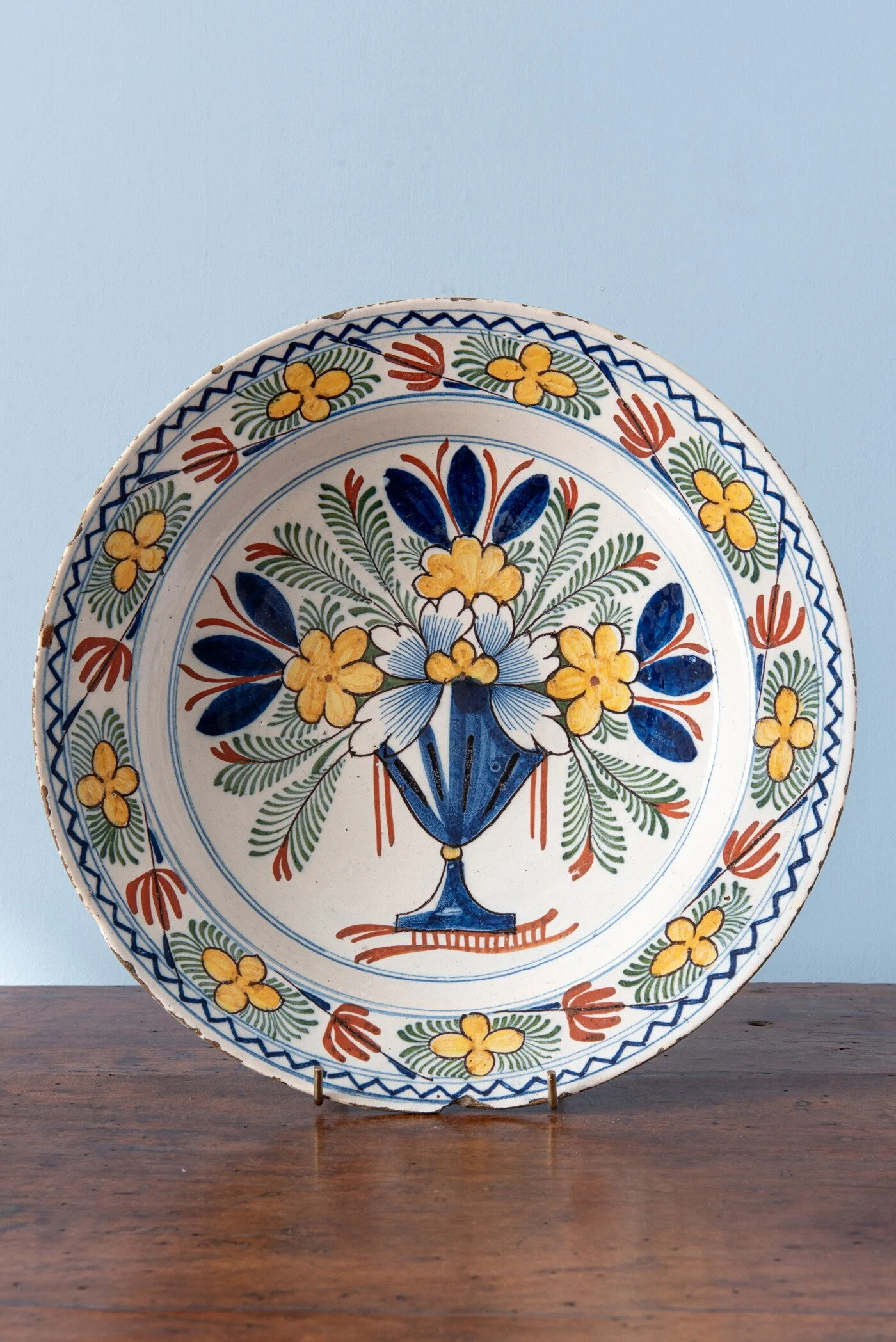
An 18th-century Dutch Delft dish decorated with an elegant baluster vase filled with flowers and foliage, in a vibrant palette of blue, yellow, green and red. The wide lip is adorned with a frieze of flowers, foliage and zigzag patterns.
Manganese outlines and fine fern-like foliage give structure to the painterly blue and yellow brushwork, lending the dish a vibrant sense of pattern and colour. An elegant, decorative piece, featuring a hole to the underside for easy wall hanging.
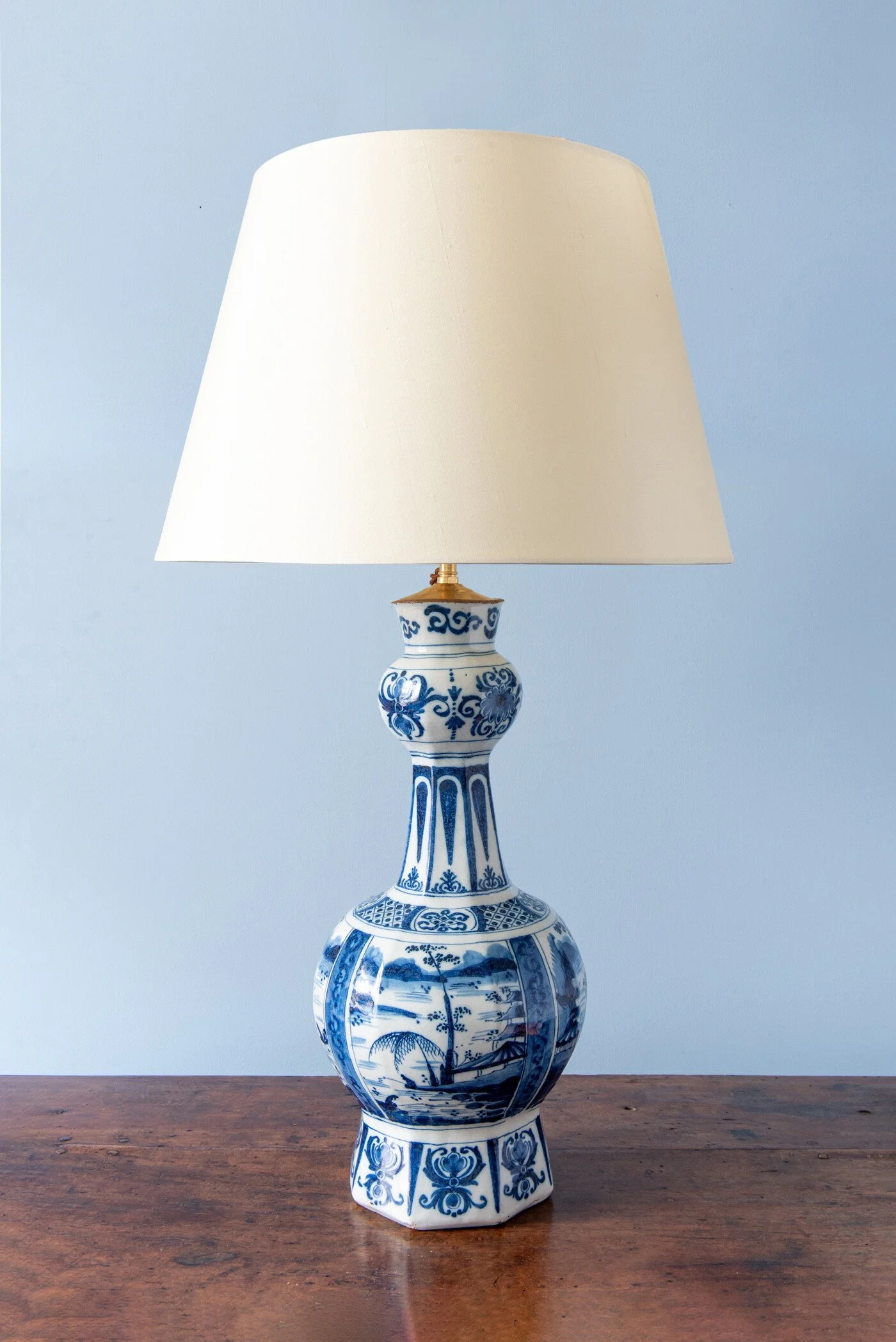
An 18th-century Dutch Delft vase, converted to a table lamp, of classic garlic neck form raised on an octagonal base. Decorated in blue and white with four atmospheric Chinoiserie landscapes, depicting figures seated beside a lake, surrounded by trees and buildings with mountains in the distance. The scenes are rendered with a compelling level of detail, the brushwork alternating between fine linework and painterly washes of blue to create movement and depth.
The base and neck are decorated with an array of scrolls, florals, lambrequins, dots and criss-cross patterns. An impressive piece in scale and execution, with the enduring decorative presence of Delft.
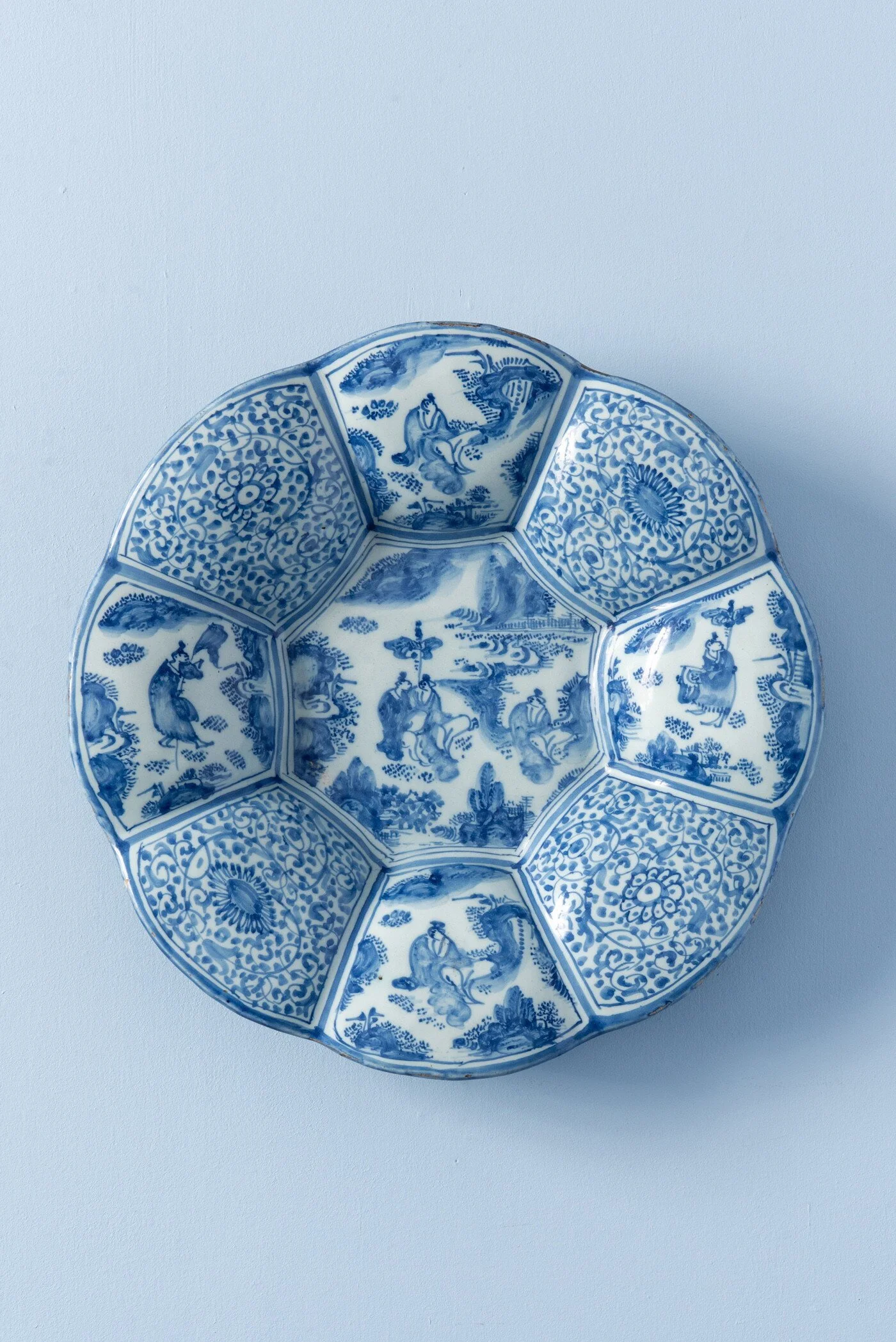
A late 17th-century Dutch Delft dish, c. 1680-1720, of octagonal lobed form, raised on a piedouche. Decorated in blue and white with a glossy glaze of bluish tonality, it features Chinoiserie Kraak-style scenes painted within shaped reserves, depicting figures in lakeside landscapes with bridges, trees and foliage.
These figurative scenes alternate with millefleur reserves, filled with scattered small flowers arranged around a larger central bloom, creating a richly animated surface. The reverse is decorated with fluid geometric motifs of circles and x-marks.
A well-preserved Delft dish, with a graceful shape and captivating decor, equally elegant displayed on a wall or presented on a tabletop.

A small, elegant late 17th-century French faience tray from Nevers, delicately painted in blue and white with manganese outlines. The oval surface presents a refined chinoiserie scene, with a seated figure beside a lakeside landscape with a bridge and trees, surrounded by a striking array of natural motifs. Thin manganese lines contrast beautifully with fluid blue brushstrokes, producing a painterly effect.
Raised on a foot, the underside is also decorated with blue brushwork. With its modest size and oval form, this tray was likely part of a ceramic dressing set. Unrestored and in excellent condition, this exquisite Nevers faience piece combines rare charm and elegant decoration.
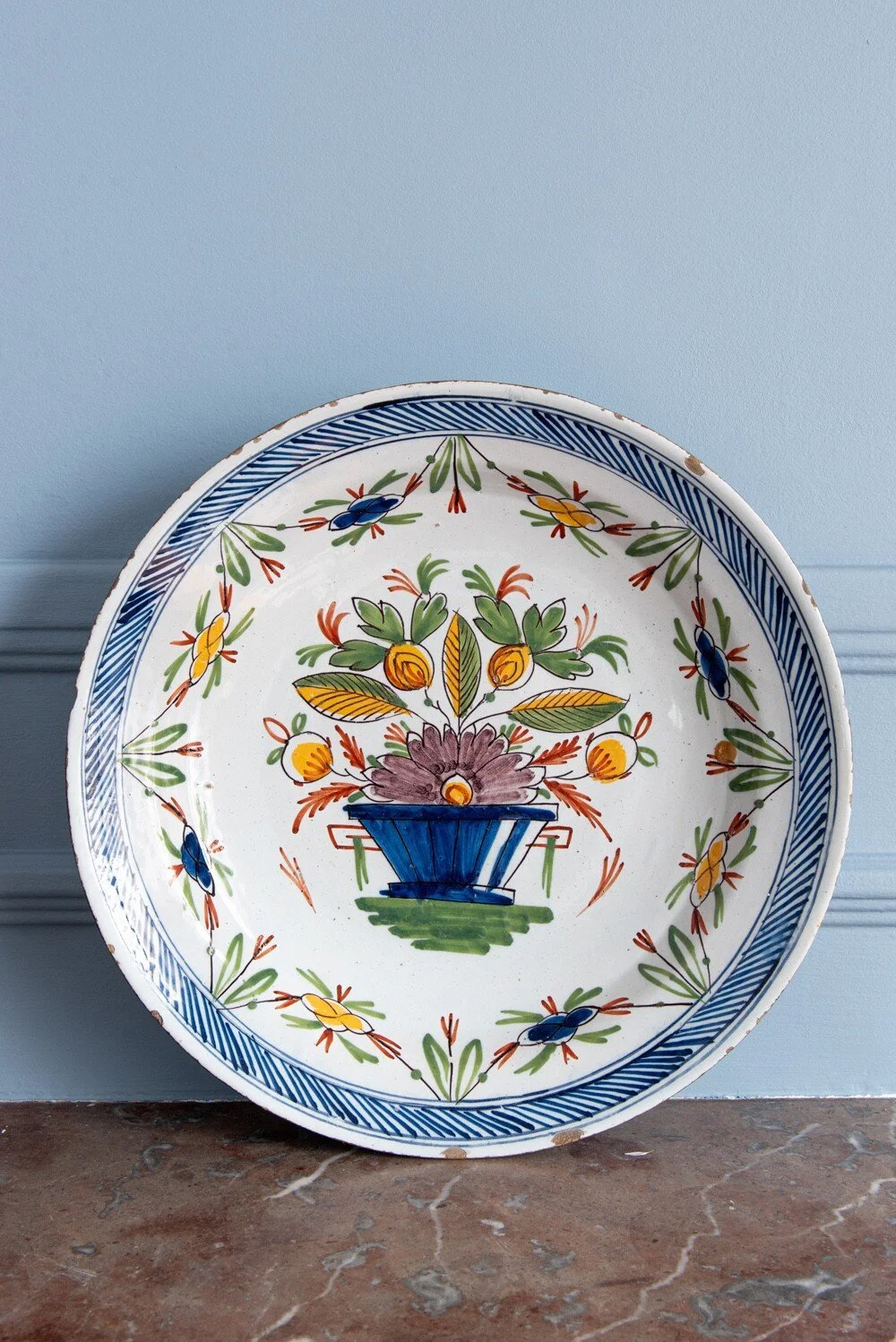
This 18th-century Dutch Delft dish features a large, shallow shape decorated with a vibrant polychrome basket overflowing with flowers. The lip features friezes of florals and stripes, creating a richly patterned effect. A joyous dish, with energetic brushwork combined with vivid colours.

An 18th-century French faience cider jug from Rouen, decorated in classic blue and white. The jug is inscribed with the date 1726 and features vibrant geometric patterns alongside an exquisite wreath of foliage and flowers, all rendered with elegant, fluid brushstrokes.
The jug displays the characteristic cider jug form, with a rounded body, slender neck, and sturdy handle. A rare and distinctive piece, with a vibrant decoration and timeless quality.
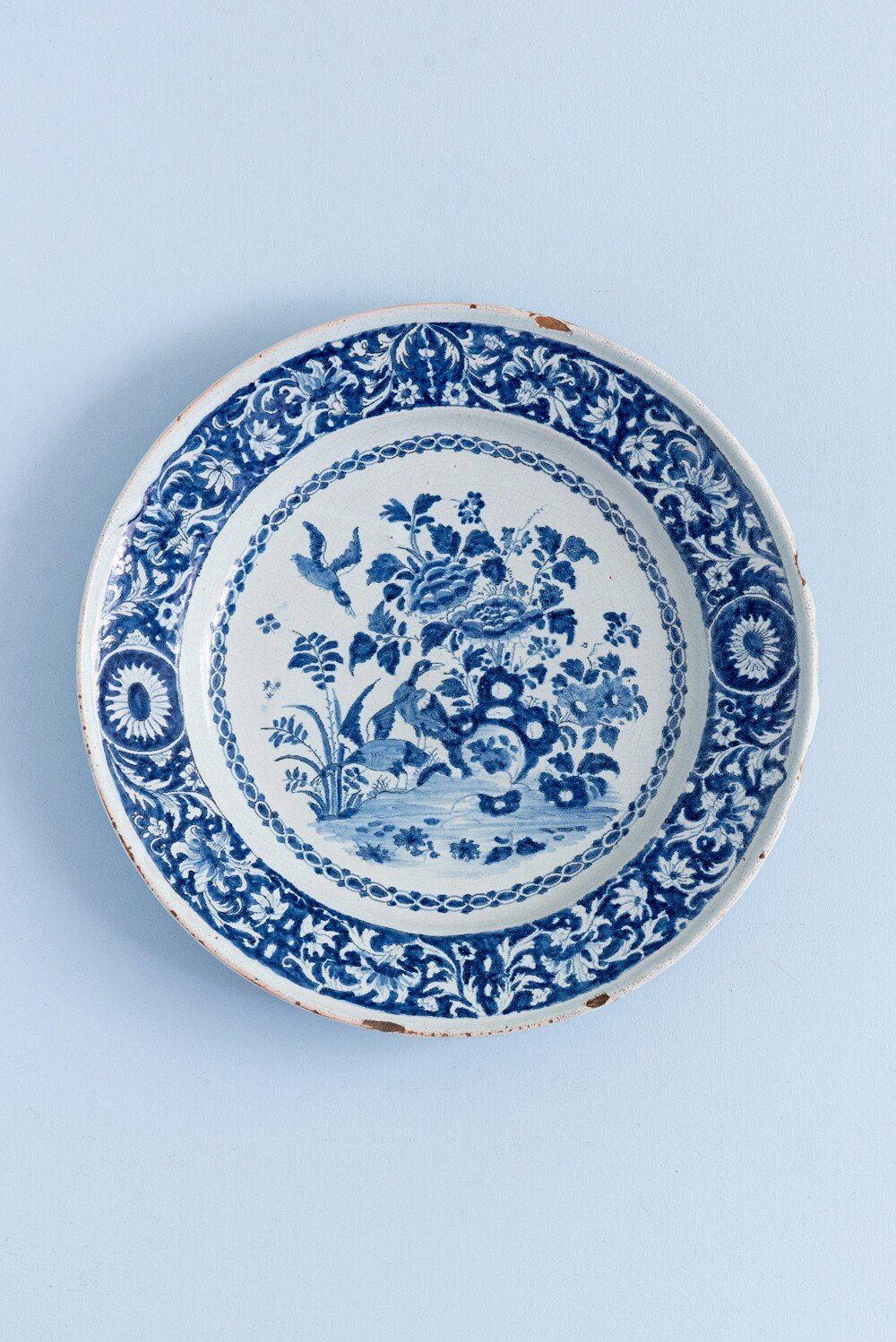
A large early 18th century French faience dish from Nevers, beautifully decorated in blue and white. The central motif features a Chinoiserie scene of birds among lush bushes, oversized flowers, and foliage. The lip is adorned with floral and foliage ornaments in the French style, adding refinement to the piece.
With its impressive size, this rare dish also features a hole on the underside for easy wall hanging, making it a striking piece for display. With elegant patterns and timeless blue-and-white decor, it is a lasting addition to any wall or shelf.

An 18th-century Spanish albarello from Catalonia, adorned with a scrolled label inscribed in elegant black script, set within rich blue and white floral and foliate decoration. The piece exemplifies the traditional albarello form, with a tall cylindrical body, gently waisted profile, and broad rim, originally devised for the storage of apothecary goods. The contrast between the formal script and the loose, flowing ornament lends the jar a distinctive charm, combining utilitarian history with decorative appeal. Well-proportioned and visually striking, it makes a refined display piece and pairs elegantly with the companion albarello currently available in our collection.

An 18th-century Spanish albarello from Catalonia, adorned with a scrolled label inscribed in elegant black script, set within rich blue and white floral and foliate decoration. The piece exemplifies the traditional albarello form, with a tall cylindrical body, gently waisted profile, and broad rim, originally devised for the storage of apothecary goods. The contrast between the formal script and the loose, flowing ornament lends the jar a distinctive charm, combining utilitarian history with decorative appeal. Well-proportioned and visually striking, it makes a refined display piece and pairs elegantly with the companion albarello currently available in our collection.

This 18th-century French faience jardiniere from Nevers is richly decorated in blue and white with lambrequins surrounded by foliage and geometric patterns. Its large octagonal body is framed by two impressive handles, highlighted with blue brushstrokes. The bottom of the basin features a striking Chinoiserie scene depicting a table and a bird, set amidst lush flowers and foliage. Combining a bold form with timeless decoration, this Nevers jardiniere makes a fine planter for a windowsill or a striking accent on a mantelpiece beneath a painting.

This 18th-century French faience dish from Strasbourg is decorated in blue and white with a lush spray of scrolls and foliage in the centre. The edge is elegantly shaped and the lip showcases a frieze of further scrolls and foliage. With a timeless colour palette and graceful patterns, this textured dish makes a beautiful decorative accent, whether displayed on a wall or tabletop.


A pair of 18th-century Dutch Delft dishes, decorated in blue and white with a building in a landscape, surrounded by lush trees, enclosed within a round reserve and framed by a frieze of scrolls and strapwork on a radiating striped ground. The lip is adorned with further scrolls and foliage, alternating with circles. This abundant sense of pattern is set in contrast with the figurative nature of the scene, its characterful architectural details, lush trees and clouds evoking a lively pastoral view.
A rare and captivating pair of Delft dishes.